Paver Cleaning in
Boynton Beach, FL
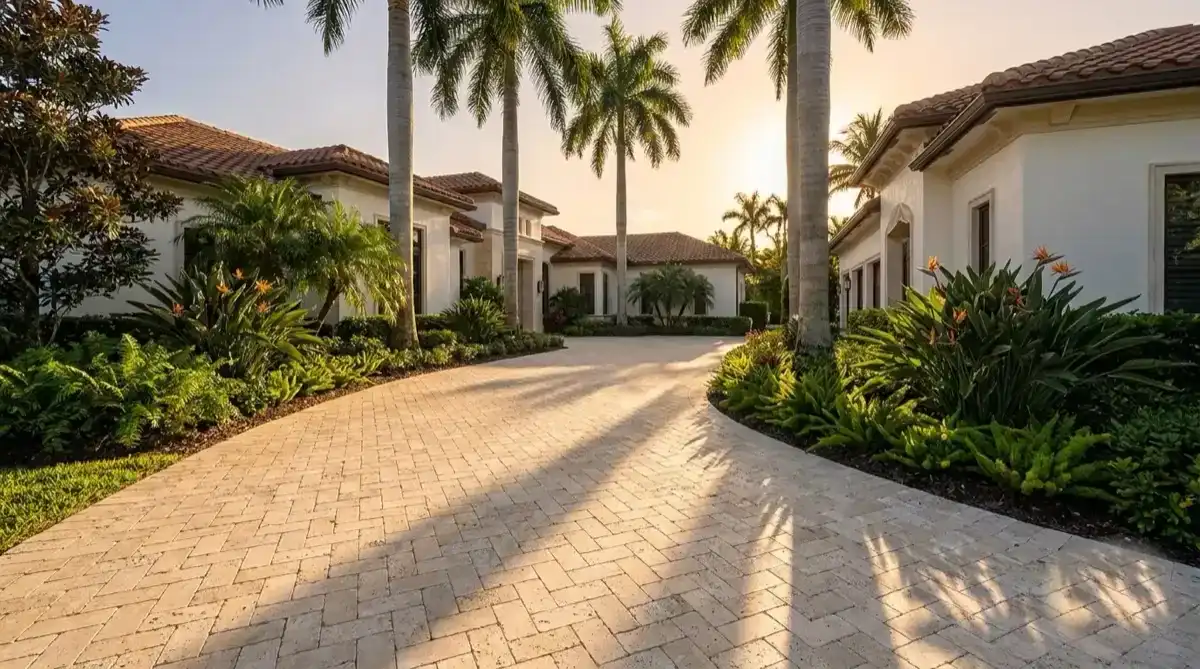
Eco-friendly paver cleaning in Boynton Beach — soft-wash technology and HOA compliance services for Palm Beach County homeowners. Serving Boynton Beach and Palm Beach County — licensed, insured, and HOA-compliant.
Why Boynton Beach Pavers Get Dirty Faster Than They Should
Cleaning in Boynton Beach is rarely about dirt. It's about biological growth in a humid climate, staining from the specific trees and irrigation water around your property, and the salt or mineral residue that settles on hardscape between rains.
All home ages and paver conditions — restoration to new installs.
Ready to Get Started?
Free, no-obligation on-site assessment in Boynton Beach. Transparent pricing delivered within 24 hours.
Cleaning in Boynton Beach: Local Conditions We Plan For
Boynton splits cleanly at the Turnpike corridor. East side, around Chapel Hill and Mission Hill near Bethesda, you've got mid-century homes — terrazzo floors inside, original concrete drives outside — where a paver upgrade transforms the whole face of the house. West Boynton is the opposite era: the Canyon communities, Valencia Reserve, and the 55+ belt built by GL Homes against the Agricultural Reserve, where driveways are newer but HOA standards and identical streetscapes mean your paver choice has to thread a needle.
The east side lives close to the water table and the Intracoastal — the Boynton Inlet is famous for how fast the bottom drops offshore, and the same coastal geology means eastern lots drain into sand that moves joint material every wet season. Out west, the ground is younger fill and the enemy is irrigation: most of those communities water from wells, and well water out here carries iron. That's the orange stripe you see along driveway edges — it's oxidized iron, bleach won't touch it, and pressure washing alone just etches it in. We treat it with oxalic-based rust removers and then seal so it doesn't rebuild.
Where we work in Boynton Beach
Pollen, Ag Reserve Dust, and Well-Water Iron in West Boynton
West of the Turnpike, in the Canyon communities and the Valencia belt, paver cleaning is a seasonal calendar rather than an emergency. Sitting against the Agricultural Reserve means those neighborhoods get real pollen and field-dust seasons, and the film that settles on a driveway or patio is not inert — the first heavy rain turns it into a grey grime that binds to the surface and starts feeding whatever biological growth is already in the joints. Rinsing the loose dust off with a hose during the worst weeks costs nothing and pushes the real clean months further out.
The other constant out here is iron. Community irrigation runs on wells, so orange staining along the spray arcs is close to default, and it needs an oxalic-based treatment as part of the cleaning visit rather than more scrubbing or a stronger cleaner. We handle those bands separately, then wash the full field with a biodegradable cleaning solution so the driveway comes out one color instead of a patchwork of treated stripes. Where a well filter or a sprinkler adjustment is the right long-term answer, we say so — cleaning the same rust arc every year is not a maintenance plan.
There is also a social reason cleaning matters more here than in older parts of the city. These are HOA-uniform streetscapes: same elevations, same driveway width, same paver color down the entire street. One surface carrying algae streaks or a rust arc is visible from three houses away, which is why appearance letters are common and why a lot of our west Boynton scheduling is driven by an inspection date rather than a homeowner's mood.
Chapel Hill and Mission Hill: Cleaning Older, Porous Surfaces Gently
On the east side, around Chapel Hill and Mission Hill, we are usually working on original mid-century surfaces — older, softer, more porous than anything poured in the last twenty years, and often never sealed in their lives. Staining on those surfaces has soaked in rather than settled on top, and moss and mildew have had decades to establish in the shaded sections. The temptation is to hit them hard. It is exactly wrong: high pressure erodes an aged surface, exposes the aggregate, and leaves a texture that traps dirt faster than before. Our approach on these homes is a longer chemical dwell at low pressure, hand agitation with a bristle brush, and the acceptance that a sixty-year-old surface will come back clean, not new.
That is also the honest line about when to call a professional instead of renting a machine for the weekend. If the job is a dusty patio and a light film, a garden hose, a push broom, and a mild outdoor cleaner will genuinely handle it. It is worth hiring out when there is rust or efflorescence involved, when the surface is old and porous enough to damage, when biological growth has gone past a surface film into the joints, or when the clean is the first step toward sealing and has to be done to a standard the sealer can bond to. We are CILB-licensed (#U-22487) and based here in Boca Raton, working Palm Beach and Broward, and we would rather tell you a job is a DIY afternoon than sell you a visit you do not need.
As for cadence: most Boynton surfaces want a proper clean once a year, and the pollen-heavy west-side driveways sometimes twice, with sealing on a two-to-three-year cycle from $1.10/sq ft. Cleaning and sealing belong in the same visit when both are due, because the surface has to be clean and completely dry before sealer goes down — seal over a stain and you have preserved it for three years.
What's Actually Growing — or Staining — on Your Boynton Beach Pavers
Half the cleaning calls we take in Boynton Beach are for something the homeowner has already tried to scrub off. The reason it came back is almost always a mismatch between the stain and the method. Here's how we identify what's on a Boynton Beach surface before touching it.
| What you're seeing | What it actually is | What removes it |
|---|---|---|
| Green or black film on the shaded side | Algae and mildew rooted in the paver's pores | A biodegradable pre-treatment with dwell time, then agitation. Pressure alone removes the visible top of the colony and leaves the roots to regrow by the next wet season. |
| Rust-coloured shadows under trees | Tannin — in Boynton Beach, iron staining from well-fed irrigation in the western communities, plus heavy pollen seasons off the Agricultural Reserve | Tannin-specific cleaner, not bleach. Bleach lightens the surface around the stain and makes the shadow more obvious, not less. |
| Orange stripes along one edge | Oxidized iron from irrigation water | An oxalic-acid-based rust treatment, applied and neutralized carefully — then redirect the sprinkler head. No amount of pressure or bleach lifts bonded iron. |
| White powder or cloudiness | Efflorescence, or a failed sealer blushing | Efflorescence rinses with an efflorescence cleaner and fades on its own. A milky failed sealer is a different job entirely — it has to be chemically stripped before anything new goes down. |
| Dark drips near the parking area | Oil or transmission fluid in the pores | Paver-safe degreaser with dwell time. Fresh spills lift in minutes on a sealed surface; a year-old stain needs restoration-grade extraction and sometimes never fully clears. |
We soft wash rather than pressure blast, and we re-sand joints afterward as part of the job. That isn't a philosophical position — it's because every wash takes some joint sand with it, and open joints in Boynton Beach mean weeds, washouts, and eventually pavers that rock underfoot.
Paver Cleaning Process in Boynton Beach
Surface assessment and biological growth mapping in Boynton Beach
Targeted biological pre-treatment application
Low-pressure deep clean and stain extraction
Strategic rinsing and post-treatment sanitization
Service receipt provided for HOA documentation
Paver Cleaning in Boynton Beach — Questions Answered
How does paver cleaning help with Boynton Beach HOA compliance?
Are your cleaning solutions safe for Florida pets and landscaping?
Can you remove rust stains from well-water irrigation systems?
My West Boynton address says Boynton Beach — why does my driveway need a county permit?
What causes the orange stains along driveway edges in Boynton's western communities?
How often should pavers be cleaned and sealed in Boynton Beach?
Is it worth hiring a professional, or can I rent a pressure washer and clean my pavers myself?
Other Services in Boynton Beach, FL
Paver Cleaning in Boynton Beach — Get Your Free Estimate
Expert paver cleaning by licensed Florida contractors. Free on-site assessment, transparent pricing, and same-week scheduling.