Brick Paver Installation in
Wellington, FL
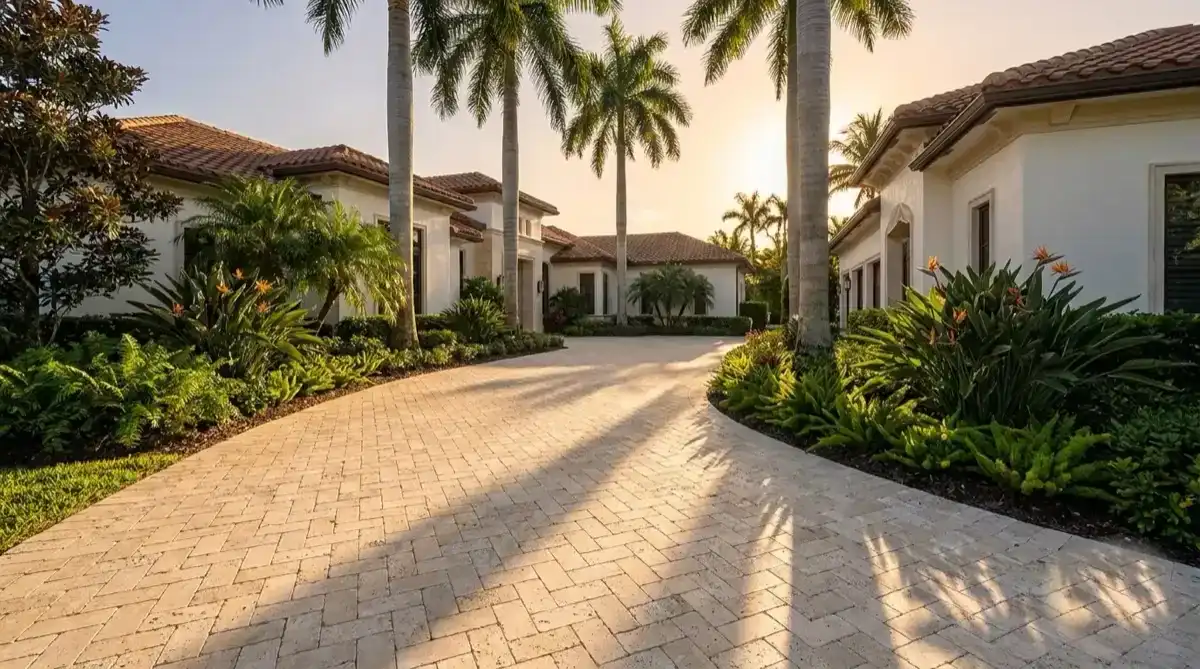
The driveway contractors Wellington’s equestrian estates call for brick pavers — Grand Prix Village luxury driveways, Versailles HOA approvals — and the muck soil engineering that every Wellington project requires but most contractors skip.
The Winter Equestrian Capital of the World — and Its Pavers Need to Prove It
Wellington hosts the Winter Equestrian Festival — the largest and longest-running equestrian competition in the world — for thirteen weeks every January through March. When the world's top riders arrive with horse trailers, support vehicles, and high expectations, the driveways, stable approaches, and entry courts of Wellington's equestrian estates are the first thing they see. Standard residential paver specifications do not apply here: trailer turnarounds require a minimum 60-foot radius, stable approach paths need hoof-safe textured surfaces with engineered drainage, and the organic muck soil that underlies most of western Palm Beach County demands excavation and geogrid reinforcement that the average contractor skips. We don't skip it.
Wellington's HOA communities — Versailles, Grand Prix Village, Palm Beach Polo & Country Club across its 45+ neighborhoods, Binks Forest, Grand Isles, and Black Diamond — each run their own Architectural Review Committee process before a single permit is filed. Wellington is an incorporated Village with its own Building Department and Projectdox permit system — not Palm Beach County unincorporated — and the approval sequence matters: ARC first, then Projectdox permit, then installation. We manage the full sequence for every project. You don't navigate a single portal.
The Wellington Climate & Soil Challenge
Wellington sits inland — no direct ocean salt air — but it trades one challenge for another: western Palm Beach County's organic muck and peat soils undermine paver bases that are installed without proper soil treatment. Combined with 60+ inches of annual rainfall and the Acme Improvement District's canal-dependent drainage system, Wellington is a technically demanding installation environment.
| Factor | Wellington Reality | Impact on Pavers |
|---|---|---|
| UV Index | 11–12 (Extreme, April–September) | Color fade, surface oxidation, sealer breakdown within 18–24 months unsealed |
| Annual Rainfall | ~60 inches · Heavy June–September | Joint sand washout, base saturation, canal overflow into low-lying areas |
| Humidity | 70–75% avg · Peaks Sept–Oct | Mold, mildew, efflorescence on unsealed surfaces year-round |
| Soil Type | Organic muck & peat — western PBC · Low bearing capacity | Settlement, cracking, drainage failure without excavation + geogrid base |
| Drainage System | Acme Improvement District: 91 mi canals, 9 pump stations | Impervious surfaces overload canal system; permeable pavers reduce runoff |
| Hurricane Season | June 1 – Nov 30 · Inland, lower surge risk but high wind/rain | Heavy debris, standing water on low-lying lots, wind-driven sand scoring |
Wellington's muck soil problem — Organic muck and peat soils throughout western Palm Beach County compress under load, retain water, and provide inadequate bearing capacity for paver systems installed on a standard base. Without excavation of the organic layer, geogrid reinforcement, and compacted fill replacement, even a well-laid paver surface will settle unevenly within 3–5 years. We assess muck depth and extent at every Wellington site visit before quoting — it is a cost factor that must be accounted for up front, not discovered after installation.
Acme Improvement District & stormwater — The Acme Improvement District manages Wellington's surface water through 91 miles of canals and 9 pump stations. Despite this infrastructure, the flat topography and high rainfall load create documented flooding on lower lots during summer storm season. Poured concrete and asphalt direct 100% of rainfall into an already-strained drainage system. Permeable paver systems with open-grade aggregate bases allow ground infiltration, reducing canal system load and performing better on the organic soil base typical of this area.
Paver Installation Services in Wellington
Driveway Replacement & Upgrade
Binks Forest (built 1994–1999), Grand Isles (1997–2000), Wellington Shores (2000–2002), and Black Diamond (2003–2005) are all entering or past the 20–25 year replacement cycle for original concrete driveways. We remove the old slab, assess and treat muck soil where needed, and install an interlocking paver system on a properly compacted base rated for 25–30 years. ARC and Village of Wellington permit handled.
Equestrian Estate Installations
Trailer turnarounds (60-foot radius minimum), stable approach paths with hoof-safe brushed-finish concrete pavers, arena surrounds, gate entry pads, and paddock access paths. Every equestrian layout is engineered for the traffic pattern first — stable placement, trailer access, paddock connectivity — before material selection begins. Wellington's WEF and polo season mean these properties must function at a professional level, not residential spec.
Pool Deck Pavers
Wellington's luxury pool environments — from Grand Prix Village estate pools to Versailles resort-style decks — demand materials that stay cool underfoot in extreme South Florida UV and provide non-slip finishes at the water's edge. Travertine and porcelain are the dominant choices at this price point. We match material and finish to HOA ARC specifications for gated communities; for non-HOA estates, we design for the property's architectural character.
Patio & Outdoor Living
Wellington's year-round outdoor lifestyle and the WEF social season create significant demand for high-quality outdoor entertaining spaces. We design and install paver patios, summer kitchen platforms, fire pit pads, and pergola floors that match the luxury standard of Palm Beach Polo & CC, Grand Prix Village, and Versailles. All outdoor living projects on muck soil include proper soil treatment and drainage engineering.
Permeable Paver Systems
Wellington's Acme Improvement District manages stormwater through 91 miles of canals — but impervious concrete driveways direct 100% of rainfall into that system during peak summer storms. Permeable paver systems use an open-grade aggregate base that allows rainfall to infiltrate the ground, reducing canal runoff load and addressing standing water on low-lying lots. On organic muck soil, permeable bases also perform better structurally by promoting drainage through the base layer rather than trapping water above it.
Walkways & Entry Courts
Entry courts and front walkways are the signature statements for Wellington's estate homes. We install motor court-style entry pavers for Grand Prix Village and Versailles properties, front path upgrades for HOA communities, and functional stable-to-residence walkways for equestrian estates. Every walkway project on organic soil includes the soil treatment step — a settled, tilted walkway on a Wellington property is a safety hazard and an immediate ARC concern.
Paver Installation Cost in Wellington, FL
Installed price per square foot, based on 2025–2026 Wellington area projects. Soil treatment, permit fees, and demolition are itemized separately in your written estimate.
| Material | Cost / Sq Ft (Installed) | Best For |
|---|---|---|
| Concrete Pavers | $15 – $22 | HOA community driveways, high-traffic areas, Binks Forest / Grand Isles |
| Travertine | $20 – $28 | Pool decks, estate patios, Versailles / Polo Club luxury properties |
| Porcelain Pavers | $22 – $32 | Modern estate homes, large-format entry courts, ultra-low maintenance |
| Marble | $28 – $40+ | Grand Prix Village estates, Versailles luxury motor courts |
| Concrete (Equestrian Grade) | $15 – $24 | Stable approaches, trailer turnarounds, arena surrounds — brushed finish |
Wellington pricing reflects muck soil treatment as a potential line item — this is assessed at the site visit and quoted separately when required. Projects on organic soil without proper treatment will fail; we include it in the quote when the soil conditions demand it, alongside the paver base depth we are pricing.
Wellington Neighborhoods & Communities
From equestrian estates in Grand Prix Village to suburban HOA communities approaching their replacement cycles — we know every community's ARC requirements and the soil conditions under every neighborhood.
Grand Prix Village
33414 · Ultra-luxury equestrian estates · 3–5 acres · Strict ARC
Versailles
33414 · European-style gated · Manned security · High ARC scrutiny
Palm Beach Polo G&CC
33414 · 2,200 acres · 45+ neighborhoods · ARC per subdivision
Binks Forest
33414 · Built 1994–1999 · Lennar/Centex · Active HOA ARC
Grand Isles
33414 · 611 homes · Built 1997–2000 · Approaching replacement cycle
Wellington Shores
33414 · Built 2000–2002 · 23–26 yr driveways
Black Diamond
33414 · 475 homes · Built 2003–2005 · 20–23 yr cycle
Wellington Downs
33414 · 57 homes · 1989–2000 · Extended replacement cycle
Olympia
33414 · Established community · HOA
Pines of Wellington
33414 · Suburban residential · HOA
Equestrian Preserve Area
33414 · Non-HOA horse properties · Pierson Rd corridor
Loxahatchee Rural (33449 / 33470)
33449 · Acreage equestrian · PBC permits · No HOA
Also serving all residential and equestrian properties throughout ZIPs 33414, 33449, and 33470. Village of Wellington permits handled for 33414; Palm Beach County permits handled for unincorporated 33449 and 33470 parcels.
HOA ARC + Village of Wellington Permits — We Handle Both
Wellington's approval sequence is non-negotiable: ARC approval must come before Village permit filing. Getting this backwards costs weeks. For equestrian properties in unincorporated areas, the authority switches to Palm Beach County. We identify the correct sequence for every address at the free estimate.
- HOA Architectural Review Committee (ARC) — Required in Versailles, Grand Prix Village, Palm Beach Polo & CC (all subdivisions), Binks Forest, Grand Isles, Black Diamond, Wellington Shores, Olympia, and Pines of Wellington. We prepare full ARC packages: material specs, color samples, dimensional layouts, reference photos, license and insurance documentation. ARC approval must precede permit filing.
- Village of Wellington Building Permit — Wellington is an incorporated municipality with its own Building Department at 12300 Forest Hill Blvd. Permits filed through the Projectdox online system. We handle the full Projectdox submission, respond to plan reviewer comments, and schedule inspections. Do not assume this is the same process as unincorporated Palm Beach County — it is not.
- Palm Beach County Building Permit — For parcels with 33449 or 33470 addresses in unincorporated Palm Beach County (immediately west and northwest of Wellington). We verify permit authority by parcel location, not mailing address, before any application is filed.
- Muck Soil Assessment — Not a permit, but a required step before any Wellington installation. We assess organic soil depth and extent at the site visit. Where muck is present, we document the treatment scope (excavation, geogrid, fill) in the written estimate. Skipping this step is the most common cause of paver failure in Wellington.
- Right-of-Way (ROW) — Work adjacent to public streets, swales, or sidewalks requires separate ROW permits from the Village or Palm Beach County. We identify ROW implications at the site visit and include them in the permit scope.
WEF Season & Seasonal Residents
Book April–October · Be Ready for January Season
The Winter Equestrian Festival brings the world to Wellington from January through March. Contractor availability tightens significantly during WEF season — ARC boards are also less accessible when equestrian owners are fully occupied with competition schedules. The optimal project window is April through October: ARC and permit processing is faster, contractor scheduling is open, and your pavers are cured and settled before the January season begins. Seasonal residents: we manage the full project while you're away, with photo updates at each stage.
Our Wellington Installation Process
On-Site Assessment: Soil, Jurisdiction & Approval Track
We visit your property, measure the project area, probe for muck soil depth and extent, identify your permit authority (Village of Wellington vs Palm Beach County unincorporated), and determine whether HOA ARC review applies. For equestrian properties, we assess trailer access geometry and drainage requirements before any layout is proposed. Written estimate delivered within 24 hours.
HOA ARC Submission — Day One
For all HOA communities — Versailles, Grand Prix Village, Palm Beach Polo & CC, Binks Forest, Grand Isles, Black Diamond, Wellington Shores — we prepare and submit the complete ARC package immediately after estimate approval. Material specifications, color samples, dimensional layout drawings, reference project photos, license, and insurance documentation submitted to the ARC. We track review status and respond to any ARC requests for additional information.
Village of Wellington or Palm Beach County Permit Filing
Once ARC approval is confirmed, we file the construction permit with the correct jurisdiction via Projectdox (Village of Wellington) or Palm Beach County Building Division for unincorporated parcels. We handle the full filing, respond to plan review comments, and coordinate inspection scheduling — you receive copies of all approvals.
Soil Treatment, Base Preparation & Installation
Existing concrete or asphalt removed and hauled. Where muck soil is present, organic material is excavated, geogrid reinforcement installed, and compacted fill placed. 6–8" compacted aggregate base installed. Bedding sand screeded. Pavers set in approved pattern, cut to fit perimeter, and compacted with plate compactor. Polymeric joint sand applied and sealed. For equestrian projects, brushed-finish concrete pavers set on hoof-safe grade with engineered drainage slopes.
Final Inspection, Sealing & Walkthrough
Village or County inspection scheduled and passed. Surface sealed with UV-resistant sealer rated for Florida sun exposure and your specific material. Final walkthrough — we verify drainage performance, joint integrity, and ARC compliance with material and layout specifications. HOA ARC compliance documentation provided for your files.
Base Preparation: Wellington Driveways Carry Trailers, Not Just Cars
Here is the thing almost nobody writes down about paver installation in Wellington. A driveway in a coastal city carries two SUVs and a delivery van. A driveway in the Equestrian Preserve, Grand Prix Village, Paddock Park or Southfields carries a dually and a six-horse gooseneck, a feed truck, a shavings delivery, and a farrier's rig — every week, turning in the same spot. That is a light-commercial load case sitting on a residential lot, and it belongs on top of a light-commercial base. Add western Palm Beach County's organic muck underneath and you have the two reasons Wellington paving fails: not enough base, and nothing stable to build it on.
Excavation — Deeper Than the Residential Spec
We dig out the full project area first: sod, roots, old concrete, and any unsuitable soil, down to the depth the finished system needs — base thickness, plus the sand bed, plus the paver height. A patio or walkway is roughly 7 to 9 inches of total dig. A house driveway goes deeper. An equestrian drive where trailers turn goes deeper again, because we are not designing for the weight sitting still, we are designing for it pivoting. Wellington also protects its trees and enforces its own landscape and appearance standards, so we identify protected trees and their root zones before excavation starts — not with a machine already parked on the drive.
Muck, Geotextile and a Platform Worth Building On
We probe for organic muck at the site visit and again at the dig, because depth varies lot to lot and sometimes corner to corner. Where organic material is present it comes out — it will never carry a load, no matter what goes on top of it. Compacted fill replaces it, with geogrid reinforcement where the excavation is deep or the span is wide, and woven geotextile separating the crushed base from everything below so the two never mix. Skip this and the base slowly disappears into the muck, taking the paver surface with it in three to five years.
Base Material, Compacted in Lifts
Crushed limerock base material goes in — a minimum of 6 inches under a patio or walkway, 8 to 10 inches under a residential driveway, and more where trailers and delivery trucks turn. We place it in 2 to 3 inch lifts and compact every one of them in both directions, plate compactor over the whole surface before the next lift arrives, with extra passes concentrated at the turning radius and the gate approach. Dumping the full depth and compacting once leaves soft pockets you cannot see on handover day and cannot miss two seasons later. A proper base is the whole product; the paving stones are only the finish on it.
Screeding the Bedding Sand
Over the stable base we screed a one inch layer of sand — coarse concrete sand, not fine play sand — pulled dead level between screed rails. The pavers seat into that bed of sand, so once we level the sand nobody walks across it; every footprint in the sand bed becomes a low paver in the finished surface. Around wash-rack drains, hose bibs, and pipe penetrations we finish the screeding by hand with a trowel and hold the falls we designed, because drainage that is a quarter inch out over a wash apron is drainage that does not work.
Laying, Cutting and Edge Restraint That Survives Turning Tires
We start laying from a fixed square edge and work off the laid surface, never off the sand bed, and we fit the pavers into borders, curves and the perimeter with wet cuts measured off the run. Then the detail that decides whether an equestrian drive lasts: the edge restraint. A trailer tire scrubbing sideways through a slow turn puts enormous lateral load on the outer course — garden-grade plastic edging is fine where a walkway meets sod, and it will not hold a turning gooseneck. At trailer turnarounds, gate pads, and truck approaches we use a concrete haunch restraint around the perimeter to secure the paver courses against tires scrubbing sideways. Lose the hard edge and the outside courses creep outward, the joints open, and the interlock that carries the load is finished.
Joint Sand, Final Compaction and the Wash-Rack Detail
Once the pavers are laid, polymeric sand is swept in and worked down into every paver joint, then we run the plate compactor across the finished surface — with a protective pad on travertine and porcelain — so the final compaction seats each unit and drives sand up into the paver joints. Excess sand comes off with a blower before the polymer is activated, and the joints are misted to set. This matters more on a horse property than anywhere else: around wash racks and hose bibs the surface gets rinsed daily, and ordinary loose sand is out of the joints inside a season, followed immediately by weed growth and loose, rocking pavers.
What the extra base depth actually costs you: deepening the excavation and adding compaction passes across the turning areas is a modest share of a Wellington project — a fraction of what the pavers themselves cost. It is also the entire difference between a drive that is still flat at year ten and one that is rutted at the turn by year three, with the perimeter walking outward and a repair bill that includes lifting and re-laying everything. If a quote for an equestrian property does not state a base depth, it is not quoting the same job. Ask for the number, in writing, from everyone you talk to.
Barn Approaches, Wash Racks and Paddock Edges
On a Wellington horse property the house is one part of the job. Along Pierson Road and Southshore Boulevard, and through Grand Prix Village, Paddock Park, Palm Beach Polo and Southfields, the paving that gets used hardest is the paving nobody photographs: the strip in front of the barn, the wash apron, the pad at the gate, the route from the residence to the aisle. Each of those is a different specification, and standard residential detailing does not cover any of them.
Hoof Traffic · Grip · Tight Joints
Barn Approaches and Aisle Aprons
A barn approach is really a driveway or parking apron that works for a living. A horse coming off a wet, slick paver surface is the risk that governs this whole area, so we specify brushed-finish concrete pavers with real surface texture rather than anything polished. Joints are kept tight and the surface is held flat — a lipped paver at a barn entrance is a stumble point for a horse and a trip point for whoever is leading it. We also plan the transition where the paving meets arena footing or shell so material does not migrate onto the hard surface and turn it into a skid pan.
Daily Water · Falls to Drain · Joint Stability
Wash Racks and Drainage Aprons
A wash rack sees more water in a week than a patio sees in a Florida summer, and it sees it in the same square metre every day. We build the apron with deliberate falls to a drain rather than a general slope away, and we specify jointing that survives repeated direct hosing. This is also where a hard edge earns its keep: the apron perimeter almost always meets soft, wet ground, and without a rigid edge restraint the outer courses drift within a couple of seasons.
60-Foot Radius · Pivot Loads · Concrete Restraint
Trailer Turnarounds and Gate Entry Pads
The turnaround geometry comes before the paving pattern: a rig needs room to swing without a three-point turn on your lawn, and the 60-foot working radius sets where the paver area has to reach. Gate pads take a different punishment — repeated stopping, starting, and steering while stationary, all concentrated on a few square feet. Both get the deeper base, the extra compaction passes, and the concrete perimeter restraint, because both are places where a residential-grade edge simply does not hold.
Connecting Routes · Retaining Wall Blocks · Sod Edges
Paddock Access, Walkways and Grade Changes
Between the buildings sit the routes people actually use in the dark at five in the morning: the walkway from the residence to the barn, the path to the paddock gate, the run to the tack room. We build these to the same standards as the front of the house, with drainage that keeps standing water off the route. Where the ground steps down at a paddock or a swale edge, a low retaining wall in matched wall blocks holds the grade cleanly, and fresh sod is laid back to the new hard edge so the landscape reads finished rather than excavated.
And the residence side of the property. The same crew and the same base build the entertaining space: a patio off the back of the house, a fire pit pad, a summer kitchen platform, a screened terrace floor. Doing them in the same mobilisation as the drive is materially cheaper than bringing equipment back a second time. Two Wellington-specific notes on planning them — the Village enforces its own landscape and appearance standards and protects trees under a preservation ordinance, so protected trees and their root zones shape the layout before anything else does; and every square foot of new impervious surface pushes more water at a drainage network the Acme Improvement District already runs hard in the summer, which is the practical argument for permeable paving on the areas that do not need to be sealed tight.
Choosing the Right Material for Wellington
Four types of pavers cover almost every project out here, and on a horse property the choice gets made twice — once for what you pave in front of the house, once for what a hoof lands on. Brushed concrete patio pavers are cheaper and easier to install across the large footprints Wellington lots allow; the stone and the porcelain go where the property gets photographed. If all you want is to build a patio off the back of the house, the same rule applies in miniature: texture and drainage first, colour second.
HOA Communities · Driveways
Concrete Pavers
The standard material for Binks Forest, Grand Isles, Wellington Shores, and Black Diamond driveways — most ARC approval lists across these communities include standard concrete paver products. Cost-effective for large driveway footprints (Wellington lots tend to be larger than coastal cities), highly durable under Florida UV, and available in colors that satisfy most HOA material specs. Requires UV-resistant sealer every 2–3 years. Brushed-finish concrete is the correct spec for equestrian stable approaches and trailer turnarounds.
Pool Decks · Estate Patios
Travertine
Natural travertine stays cooler underfoot under direct Florida sun than concrete or porcelain, which is the primary reason it dominates Wellington's pool deck market at the luxury end. For Versailles, Grand Prix Village, and Palm Beach Polo & CC properties, travertine also carries the visual premium that matches the property's positioning. On muck soil, travertine's weight requires verified soil stabilization — we account for this in the base engineering.
Modern Estates · Entry Courts
Porcelain Pavers
Large-format porcelain (24"×24" and 24"×48") is the contemporary choice for Wellington's newer estate homes and grand entry motor courts. Non-porous by nature — unlike concrete, porcelain doesn't require sealing for UV protection and resists Florida's humidity-driven mold and efflorescence. Higher upfront cost than concrete; lower lifetime maintenance cost. Versailles and Grand Prix Village ARC boards have approved large-format porcelain for premium applications.
Grand Prix Village · Ultra-Luxury
Marble
Wellington's $10M–$18M+ Grand Prix Village estates and Versailles trophy properties use marble for motor court entry statements and formal walkways. Marble requires more maintenance than porcelain or travertine in South Florida's UV — proper sealing and annual maintenance are essential — but provides a visual distinction appropriate for properties at this price point. We specify the correct sealer chemistry and maintenance schedule for every marble installation.
Wellington Paver Installation FAQ
Frequently Asked Questions
How much does paver installation cost in Wellington, FL?
What makes equestrian estate paver installation different in Wellington?
How does Wellington's muck soil affect paver installation — and what do you do about it?
How do I get HOA / ARC approval for paver installation in Wellington?
What is the Village of Wellington permit process for paver installation?
Can permeable pavers help with Wellington's drainage and flooding?
Which Wellington communities and ZIP codes do you serve?
How do you prepare the ground for pavers on Wellington's muck soil?
Can I install pavers myself on a Wellington property?
How much would a 20x20 paver patio cost in Wellington, FL?
Are you licensed and insured for paver work in Wellington?
Ready to Start Your Wellington Paver Project?
We handle the HOA ARC package, soil assessment, and Village of Wellington or Palm Beach County permit filing. Written estimate within 24 hours of your free on-site assessment — no obligation.
More Paver Services in Wellington