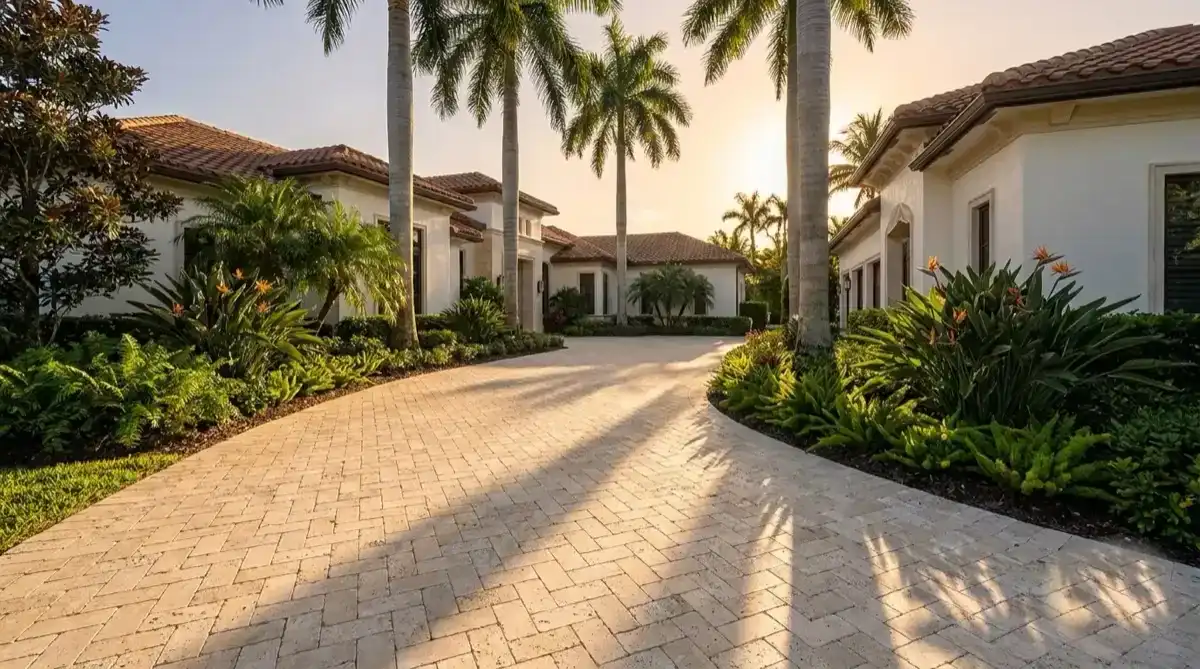
Paver Installation in
Greenacres, FL
Clay soil deep-base engineering, FEMA Flood Zone AE permeable systems, C-51 canal SFWMD ROW compliance, and HOA approval management for River Bridge, Nautica Isles, and beyond.
Three Greenacres Challenges — Flood Zone AE Compliance, Clay Soil, and HOA Complexity Each Require a Different Approach
Greenacres is an inland Palm Beach County city with three distinct challenges that most paving contractors don't advertise they don't know how to handle. Since FEMA's 2017 map update reclassified parts of Greenacres from Zone X (minimal hazard) to Zone AE (Special Flood Hazard Area), every installation in a flood-designated area must be designed for drainage first — which means permeable paver systems, proper grading, and attention to the overtaxed C-51 canal drainage network.
Underneath the surface, Greenacres' inland clay soils are the opposite of the sandy fill found in Boca Raton or Delray Beach. Clay expands when saturated and contracts when dry. A standard 4–6-inch compacted gravel base laid directly over unaddressed clay will heave, develop joint gaps, and fail within 2–3 wet seasons regardless of paver quality. Proper Greenacres driveway installation requires 8–12 inches of compacted base in lifts over geo-textile fabric — every time. And for River Bridge, Nautica Isles, and Pinewood Lake residents, the City of Greenacres won't issue a building permit until the HOA's Architectural Review Committee signs off first.
Craft Pavers knows the permit contact, the ARC process for each major Greenacres community, the clay soil depth requirements by neighborhood, and the SFWMD right-of-way rules for C-51 canal–adjacent properties. That local knowledge is what separates installations that last from ones that fail the first rainy season.
The Greenacres Paver Challenge
Three inland forces — flood zone compliance, clay soil instability, and C-51 canal ROW restrictions — that every Greenacres homeowner should understand before getting a quote.
| Factor | Greenacres Reality | Impact on Pavers |
|---|---|---|
| FEMA Flood Zone AE | Reclassified Oct 2017 from Zone X — parts of city | 1–2% grading mandatory; permeable pavers strongly recommended |
| Clay Soil Instability | Inland clay — expands wet, shrinks dry (no sandy fill) | Standard 4–6 in. base fails in 2–3 seasons; 8–12 in. required |
| UV Index | 11–12 (Extreme, April–September) | Color fade, sealer breakdown, polymeric sand degradation |
| Annual Rainfall | 57 inches · Rainy season June–Sept | Clay saturation; drainage design critical to prevent heave |
| C-51 Canal ROW | SFWMD right-of-way along canal corridor | Written SFWMD approval required before any work in ROW |
| HOA / ARC Approvals | River Bridge, Nautica Isles, Pinewood Lake, Magnolia Bay — all require ARC review | City permit cannot be filed until ARC approval is in hand |
The inland advantage — no salt surcharge — Unlike coastal Palm Beach County cities, Greenacres has no significant salt-air exposure. Standard high-quality polymeric joint sand is sufficient for all Greenacres installations — no marine-grade upgrade required. Sealing cycles run 3–4 years rather than 2. More of your budget goes to square footage and material quality.
Permeable pavers for Flood Zone AE — Greenacres manages 645 stormwater structures all funneling into the C-51 canal. Standard impervious surfaces shed 100% of rainfall into this already-stressed system. Permeable paver systems allow infiltration through the surface — directly reducing runoff volume from your property and qualifying for stormwater impervious-surface consideration.
Paver Installation Services in Greenacres
From River Bridge gated driveways to Flood Zone AE permeable systems — each service engineered for Greenacres' clay soil and inland drainage conditions.
Driveway Paver Installation
Concrete and travertine driveways with 8–12-inch compacted clay soil base, geo-textile separation fabric, and 1–2% drainage slope. Dillman Farms and Greenacres Heights wide-clearance driveways engineered for large-lot properties. Deep-lift compaction in 2-inch increments — no shortcuts.
Permeable Pavers (Flood Zone AE)
Open-graded aggregate base systems for Zone AE addresses and C-51 canal–adjacent properties. Reduces impervious surface runoff into the overtaxed stormwater network. Meets Greenacres Engineering Division drainage standards. Geo-textile at base, open joints for infiltration — no joint sand.
Pool Deck Pavers
Travertine and cool-touch porcelain pool surrounds with non-slip matte finish standard. Clay soil base fully remediated before pool deck installation begins. Drainage graded away from equipment pads. 3-year sealing cycle — no salt-air premium for inland Greenacres properties.
HOA Community Installations
Full ARC application package for River Bridge (1,100 homes), Nautica Isles (503 homes), Pinewood Lake (98 townhomes), Magnolia Bay, Buttonwood, and El Lago. Scope, scaled drawing, specs, contractor license, and COI prepared. Permit filed only after ARC approval — never simultaneously.
Patio & Outdoor Living Areas
Custom paver patio designs for outdoor kitchens, pergola surrounds, and entertaining spaces. Clay soil base engineered for each patio footprint. Standard polymeric joint sand — no salt surcharge for inland properties. Gas, electrical, and drainage access coordinated with other trades.
Walkways & Entry Pavers
Front entry and side walkway paver installation for residential and HOA-governed properties. Concrete and travertine walkways with proper clay soil base preparation and edge restraint. Full ARC documentation for governed communities. Spanish-language consultation available.
Paver Installation Cost in Greenacres
Installed price includes material, clay soil base prep, labor, polymeric joint sand, edge restraint, and cleanup. Permeable base upgrades, HOA package prep, and NOC recording itemized separately.
| Material | Installed Price / sq ft | Best For | Sealing Cycle |
|---|---|---|---|
| Concrete Pavers | $12 – $18 | Driveways, patios, Dillman Farms, Greenacres Heights | 3–4 years |
| Permeable Concrete Pavers | $14 – $20 | Flood Zone AE, C-51 canal properties, drainage compliance | 3–4 years |
| Travertine | $17 – $25 | Pool decks, premium patios, River Bridge, Nautica Isles | 3 years |
| Porcelain | $20 – $29 | High-end outdoor kitchens, Pinewood Lake, premium entertaining | 3 years |
| Natural Limestone | $19 – $28 | Premium patios, low-maintenance inland finish | 3–4 years |
Clay soil base upgrade (8–12 in. vs. standard 4–6 in.) adds $1–$2/sq ft. Permeable open-grade base for Zone AE adds $2–$3/sq ft. No coastal salt-air surcharge applies. Free on-site estimate required for complete scoping.
What Actually Moves the Price in Greenacres
Two driveways of the same size, two streets apart, can quote differently — and it usually has nothing to do with the paver you picked. These are the things we walk through at the estimate, and the reason the per-square-foot number is a range instead of a flat rate.
Project area & shape
Square footage sets the baseline, but the outline sets the labor. A rectangular driveway or parking pad installs fast because nearly every unit is laid full-size. A patio that curves around a screen enclosure or a walkway that bends toward the front door needs cut pavers the whole way around the perimeter, and every cut is a hand operation.
Tearing out what's there
Most Greenacres jobs start by removing a cracked builder-grade concrete slab, old asphalt, or sod. Breaking it up, loading it, and hauling it off is a real line item — and it is priced separately from the excavation that follows, because the two are different amounts of work on different days.
Base depth on your clay
Clay depth varies block to block across the city. A patio on firm subgrade can run a standard 6-inch compacted base; a driveway over soft plastic clay needs 8–12 inches of base material placed in lifts. Same city, same paver, different ground — and that difference is the single biggest swing in a Greenacres quote.
Material tier
Concrete pavers to porcelain is roughly a 2x spread per square foot installed. Inland, though, the honest advice is that the tier matters less here than the base does: no Greenacres address carries a salt surcharge, so a concrete paver on a properly engineered base outlives a premium stone on a thin one, every time.
Edges, borders & features
Edge restraint around the full perimeter is standard on every job and already in the number. A soldier-course border, an inlay band, a fire pit surround, steps at a grade change, or a low retaining wall where the yard falls away each add their own material and labor, and each is itemized on its own line.
Access & staging
Base material arrives by the ton. If a truck can back up to the project area, the cost stays low. A rear patio reached through a 36-inch side gate means the same tonnage moves by wheelbarrow — identical material, considerably more hours. We measure the gate at the site visit, not on install day.
Neighborhoods We Serve in Greenacres
From River Bridge's gated driveways to Dillman Farms' large open lots — with local knowledge of every HOA ARC process, clay soil depth, and SFWMD canal ROW boundary.
ZIP Codes Served
Permits, HOA & Compliance — We Handle It All
Greenacres has layered approval requirements
City of Greenacres Building Department: 5800 Melaleuca Lane · (561) 642-2052 · groupblg@greenacresfl.gov. Hours: Mon–Fri 8:00 AM–4:30 PM. Online portal available at esuite.greenacresfl.gov/eSuite.Permits/. NOC threshold: $2,500+. HOA ARC approval must come before permit filing — not simultaneously.
South Florida Rainy Season Runs June–September — Schedule Before It Arrives
Greenacres clay soil saturates during the rainy season and every active project faces drainage and scheduling challenges. HOA boards are actively meeting January through May, permit processing is routine, and dry-season conditions produce the best compaction results. The optimal window: book January–May for dry-season installation — have your finished patio, driveway, or pool deck fully cured and sealed before June arrives.
How We Install Pavers in Greenacres
Clay soil base engineering, FEMA Zone AE drainage design, C-51 canal ROW clearance, and HOA ARC sequencing make Greenacres installations more complex than most contractors anticipate. Here's what every Craft Pavers Greenacres project includes.
Site Assessment, Soil & Flood Zone Check
On-site evaluation: soil composition (clay depth and profile), flood zone designation (Zone AE boundaries), drainage slope, HOA status, and SFWMD ROW boundaries for C-51 canal–adjacent properties. Properties near the canal are reviewed against the survey before any base design is finalized.
HOA ARC Submission (If Applicable)
For River Bridge, Nautica Isles, Pinewood Lake, Magnolia Bay, and other governed communities: ARC package prepared and submitted with scope, scaled drawing, specs, contractor license, and COI. City of Greenacres permit filed only after ARC approval is in hand — never simultaneously.
Permitting & NOC Recording
Greenacres Building Department application via online portal (esuite.greenacresfl.gov) or in person at 5800 Melaleuca Lane. NOC notarized and recorded with Palm Beach County Clerk for projects at $2,500+ — filed before first inspection. Sunshine State One Call (811) placed before any excavation.
Clay Soil Excavation & Drainage Engineering
Clay subgrade excavated to required depth. Geo-textile weed and separation fabric installed directly on prepared subgrade. French drain or perforated pipe installed where subsurface water retention is detected. For Zone AE properties: open-grade aggregate base specified for permeable infiltration rather than standard dense-grade.
Base Preparation & Compaction
8–12 inches of compacted base stone for driveways (4–6 inches for pedestrian areas), compacted in 2-inch lifts using a plate compactor — never all at once. Edge restraint installed with 10-inch spikes at 12-inch intervals. Grading verified at minimum 1–2% away from all structures before bedding layer placement.
Paver Installation, Jointing & Sealing Schedule
Standard high-quality polymeric joint sand on all Greenacres installations — no marine-grade upgrade required (inland location, no salt-air exposure). Final compaction and surface inspection. Sealer applied 4–6 weeks post-installation. Written 3–4-year sealing schedule provided. Spanish-language project documentation available on request.
Base Preparation: The Part of a Greenacres Driveway You Never See — and the Only Part That Decides How Long It Lasts
The pavers are the last thing placed and the only thing anyone looks at. Everything that determines whether the surface is still flat and tight in year fifteen happens underneath them, in layers that get buried the same afternoon they go in. Greenacres makes that truer than most places: there is no salt here to eat a joint and no marine-grade anything to buy, so the entire performance question comes down to base preparation over clay. This is the step-by-step we run on every project area, and the reason we would rather sell you a concrete paver on a proper base than a premium stone on a thin one.
Excavate to Firm Subgrade
We excavate the full project area to the depth the finished system needs — base thickness, plus the sand bed, plus the paver height. A patio or walkway is roughly 7–9 inches of total dig; a driveway goes deeper because vehicle loads want more compacted base beneath them. Sod, roots, and the old slab come out. Where the clay under that is soft and plastic, we keep digging and remove it rather than pretend a plate compactor can fix it in place. Getting the excavation uniformly level here is what makes every layer above it accurate.
Geo-Textile Over the Clay
Woven separation fabric goes down across the excavated subgrade before a single stone of base material is placed. Crushed limerock and wet clay want to mix; without the fabric, the base slowly punches down into the clay through the rainy season and the paver surface follows it. The fabric keeps the two layers doing their separate jobs, and it blocks weed growth pushing up from below. Inland Greenacres clay is exactly the soil this fabric was designed for.
Base Material, Compacted in Lifts
Crushed limerock base goes in — a minimum of 6 inches for a patio or walkway, 8 to 12 inches for a driveway over Greenacres clay. It is placed in 2-to-3-inch lifts, and we run the plate compactor over every lift before the next one is spread. Dumping the full depth and compacting once looks identical on the day and leaves soft pockets that telegraph into dips a year later. Multiple compaction passes per lift is the slow way and the only way to get a genuinely stable base.
Screeding the Bedding Sand
Over the compacted base we screed a one-inch layer of bedding sand — coarse concrete sand, never fine play sand — pulled dead level between screed rails. This sand bed is what the pavers seat into, so we level the sand precisely and then nobody walks it; a footprint in the screeded bed becomes a low paver in the finished surface. Small corrections around drains and pipe penetrations are cut in by hand with a trowel.
Laying, Cut Pavers & Edge Restraint
We start laying from a fixed square edge and set the pavers in the approved pattern, always working off the surface already laid rather than off the sand bed. Cut pavers are measured and wet-cut to close out the perimeter, borders, and curves. Then the detail most failed DIY patios skip entirely: a rigid edge restraint around the whole perimeter — spiked plastic edging against garden beds and sod, concrete restraint against open ground. Without a hard edge, the pavers creep outward, joints open, and the interlock that carries the load is gone.
Joint Sand & Final Compaction
Polymeric joint sand is swept across the paver surface and worked into every joint. Standard high-quality polymeric is correct in Greenacres — there is no salt load inland to justify a marine-grade compound, and we will not charge you for one. We run the plate compactor over the finished surface, with a protective pad on travertine and porcelain, so the final compaction seats each paver into the bedding layer and drives the sand fully up into the paver joints. Excess sand is cleared off with a blower, the joints are misted to activate, and the locked joints shut out the weed growth and washout that ruin swept-sand work.
Where a Greenacres budget should actually go: on the coast, a meaningful slice of every quote is spent resisting salt — marine-grade jointing compound, salt-rated sealer, tighter sealing cycles. None of that applies here. If you take the money a beachfront homeowner spends on corrosion resistance and put it into base depth instead, you end up with a driveway that outlasts theirs on a lower maintenance budget. That is the whole inland argument, and it is why we photograph the base at each stage and hand those photos over with your project documentation — you should be able to see what you paid for after it's buried.
Most Greenacres Driveways We Replace Were Poured Somewhere Between the Mid-1980s and the Mid-2000s
Greenacres grew in subdivisions, and those subdivisions came with builder-grade concrete driveways: a thin pour on minimal base preparation, finished to a schedule. Two or three decades of clay moving underneath them and eleven-to-twelve UV summers on top of them have brought a lot of those slabs to the end of their service life at roughly the same time. The tell-tale signs are always the same — a crack running corner to corner, one panel that has settled below its neighbor, spalling at the apron where the drive meets the street, and a permanent damp stain where water sits after every storm instead of running off.
A slab fails as one object. That's the real argument for changing over rather than pouring again: once a concrete driveway cracks, the repair is cosmetic and the next crack is already on its way. A paver surface fails one unit at a time, and a single unit can be lifted out, re-bedded, and put back. If a plumber has to open a trench through the middle of it in eight years, the pavers come up, the trench gets backfilled and compacted, and the same pavers go back down — no seam, no colour-matched patch, no second pour that never quite matches the first.
Why the slab cracked
Almost never the concrete itself. It's the ground: a thin, under-compacted base over clay that expands through the rainy season and shrinks back in the dry months. Concrete has no way to move with that, so it relieves the stress the only way it can — it cracks, and then the crack lets water into the subgrade and the cycle accelerates.
What the changeover involves
The slab is broken out and hauled away, then we excavate below where it sat, because the original base almost never has the depth or compaction a paver system needs. Geo-textile, base material in lifts, plate compactor on every lift, screeded bedding sand, pavers, edge restraint around the perimeter, polymeric joint sand, final compaction. The drive is typically usable within days, not weeks of curing.
What it costs to do right
Concrete pavers over a properly built base sit at the value end of our range, and inland Greenacres carries no salt premium on top. The line items to look for on any competing quote are demolition and haul-away, base depth in inches, and edge restraint — if a quote is silent on all three, it is not cheaper, it is smaller.
What a Greenacres Budget Actually Buys — and the Part You Can Reasonably Do Yourself
Greenacres is a value market and we quote it as one. Given a fixed number, the money that returns the most out here goes underground: depth and compaction in the paver base, geo-textile over the clay, and drainage that carries water off the lot. Two neighbours can spend an identical amount — one on imported stone over a thin base, one on ordinary units over a deep one — and five rainy seasons later only one of those surfaces is still flat. That is not a sales line, it is what we find when we tear the failed ones out.
So the types of pavers that do their best work on a Greenacres budget are the unglamorous ones: standard concrete paving stones and plain clay brick, in the roughly $12–$16 per square foot installed tier. They carry vehicle load, they are colour-stable under an eleven-to-twelve UV index, they are easier to install to a tight tolerance than oversized slabs, and — the part nobody thinks about until it matters — they are still stocked in eight years when a utility trench crosses the paver area and a dozen units have to be matched. Inland, with no salt cycle to design against, none of the marine-grade premiums a beachfront address pays for buy you anything here. That difference is real square footage.
If you want to build a patio yourself, pick the geometry that forgives. A square or rectangular rear patio is the right first attempt, because nearly every unit goes down full-size and only the final course has to fit the pavers to a trimmed edge; a curve around a pool or a planting bed triples the cutting and the cutting is where weekends disappear. Work in this order: excavate the marked-out area past the topsoil into firm ground, place base stone in 3″ lifts with a rented compactor over each one, then strike a one inch layer of sand flat across the top. Set from a string line, keep the joints tight as the pavers are laid, and resist the urge to kneel on the screeded bed of sand. Cut wet, both for a clean face and to keep the dust down. Finish by sweeping polymeric sand in, compacting once more, and blowing the loose sand off before it stains the surface.
The honest stopping points: a driveway, where clay depth decides the base spec and the city wants a permit and inspections; anything with wall blocks, a seat wall, or a grade change holding soil back; permeable paving for a Flood Zone AE address, which is an engineered open-graded system rather than a material swap; and any layout that has to be coordinated with irrigation, landscaping, or a canal-side survey line. Those are the jobs where a saved labour cost gets spent twice. Everything short of them, we will happily talk you through at the estimate whether you hire us or not.
Paver Materials for Greenacres' Inland Conditions
Material selection depends on flood zone status, clay soil depth, HOA aesthetic guidelines, and project use — not coastal specifications that don't apply inland.
Concrete Pavers
Inland Greenacres · Best ValueThe most cost-effective durable option for Dillman Farms, Greenacres Heights, and non-HOA residential properties. Color-stable, high load-bearing capacity, and wide availability for future repairs. Standard high-quality polymeric sand joint sufficient — no marine-grade compound needed inland. 3–4-year sealing cycle. For large driveways over Greenacres clay, 8–12 inches of compacted base is required — not negotiable. Upgrade to permeable concrete pavers is recommended for any Zone AE address.
Permeable Concrete Pavers
Flood Zone AE & Drainage ComplianceOpen-graded permeable concrete paver systems designed for Zone AE addresses and C-51 canal–adjacent properties. The open-joint, open-aggregate base allows rainfall to infiltrate through the surface rather than becoming runoff entering the already-stressed C-51 canal system. Directly reduces impervious surface coverage and qualifies for stormwater management consideration. Cost premium over standard concrete: approximately $2–$3/sq ft installed. Recommended for all Greenacres Zone AE properties and any lot with documented drainage challenges.
Travertine
Pool Decks & Premium PatiosThe preferred finish for River Bridge, Nautica Isles, and Pinewood Lake premium outdoor living areas. Travertine stays cool underfoot in direct South Florida sun and is highly UV-resistant. Unlike coastal installations, Greenacres travertine does not require marine-grade sealer — standard penetrating sealer on a 3-year cycle is appropriate. Clay soil base must be fully engineered before travertine installation — the material requires a stable, level base. ARC aesthetic approval is typically straightforward for travertine in governed Greenacres communities.
Porcelain
High-End Outdoor Living AreasNear-zero porosity — highest stain resistance of any paver material and the lowest long-term maintenance cost for premium outdoor kitchens and entertaining spaces. Large-format slabs (24×24, 24×48) create seamless contemporary surfaces popular in Pinewood Lake, Nautica Isles, and newer Greenacres developments. 3-year sealing cycle. Requires laser-leveled, fully remediated clay base — no porcelain installation begins until the subgrade is confirmed stable. Non-slip matte finishes available for pool surrounds.
What Makes Us Different in Greenacres
Clay Soil Base Engineering
We require 8–12 inches of compacted base on Greenacres clay for every driveway — compacted in 2-inch lifts over geo-textile fabric. We will not install standard 4-inch base over unaddressed clay. That decision determines whether your pavers last 20 years or 3 seasons.
FEMA Zone AE Permeable Paver Expertise
We design permeable paver systems specifically for Greenacres' Zone AE properties and C-51 canal drainage network. Open-grade aggregate base, no joint sand, geo-textile at bottom — each element engineered to reduce impervious surface runoff, not just check a box.
C-51 Canal SFWMD ROW Compliance
Before quoting any canal-adjacent installation, we review the property survey and confirm SFWMD ROW boundaries. No excavation, paving, or hardscape work begins near the C-51 corridor without documented ROW clearance — the property owner's liability, not the contractor's.
Complete HOA ARC Application Packages
River Bridge, Nautica Isles, Pinewood Lake, Magnolia Bay, and Buttonwood ARC applications prepared in full: scope, scaled drawing, material specs, contractor license, and COI. We submit in the correct sequence — ARC approval before city permit — and coordinate follow-up until approval is in hand.
Spanish-Language Consultations
Greenacres has a 44.8% Hispanic population. We conduct estimates, consultations, material selection discussions, and project updates in Spanish for homeowners who prefer it. Same detailed, complete process — in your preferred language. Note your preference in the estimate form.
Free Written Estimate in 24 Hours
On-site assessment with clay soil evaluation, flood zone check, SFWMD ROW review, and HOA status confirmed. Itemized written quote delivered within 24 hours of site visit. No quote-from-photos. No undisclosed line items added after the project starts.
Paver Installation in Greenacres — Questions Answered
How much does paver installation cost in Greenacres, FL?
How much would a 20x20 paver patio cost in Greenacres?
Can you lay pavers directly on dirt in Greenacres?
Can I lay patio pavers myself in Greenacres, or should I hire a contractor?
Why did my Greenacres property get reclassified to FEMA Flood Zone AE in 2017?
Do I need a permit for paver installation in Greenacres, FL?
What base preparation does Greenacres' inland clay soil require?
How do permeable pavers help with Greenacres' flooding and drainage problems?
My property is next to the C-51 canal — what do I need to know before installing pavers?
How do HOA approvals work at River Bridge, Nautica Isles, or Pinewood Lake?
What makes Greenacres paver installations different from coastal Palm Beach County?
Does Craft Pavers offer Spanish-language consultations for Greenacres homeowners?
Other Paver Services Near Greenacres, FL
Existing pavers that need attention? We cover every service category.
Ready to Transform Your Greenacres Property?
Free on-site estimate. All permits handled. HOA ARC packages prepared. Written quote in 24 hours. Book January–May — be done before rainy season.