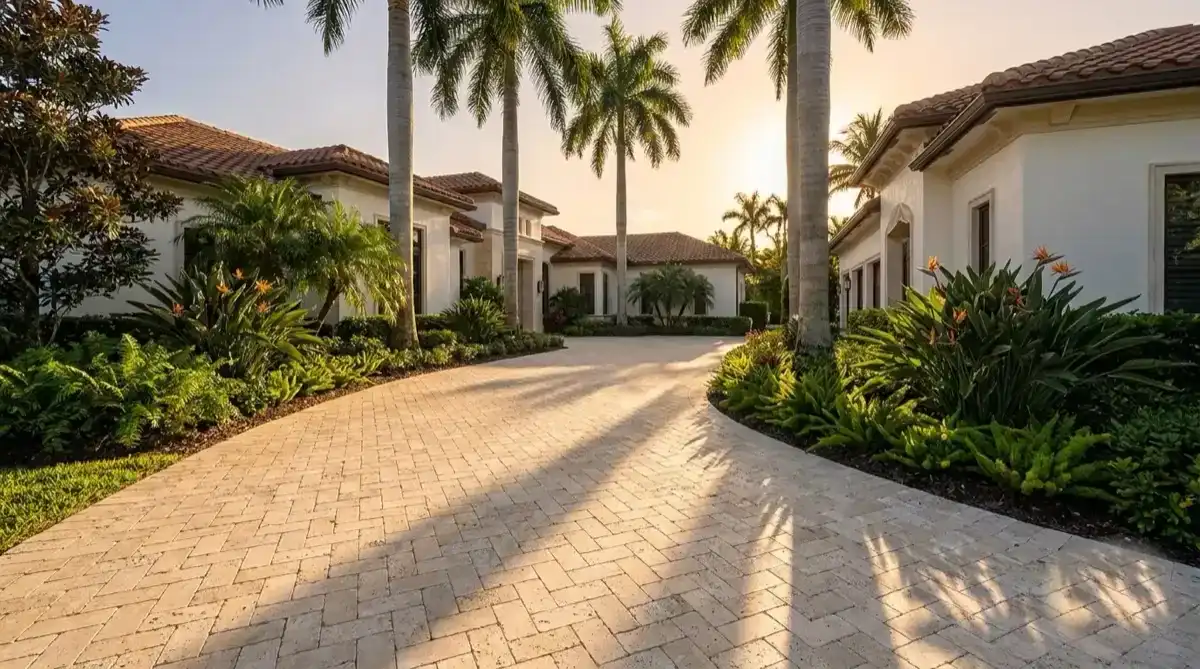
Brick Paver Installation in
Hollywood, FL
A 1920s planned city between Fort Lauderdale and Miami, with historic-district streets on one end and the Broadwalk's salt air on the other. Driveway pavers, pool decks, and patios specified for old subgrades, tidal canals, and Broward's strictest-in-South-Florida permitting — historic review included when your street calls for it.
A 1920s Plan, a 2.5-Mile Beachfront, and Streets That Predate the Concrete on Them
Hollywood sits between Fort Lauderdale and Miami, but it isn't a suburb of either — it's a planned city laid out in the 1920s, and that origin still shapes every hardscape decision here. The oldest neighborhood, east of U.S. 1, keeps its pre-war street pattern and its historic homes, and the city protects that character formally: Hollywood's Historic Preservation Board reviews modifications to historic properties and properties within designated districts, working from the Secretary of the Interior's Standards and the city's own Design Guidelines for Historic Properties and Districts, which cover materials, scale, and location. For a paver project in Hollywood Lakes, that means one question gets answered before anything else: does this address and this scope need historic review? We confirm the review path with the city for every Lakes-area estimate and build it into the schedule — an extra step handled in the right order is paperwork; discovered mid-project, it's a stop-work order.
The 1920s plat has a second consequence: age underground. Hollywood's older streets carry some of Broward's oldest driveways and walkways, poured over subgrades that have settled, rooted, and washed out for the better part of a century — which is why we treat the joint-and-base specification as the heart of any project on the east-side grid, correcting the ground at tear-out instead of paving over its history. Add the coastal gradient — direct Atlantic salt air along the Broadwalk, Hollywood's roughly 2.5-mile oceanfront promenade; tidal canals through Hollywood Lakes and parts of Emerald Hills; a standard inland spec for overlay-or-replace decisions in Hollywood Hills — and Broward's permit regime on top, filed through the city's ePermit service and Broward County's ePermitsOneStop where the project qualifies. One contractor, one written estimate, and every review path sorted before work is quoted.
The Hollywood Climate Challenge
Hollywood runs the full South Florida gradient in one city: ocean salt on the beach corridor, tidal canal water behind the Lakes, century-old subgrades on the original grid, and a five-month wet season over all of it. Each factor has a specific, physical effect on how a paver system must be built.
| Climate Factor | Hollywood Reality | Impact on Pavers |
|---|---|---|
| UV Index | 11–12 (Extreme, April–September) | Color fade, surface oxidation, sealer breakdown within 18–24 months unsealed |
| Annual Rainfall | ~60 inches · Heavy June–September | Joint sand washout, base saturation, ponding on the flat original grid |
| Ocean Salt Air | Atlantic beachfront along the ~2.5-mile Broadwalk corridor | Salt crystallization in pores → spalling, efflorescence on beach-corridor blocks |
| Tidal Canal & Lake Water | Hollywood Lakes' lakes and canals; canal-backed lots in parts of Emerald Hills | Near-waterfront salt loads inland; marine jointing sand required waterside |
| Aging Subgrades | 1920s plat east of U.S. 1; mid-century grid inland | Settled, root-heaved ground under old drives — subgrade corrected at tear-out |
| Hurricane Season | June 1 – Nov 30 · Surge exposure via the beach and Intracoastal | Storm surge and wind-driven salt spray; edge restraint and joint lock matter post-storm |
The gradient runs east to west — A Hollywood paver spec changes block by block. Beach-corridor surfaces near the Broadwalk need porcelain or travertine, marine jointing sand, and salt-blocking sealer. Hollywood Lakes' canal- and lake-backed lots carry tidal-water salt loads despite being well inland of A1A. By Hollywood Hills and the western grid, a standard concrete-paver spec with UV-rated sealer performs fine. We price and specify by measured distance to salt water — not by a one-size template stretched across a city that spans ocean to inland in a few miles.
Old ground fails new surfaces — On the 1920s grid, the enemy isn't the climate above the pavement but the century below it: subgrades that settled unevenly, ficus and oak roots that heaved slabs, swale edges that washed out. A rigid slab poured over that history cracks along it. An interlocking paver system over a corrected, lift-compacted base flexes with minor movement and stays repairable — individual pavers lift and reset after root or utility work, instead of the saw-and-repour cycle the old concrete demanded.
Paver Installation Services in Hollywood
Driveway Pavers & Replacement
The core Hollywood project: retiring a concrete drive that's decades past its service life — original on the oldest Lakes-area streets, mid-century in Hollywood Hills — and replacing it with an interlocking system over a corrected base. We handle the city building permit, coordinate right-of-way review where the apron touches the swale, and confirm the historic review path for district addresses before quoting a timeline. See our full paver installation service for scope details.
Pool Deck Pavers
Travertine leads Hollywood pool decks because it stays cool underfoot through the long sun season; porcelain is the step up for lake- and canal-backed decks in Hollywood Lakes and Emerald Hills, where waterside salt adds up. Inland pools in Hollywood Hills can run standard concrete pavers with a UV-rated sealer. Deck drainage is always graded away from both the pool shell and the house — and on waterfront lots, away from the seawall cap as well.
Patio & Outdoor Living
Patios, walkways, fire pit pads, and summer kitchen platforms — sized to Hollywood's older east-side lots, where a well-designed 300–500 sq ft patio does the work of a suburban half-acre yard. In Broward's cities a patio typically needs a building permit just like a driveway does, so we fold the filing into the project rather than leaving it to you. For historic-district addresses, we confirm whether the scope needs Historic Preservation Board review before work is scheduled.
Historic-District Properties
Hollywood's oldest neighborhood, east of U.S. 1, includes designated historic districts where the Historic Preservation Board reviews modifications guided by the city's Design Guidelines for materials, scale, and location. For these addresses we confirm the review path with the city first, prepare documentation that speaks the guidelines' language — clay brick and traditional patterns tend to fit the 1920s architecture naturally — and sequence the approval before the building permit, so the schedule holds.
Lakeside & Canal-Side Pavers
Hollywood Lakes wraps its namesake lakes and canals, and parts of Emerald Hills back onto canals as well — waterside terraces, dock aprons, and walkways that live next to tidal water. We spec marine-grade polymeric sand in every joint, porcelain or travertine for salt resistance, and grading that sheds water away from the seawall cap and the house. Work on the seawall itself is marine-contractor scope; everything landward of the cap is ours.
Pavers Over Existing Concrete
Hollywood's mid-century blocks are full of original slabs — some sound enough to overlay, many not. When the slab is stable and drainage fall allows, an overlay saves demolition cost; when it's cracked and moving — the norm on the oldest subgrades — an overlay just transfers the cracks upward. We assess honestly at the site visit and show you the reasoning either way; our pavers-over-concrete guide walks through the full decision tree before we ever arrive.
Paver Installation Cost in Hollywood, FL
Installed price per square foot — $12–$32 across materials, based on recent Broward and Palm Beach County projects. Marine-grade materials, permit fees, and any historic-review documentation are itemized separately in your written estimate. For the full regional breakdown, see our South Florida paver cost guide.
| Material | Cost / Sq Ft (Installed) | Best For |
|---|---|---|
| Concrete Pavers | $12 – $20 | Driveways in Hollywood Hills and the inland grid — best value under vehicle loads |
| Clay / Brick Pavers | $15 – $24 | Hollywood Lakes' pre-war streets — kiln-fired color that suits 1920s architecture and holds under UV |
| Travertine | $18 – $28 | Pool decks and lakeside patios — cool underfoot, natural salt resistance |
| Porcelain Pavers | $22 – $32 | Beach-corridor and canal-side surfaces — non-porous, best-in-class for salt |
Waterside projects include marine polymeric sand and salt-blocking sealer as standard line items — required for long-term performance next to tidal water, and itemized transparently in every waterfront estimate. Premium natural stone beyond these tiers is priced by written quote.
What Actually Moves the Price in Hollywood
Two similar driveways — one in Hollywood Hills, one on a Lakes-district street — can price out very differently. These are the factors we walk through at every estimate, and why the per-square-foot number is a range, not a flat rate.
Project area & footprint
Total square footage sets the baseline, but shape matters as much as size. A rectangular driveway installs efficiently; a patio wrapping a pool or following a lake edge requires far more cut pavers along the perimeter, and cutting is labor.
Excavation & haul-away
Removing an existing slab, then excavating to depth, is a real line item — and on Hollywood's oldest streets, the subgrade correction underneath is where the honest work lives. Driveways dig deeper than patios because vehicle loads demand a thicker base.
Review path by address
An inland Hollywood Hills patio is one building-permit filing. A Lakes-district address may add Historic Preservation Board review before the permit; an apron touching the swale adds right-of-way review. Each track is confirmed with the city and itemized before we commit to a timeline.
Material tier
Concrete pavers to porcelain is roughly the full $12–$32 spread per installed square foot. Waterside projects also carry marine polymeric sand and salt-rated sealer as required line items — not upsells.
Ground conditions by block
The 1920s grid east of U.S. 1 carries the oldest, most settled subgrades; the mid-century blocks west of it are younger but still decades into root and settlement cycles. Same city, different ground, different prep — we confirm at excavation, when we can see the actual soil.
Access & staging
Base material arrives by the ton. If the truck can stage next to the project, cost stays down. A waterside terrace behind a Lakes house means wheelbarrow runs through a narrow side yard — more hours, same material.
Hollywood Neighborhoods & Nearby
From the Lakes' 1920s streets to Emerald Hills' golf-course blocks to the Broadwalk's salt-air corridor — each part of Hollywood brings its own ground age, salt exposure, and review path.
Hollywood Lakes
The city's oldest neighborhood, east of U.S. 1 · Lakes & canals · Historic-district review possible
Emerald Hills
Golf-course community · Some canal-backed lots · Estate driveways and pool decks
Hollywood Hills
Dates to about 1960 · Inland family blocks · Mid-century drives in the replacement cycle
Beach / Broadwalk Corridor
~2.5-mile oceanfront promenade · Direct salt air · Porcelain & travertine lead
Downtown / Hollywood Blvd
The 1920s core · Compact older lots · Walkways and entry upgrades
North Central Hollywood
Mid-century grid · Original slabs · Overlay vs. tear-out assessed per lot
Dania Beach
Neighboring city to the north · Separate permit jurisdiction · Same coastal spec logic
Hallandale Beach
Neighboring city to the south · Own building department · Beach-corridor salt spec
West Hollywood Area
Inland residential blocks · Standard spec · Driveway replacements
Also serving residential properties throughout Hollywood and neighboring Broward cities — see our city pages for Fort Lauderdale, Coral Springs, and Weston. City of Hollywood addresses permit through the city's Development Services; Dania Beach, Hallandale Beach, and other neighboring cities have their own building departments — we identify the correct jurisdiction from your parcel record.
Hollywood Can Add a Review Layer No Other Broward City Page on This Site Has: Historic Preservation — We Sequence All of It
The patio exemptions common in Miami-Dade and Palm Beach County mostly don't exist in Broward's cities — in Hollywood, plan on a permit for the driveway and usually the patio too, with historic review layered on top for designated districts. Here's how the tracks break down; our county-by-county paver permit guide covers the full three-county picture with sources.
- City of Hollywood Building Permit — Hollywood's Building Division sits inside the Department of Development Services, and like other Broward cities, driveway and patio work that neighboring counties often exempt requires a building permit here. The city runs an ePermit service for electronic submission of shorter-review permits, and through Broward County's ePermitsOneStop, city and associated county approvals can move in one combined process. We prepare and file the complete package: site plan, survey, product specs, and contractor license and insurance.
- Historic Preservation Review — Properties that are locally designated or sit within a designated historic district may need Historic Preservation Board review before exterior modifications, guided by the Secretary of the Interior's Standards and the city's Design Guidelines for Historic Properties and Districts. Whether a given paver scope triggers it depends on the property and the work — for Hollywood Lakes and other district addresses we confirm the review path with the city before quoting a timeline, and sequence the approval ahead of the building permit.
- Right-of-Way / Swale Work — If the driveway apron, walkway, or any part of the project touches the swale or public right-of-way, that work carries its own review and inspection track. The apron — the piece between your property line and the street — is the part regulators care about most, and on Hollywood's oldest streets it's also where the worst settlement lives.
- Dania Beach, Hallandale Beach & Neighboring Cities — Each is a separate incorporated municipality with its own building department; a Hollywood filing does not cover their addresses. We determine the correct jurisdiction from your parcel record at the site visit — near city lines, the mailing address alone can mislead.
- Inspections — Broward-city paver permits typically involve a base inspection before the pavers go down and a final inspection after completion; right-of-way work is inspected on its own track. Review timelines vary with city workload and any historic-board calendar — we confirm current timelines with the city at filing, schedule every inspection, and hand you the closed permit documentation at the end.
Scheduling · Straight Answer
Based in Boca Raton, ~30 Miles North — Here's What That Honestly Means
Hollywood is the southern edge of our service area, and we'd rather tell you that than pretend otherwise. Estimates are typically scheduled within a few days — not next-day, and never same-day — and we batch Hollywood site visits so the drive never rushes the assessment. For the installation itself, distance is irrelevant in practice: pavers and base material deliver to your site, and the crew is on-site each morning for the duration, with no travel surcharge. Our 360+ completed projects and 45 five-star Google reviews are company-wide figures across Palm Beach and Broward counties — not an invented local count.
Our Hollywood Installation Process
On-Site Assessment: Review Path, Salt Zone & Slab Condition
We visit your property, measure the project area, and answer the three Hollywood questions in order: does this address sit in a designated historic district (we confirm the review path with the city, not from assumptions); how close is tidal water (the Broadwalk corridor, the Lakes' canals, or inland — it determines the jointing and sealer spec); and is the existing slab an overlay candidate or a tear-out. Written, itemized estimate within days of the visit.
Approvals in the Right Order — Historic Review, Then Permit
For district addresses, any Historic Preservation Board review is sequenced before the building permit so the schedule holds. We then prepare and file the building permit with the city's Development Services — using the ePermit service where the scope qualifies, and Broward County's ePermitsOneStop where county approvals ride along. Work touching the swale or right-of-way is filed on its own track alongside.
Demolition & Base Engineering
Existing concrete removed and hauled. On Hollywood's oldest streets this is where the real work starts: the exposed subgrade shows a century of settlement, roots, and washout, and each defect gets corrected before base material goes down. Compacted limerock base installed in lifts: 6" minimum for patios and walkways, 8–10" for driveways, with geotextile wherever the exposed soil calls for it.
Laying, Cutting & Jointing
Bedding sand screeded to one inch; pavers set in the approved pattern — traditional layouts where a historic streetscape calls for them — wet-cut to perimeter and borders, edge restraints installed around the entire footprint. Marine polymeric sand for beach-corridor and waterside projects; standard polymeric sand inland. Final plate compaction seats the surface and locks the joints.
Inspection, Sealing & Walkthrough
Base and final inspections passed on the city's schedule; right-of-way work inspected on its own track where applicable. Surface sealed with a UV-resistant, salt-rated penetrating sealer matched to your material and distance from tidal water. Final walkthrough covers drainage performance and joint integrity, and you receive the closed permit documentation — including any historic-review approvals — for your records.
Base Preparation: Building New Hardscape on a Century-Old Grid
The pavers you see are the last 20% of the job. The base underneath decides whether the surface is still flat and interlocked in year fifteen — and in Hollywood, the right base depends on how old the ground under your block is. The 1920s plat east of U.S. 1 has had a hundred years to settle and root; the mid-century grid inland is younger but well into the same cycle. We spec the base to the parcel, not to a one-size template.
Excavation to Engineered Depth
We excavate the full project area — removing sod, roots, old concrete, and unsuitable soil — to the depth the finished system needs: base thickness plus sand bed plus paver height. For a patio or walkway that means roughly 7–9 inches of total dig; a driveway goes deeper because vehicle loads demand a thicker base. Getting the excavation level and uniformly graded at this stage is what makes every later layer accurate.
Correcting What a Century Left Behind
On the oldest blocks, excavation reads like an archaeology dig: root systems from decades-old ficus and oak, settled utility trenches, washout voids along the swale line. Each gets corrected — root-pruned, recompacted, or filled with structural material — before base goes down. On waterside lots and wherever the exposed soil is loose or organic, we lay woven geotextile fabric so the base can't migrate into the ground below during the wet season.
Base Material, Compacted in Lifts
Crushed limerock base goes in — a minimum of 6 inches for patios and walkways, 8 to 10 inches for driveways. We place it in 2-to-3-inch lifts and run the plate compactor over each lift before adding the next. Dumping the full depth and compacting once leaves soft spots that telegraph into dips later. Multiple compaction passes per lift is slower, and it is the only way to build a genuinely stable base.
Screeding the Bedding Sand
Over the compacted base we screed a one-inch layer of bedding sand — concrete sand, not fine play sand — pulled dead level between screed rails. This sand bed is what the pavers actually seat into, so we level it precisely and then stay off it. Nobody walks the screeded bed; footprints here become low pavers later. Small corrections around drains get touched up by hand trowel.
Laying, Cutting & Edge Restraint
We start laying from a fixed square edge and set the pavers in the approved pattern, working off the laid surface — never off the sand bed. Cut pavers are measured and wet-cut to fit the perimeter, borders, and curves. Then the detail most failed DIY patios skip: a rigid edge restraint around the entire perimeter. Without a hard edge, the pavers creep outward, joints open, and the interlock that gives the system its strength is gone.
Joint Sand & Final Compaction
Polymeric joint sand is swept across the surface and worked into every joint — marine-rated near the beach corridor and waterside lots, standard-rated inland. We run the plate compactor over the finished surface (with a protective pad on travertine and porcelain) so the final pass seats each paver and drives sand fully up into the joints. The joints are misted to set, locking out the weed growth and washout that plague swept-sand installations.
Why the joint-and-base spec is the whole game on old streets: a rigid slab poured over a century of ground history cracks along that history — which is exactly what the slab we're removing did. An interlocking paver surface over a corrected, lift-compacted base flexes with minor movement, and its locked joints keep the system tight through wet-season saturation. The difference is invisible on installation day and decisive five years in. We photograph every base at each stage and include those photos with your project documentation: you should be able to see what you paid for, even after it's buried.
Choosing the Right Material Across Hollywood's East-West Gradient
Hollywood Lakes · Historic Character
Clay / Brick Pavers
The natural fit for the 1920s streets: kiln-fired clay holds its color under Florida UV without depending on sealer, and its warm tones and traditional patterns suit pre-war architecture in a way cast concrete rarely does — a real advantage where a historic district's design guidelines weigh materials and appearance. Less suited to direct waterside positions than porcelain or travertine due to higher porosity, but the first material we show for a Lakes-district driveway or walk.
Driveways · Hollywood Hills & the Inland Grid
Concrete Pavers
The workhorse for driveway replacements in Hollywood Hills and the mid-century blocks — cost-effective at driveway footprints, highly durable under vehicle loads, and available in a wide color range. Requires a UV-resistant sealer every 2–3 years, and on any canal- or lake-backed lot, marine-grade polymeric sand is still required in the joints even with concrete pavers. For most inland Hollywood driveways, the best value per installed square foot.
Pool Decks · Lakeside Patios
Travertine
Natural travertine stays cool underfoot in direct Florida sun — the reason it dominates pool decks here through the long sun season. It resists salt penetration far better than concrete and pairs well with marine polymeric sand on the Lakes' canal-backed lots and Emerald Hills' waterside yards. Sealed travertine requires renewal every 2–3 years in this UV-and-salt combination — a maintenance rhythm we set up at handover.
Beach Corridor · Canal-Side · Top Salt Resistance
Porcelain Pavers
The correct choice for the Broadwalk-corridor blocks in direct Atlantic salt air and for dock-adjacent surfaces on tidal water. Porcelain is fully non-porous — salt has nowhere to penetrate and crystallize. Large-format porcelain also suits the contemporary renovations appearing across the beach side. Higher upfront cost than concrete; significantly lower maintenance over a 10-year horizon next to salt.
Hollywood Paver Installation FAQ
Frequently Asked Questions
How much does brick paver installation cost in Hollywood, FL?
Do I need a permit for driveway pavers in Hollywood, FL?
My house is in Hollywood Lakes — does historic review apply to a paver driveway?
How does salt exposure work in Hollywood — is it just the Broadwalk area?
What's different about paver work on Hollywood's older streets?
Can you install pavers over my existing concrete driveway or patio?
How much would a 20x20 paver patio cost in Hollywood?
You're based in Boca Raton — do you actually work in Hollywood?
Are you licensed and insured for paver work in Hollywood, FL?
Ready to Start Your Hollywood Paver Project?
We handle the salt-zone material spec, the city permit filing, and — where your street calls for it — the historic-review sequencing. Written, itemized estimate after your free on-site assessment, no obligation, no travel surcharge.
More Paver Services in Hollywood