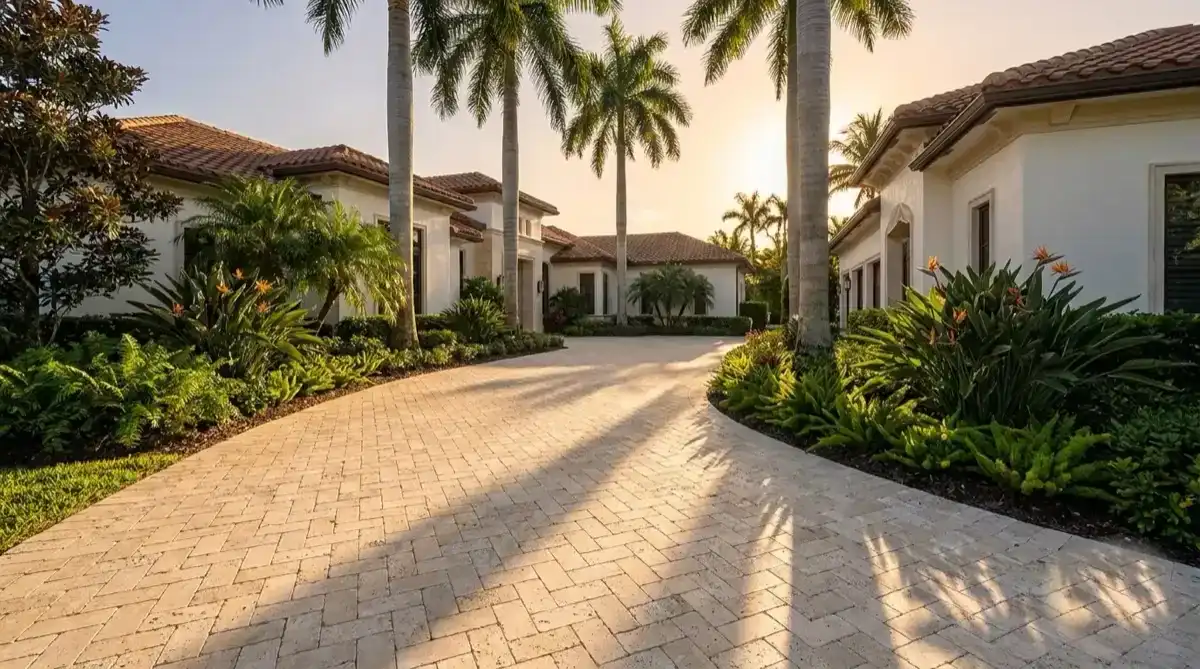
Paver Installation in
Juno Beach, FL
Barrier island dual salt-air engineering, FEMA Zone VE coastal design, sea turtle lighting compliance, and HOA pre-approval for Alicante, Oak Harbour, Ocean Trace, and every gated community on the island.
A Barrier Island With the Most Aggressive Salt Environment in Palm Beach County — and a Sea Turtle Lighting Law Most Contractors Have Never Heard Of
Juno Beach is a barrier island. The Atlantic Ocean is on one side, the Intracoastal Waterway is on the other. Every property — beachfront or not — is simultaneously exposed to salt air from two directions. The practical result: standard polymeric joint sand that works fine in Boca Raton will fail on a Juno Beach installation within a single season. Marine-grade polymeric joint compound is not an upsell in Juno Beach. It is the correct baseline specification, and every competing quote that doesn't include it is quoting you a joint system that won't last.
On the FEMA side, Juno Beach's beachfront properties carry Zone VE designations — the highest-risk category in the National Flood Insurance Program, assigned to areas with wave action during a 100-year flood event. Zone VE properties require engineered base designs that accommodate post-surge paver reset, not removal. Intracoastal-side properties in Zone AE face storm surge risk from the opposite direction. Every Juno Beach project at Craft Pavers begins with a zone verification and drainage design calibrated to the property's specific flood exposure.
And then there's the detail no competitor pages mention at all: Juno Beach is the home of the Loggerhead Marinelife Center, monitoring one of the world's most important sea turtle nesting beaches — an 8.5-mile stretch nesting from March 1 through October 31. Any paver installation with exterior lighting near the beach must use amber LEDs at 560 nanometers or higher, fully shielded, with no upward scatter. We build lighting compliance into the project design, not as an afterthought.
The Juno Beach Paver Challenge
Five forces unique to Juno Beach's barrier island position that destroy standard paver work within 3–5 years. We engineer for each specifically — and disclose the differences before the contract is signed.
| Factor | Juno Beach Reality | Impact on Pavers |
|---|---|---|
| Dual Salt Air (Atlantic + ICW) | Both directions — no 'inland' on a barrier island | Marine-grade polymeric joint compound required on every project |
| FEMA Zone VE (Beachfront) | Wave-action velocity zone; Base Flood Elev. 9–10 ft | Permeable base design; pavers must be resettable post-surge |
| FEMA Zone AE (Intracoastal) | Storm surge from the west during hurricane events | 1–2% grading away from structures; drainage integration required |
| Sea Turtle Lighting Ordinance | March 1–Oct 31 — amber 560nm+ LEDs required near beach | All exterior lighting must be specified at design stage, not after |
| UV Index | 11–12 (Extreme, April–September) | Sealer breakdown, color fade; 18–24 month cycle beachfront |
| HOA / ARC Approvals | 6 gated communities — all require written ARC approval | City permit cannot be filed until ARC approval is in hand |
Marine-grade polymeric joint compound — baseline for every Juno Beach installation — The $0.30–$0.50/sq ft premium over standard polymeric sand extends joint stability from 1–2 seasons to 5–7+ seasons in Juno Beach's dual-salt environment. Beachfront sealing schedule: 18–24 months. Intracoastal and interior island: 2–2.5 years. Written sealing schedule included with every installation.
Sea turtle lighting compliance — built into the project design — Palm Beach County requires amber LEDs at 560nm or higher, fully shielded, with zero upward scatter from March 1–October 31. We specify compliant fixtures at the design stage for every Juno Beach installation with pathway, step, or driveway lighting. FWC enforcement violations require fixture replacement at property owner expense.
Paver Installation Services in Juno Beach
From beachfront travertine patios to Zone VE permeable driveways — each service engineered for Juno Beach's barrier island dual-salt conditions and sea turtle ordinance compliance.
Driveway Paver Installation
Travertine, concrete, and natural limestone driveways with marine-grade polymeric joint compound standard. Proper 1–2% drainage slope and edge restraint with 10-inch spikes at 12-inch intervals. Sea turtle–compliant amber LED driveway edge lighting specified at design stage for beachfront addresses.
Beachfront & Oceanside Patio Pavers
Atlantic-facing patios for Juno Beach oceanfront homes and condominiums. Travertine standard for beachfront patios — cool underfoot, salt-resistant, appropriate for the Juno Beach luxury aesthetic. Zone VE grading designed for post-surge paver reset rather than full replacement. 18–24-month sealing cycle. Sea turtle lighting compliance mandatory.
Pool Deck Pavers
Travertine and porcelain pool surrounds with non-slip matte finish. Salt-chlorine-resistant sealers applied on 18–24-month cycle for oceanfront properties. Non-slip matte finish standard. Drainage graded away from equipment pads. Pool deck lighting specified to comply with turtle ordinance for beach-adjacent installations.
Permeable Pavers (Zone VE / AE)
Open-graded permeable paver systems for FEMA Zone VE beachfront and Zone AE Intracoastal properties. Allows stormwater infiltration rather than sheet runoff. Pavers can be individually reset after storm surge displacement without removing the entire base. Recommended for all beachfront Juno Beach addresses.
HOA Community Installations
Full ARC application packages for Alicante, Cote De La Mer, Oak Harbour, Ocean Trace, Seaview, and 700 Ocean Drive. Scope, scaled drawing, material specs, contractor license, and COI prepared. For beachfront buildings, sea turtle lighting compliance documentation included in ARC package. Permit filed only after ARC approval is in hand.
Outdoor Living & Entertainment Areas
Custom paver outdoor kitchens, pergola surrounds, and entertaining areas for Juno Beach's year-round alfresco lifestyle. Marine-grade joints standard. Lighting designed to amber-LED sea turtle specifications where applicable. Gas line, electrical, and drainage access coordinated with other trades.
Paver Installation Cost in Juno Beach
Installed price includes material, base prep, labor, marine-grade polymeric joint compound, edge restraint, and cleanup. Marine-grade joints are baseline — not an upgrade — on all Juno Beach installations. HOA package prep and NOC recording itemized separately.
| Material | Installed Price / sq ft | Best For | Sealing Cycle |
|---|---|---|---|
| Concrete Pavers | $14 – $21 | Interior island driveways, Crystal Pointe, Juno Shores, Bay Colony | 2–2.5 years |
| Permeable Concrete Pavers | $16 – $23 | Zone VE beachfront, Zone AE Intracoastal, storm-surge-ready design | 2–2.5 years |
| Travertine | $19 – $28 | Beachfront patios, pool decks, Alicante, Ocean Trace, 700 Ocean Drive | 18–24 mo (beachfront) |
| Natural Limestone | $21 – $30 | Premium oceanfront estates, organic coastal-native aesthetic | 18–24 mo (beachfront) |
| Porcelain | $22 – $32 | Premium pool surrounds, outdoor kitchens, zero-porosity finish | 2–2.5 years |
Beachfront and oceanfront properties typically 15–25% above base pricing. Marine-grade polymeric joint compound included in all Juno Beach pricing — no standard sand option. Free on-site estimate required for complete scoping including zone verification.
Why Two Juno Beach Quotes for the Same Square Footage Aren't Comparable
On a barrier island of small lots, courtyards, and shared drives, the paver you choose is rarely the biggest number in the quote. These six factors are what we price at the site visit — and what to look for on anyone else's estimate.
Access and staging
This is the one that separates island quotes. Base material arrives by the ton, and on a compact beachside lot the truck often can't get near the project area. A courtyard patio reached through a gate means every ton of base and every pallet of paving stones moves by wheelbarrow — identical material, considerably more hours. We measure the gate and the route before quoting, not on install day.
Perimeter versus area
Small lots have a high edge-to-area ratio. A townhome courtyard or a narrow side walkway puts far more of the surface up against walls, planters, pool coping, and equipment pads, which means far more cut pavers than an open patio of the same size. Every cut is measured and wet-cut by hand, so the outline drives labor more than the total square footage does.
Demolition and haul-away
Removing an old concrete slab, tired brick, or sod and hauling it off the island is a distinct line item from the excavation that follows. On condominium and townhome properties, disposal often has to be staged around association hours and a designated route, which is a scheduling cost as much as a labor one.
Base depth by load and zone
Coastal sand drains well and holds shape poorly. A walkway and a driveway are not the same build: vehicle loads need a deeper compacted base, and Zone VE beachfront designs use an open-graded base so the surface can be reset after surge rather than demolished. The base spec follows the load and the zone, and it moves the price.
Material tier and joint compound
Concrete pavers to porcelain is roughly a 2x spread per square foot installed. Marine-grade polymeric joint compound sits inside every one of those tiers as a baseline, not an upgrade — $0.30–$0.50/sq ft. A quote that comes in under our concrete range is usually quoting standard joint sand, which is the one specification that will not survive here.
Edges, borders and grade changes
Edge restraint around the full perimeter is standard and already priced in. Soldier-course borders, inlay bands, steps down to a dune walkover, a fire pit surround, or a low retaining wall where the lot falls toward the seawall each carry their own material and labor and are itemized on their own lines.
Neighborhoods We Serve in Juno Beach
From Alicante's gated luxury homes to Juno Shores' oceanfront condos — with local knowledge of every HOA ARC process, flood zone boundary, and sea turtle lighting requirement specific to each address.
ZIP Code Served
Permits, HOA & Compliance — We Handle It All
Juno Beach has more layers than most towns its size
Town of Juno Beach Building Department: 340 Ocean Drive · (561) 626-1122 · permitting@juno-beach.fl.us. Permitting line: (561) 656-0302. NOC threshold: $2,500+. HOA ARC approval must come before permit filing. Beachfront projects may require CCCL coordination with the Florida DEP.
Two Juno Beach Installation Windows — Book Around the Turtle Season and Before Snowbirds Return
Sea turtle nesting runs March 1–October 31. Snowbirds depart May and return October. The two strategic windows: July–September (snowbirds gone, crews available, install complete before October season) or November–February (nesting complete, full lighting installation with no ordinance constraints, project cured before March). Beachfront lighting projects started in April or May face the worst scenario: permit processing delays pushing into nesting season. Plan your Juno Beach installation around these windows — we help you do exactly that.
How We Install Pavers in Juno Beach
Dual salt-air exposure, FEMA Zone VE coastal grading, sea turtle lighting compliance, and HOA sequencing make Juno Beach installations more complex than most contractors expect. Here's what every Craft Pavers Juno Beach project includes.
Site Assessment, Zone & Lighting Review
On-site evaluation: FEMA flood zone designation (VE or AE), salt exposure level by address, HOA status, and sea turtle lighting zone confirmation for beachfront properties. We identify whether planned exterior lighting requires amber LED specification before design is finalized — not after fixtures are purchased.
HOA ARC Submission (If Applicable)
For Alicante, Cote De La Mer, Oak Harbour, Ocean Trace, Seaview, and 700 Ocean Drive: ARC package prepared and submitted with scope, scaled drawing, material specs, contractor license, and COI. For beachfront buildings, sea turtle lighting compliance documentation is included in the ARC package. Permit filed only after ARC approval is in hand.
Permitting & NOC Recording
Town of Juno Beach Building Department permit application filed at 340 Ocean Drive. NOC notarized and recorded with Palm Beach County Clerk for projects at $2,500+ — filed before first inspection is requested. Sunshine State One Call (811) placed before any excavation. Coastal Construction Control Line (CCCL) coordination with Florida DEP for qualifying beachfront projects.
Base Preparation — Coastal Sandy Soil
Juno Beach sits on coastal sandy substrate over limestone bedrock — better draining than inland clay but requiring proper geotextile separation and compacted base depth calibrated to the load type. Zone VE base designs use open-graded aggregate allowing post-surge paver reset. Grading verified at 1–2% slope away from all structures. French drain or dry well where subsurface water is detected near Pelican Lake.
Paver Installation & Marine-Grade Jointing
Marine-grade polymeric joint compound on every Juno Beach installation — no standard sand option. Compound rated for continuous salt-air exposure. Final compaction and surface inspection. Edge restraint with 10-inch spikes at 12-inch intervals. Sea turtle–compliant amber LED pathway and step fixtures installed per design specification.
Sealing Schedule by Salt Exposure Zone
Sealer applied 4–6 weeks post-installation after efflorescence dissipation. Written sealing schedule by zone: 18–24 months for Atlantic-facing beachfront; 2 years for Intracoastal-side and interior island. Pool decks with salt-chlorine systems always on 18-month cycle. Schedule is written, specific to the property's zone, and included with project documentation.
What a Juno Beach Paver Installation Actually Looks Like From Your Driveway
Working on a barrier island is a logistics problem before it is a masonry problem. Lots are small, driveways are shared, condominium and townhome properties come with staging rules and quiet hours, and the ground under all of it is loose coastal sand over limestone. None of that changes what a durable paver system is — excavation, a compacted base, a screeded sand bed, tight joints, a hard edge — but it changes how the days are sequenced and where the hours go. Beachfront work here is also planned around coastal sensitivities, which is why the lighting and the calendar are settled in design rather than discovered on site.
Here is the order of operations we walk homeowners and boards through before anything is signed, so nobody is surprised by which day the noise happens or why the crew spends an afternoon on a layer that ends up buried.
-
Day 1 · Layout & protection
The project area is marked out and the route from the street is protected — pool coping, seawall caps, irrigation heads, and neighbouring sod all get covered before a wheel touches them. Sunshine State One Call (811) has already cleared the excavation. On association properties the staging area, the disposal route, and the working hours are confirmed with management the same morning.
-
Days 1–2 · Demolition & excavation
Old slab, brick, or sod comes out and goes off the island. Then we excavate the full project area to the depth the system needs — base thickness plus the sand bed plus the paver height, deeper under a driveway than under a patio or walkway. On tight lots this is the wheelbarrow phase, and it is the honest reason a compact courtyard can cost more per square foot than an open yard twice its size.
-
Day 2 · Geotextile over the sand
Woven fabric is rolled across the excavated subgrade. Coastal sand is free-draining, which is a gift for stormwater and a hazard for structure: without separation, crushed base material works its way down into the sand and the paver surface settles behind it. The fabric holds the two layers apart and keeps weed growth from finding its way up through the system later.
-
Days 2–3 · Base material, lift by lift
Crushed limerock base is spread and compacted in 2-to-3-inch lifts, with the plate compactor run over each lift before the next is placed. Zone VE beachfront builds use an open-graded base so the surface can be lifted and reset after a surge event rather than jackhammered out. This is the loudest part of the job and the part that determines everything after it.
-
Day 3 · Screeding the bedding sand
A one-inch layer of bedding sand — coarse concrete sand, not fine play sand — is screeded dead level between rails across the compacted base. The crew then stays off it entirely; a footprint in a screeded sand bed becomes a low paver in the finished surface. Corrections around drains, deck drains, and equipment pads are cut in by hand with a trowel.
-
Days 3–4 · Laying, cutting & edge restraint
Pavers are set from a fixed square edge in the approved pattern, working off the laid surface and never off the sand bed. Cut pavers close out the perimeter, the curves, and every wall and coping line — the bulk of the cutting on an island lot. Then rigid edge restraint goes in around the entire perimeter: spiked edging against planting beds, concrete restraint against open ground. Without a hard edge, wind-driven sand and storm wash open the joints and the interlock is finished.
-
Day 4 · Joint compound & final compaction
Marine-grade polymeric joint compound is swept across the paver surface and worked down into every joint. A final compaction pass with a padded plate seats each unit into the bedding layer and drives the compound fully home. Excess sand is cleared with a blower, the joints are misted to activate, and the site — including the route back to the street — is washed down and handed back.
-
Weeks 4–6 · Sealing
Sealer is deliberately not applied on the last day. The surface needs four to six weeks for efflorescence to work its way out, and only then does penetrating sealer go on. That visit is when you receive the written sealing schedule calibrated to your address — 18–24 months on the Atlantic side, two years or a little more toward the Intracoastal and the island interior.
On a Juno Beach Lot, Every New Paver Surface Has to Answer for Its Own Rainfall
Inland, a badly graded patio is an inconvenience — water sits, the sod goes yellow, life continues. On a compact island lot the same mistake has nowhere to go but sideways: into a neighbour's yard, against a townhome foundation eight feet away, or straight down a shared drive into a storm drain that is already taking the whole street. Small lots leave no slack, so drainage gets designed at the same time as the layout rather than corrected afterwards with a trench and an apology.
Slope before anything else
Minimum 1–2% fall away from every structure, verified with a level across the compacted base before the bedding sand is ever screeded. On a narrow lot that fall has to be shaped in three dimensions — away from the house, away from the property line, and toward the point you have actually chosen to send it.
Permeable where the lot is tight
An open-graded permeable build lets rainfall infiltrate through the paver joints and into the base instead of sheeting off the surface. On coastal sand that infiltration is genuinely fast, and on a lot with no room for a swale it is often the only honest answer. It is also the build that resets most easily after surge.
A destination, not just a direction
Sloping water away from the house is half a plan. The other half is where it lands: a dry well, a French drain tied into the low corner, a planted strip of sod that can absorb the volume, or a controlled path to the existing storm drain. We identify the destination at the site visit and put it in the estimate in writing.
Condominium and townhome work carries one more layer: on shared property the drainage design has to satisfy the association as well as the town, because water leaving your patio is landing on common ground. We put the grading plan and the drainage destination into the ARC package alongside the material specifications, which is usually the difference between an approval and a second board meeting.
The Same Installation Seen in Depth, Bottom to Top
The timeline above is the job measured in days — the step-by-step a homeowner watches from the driveway. This is the same job measured in inches — a section through a finished Juno Beach installation, from the sand you started with to the joints you finish with. It is also the most useful thing to read if you are pricing a quote against a DIY patio: the layer you can see is the thin one, and every layer that keeps it flat and locked fifteen years from now is buried beneath it. Anyone deciding whether to build a patio and do it yourself should look at this table rather than at a materials price.
| Layer | Patio or walkway | Driveway or parking | Why it is like this on a barrier island |
|---|---|---|---|
| Subgrade | Excavated clean | Excavated clean, deeper | Roots, old slab and disturbed fill come out. What is left is loose sand — free-draining, and structurally worth nothing until something is built on it. |
| Separation fabric | Woven geotextile | Woven geotextile | Keeps the stone above from migrating down into the sand, and the sand from pumping up into the stone under load. Without it the two layers slowly become one. |
| Paver base | 6 inches compacted | 8–10 inches compacted | Crushed limerock placed in 3″ lifts — we run the plate compactor over each lift before the next is spread. A proper base is the only structural layer in the whole assembly. The fines and rock dust are what lock a dense-graded base together, which is exactly why pea gravel is not a base material. Zone VE beachfront gets an open-graded permeable paving build instead, so a surge can pass through rather than lift it. |
| Bedding | A one inch layer of sand | A one inch layer of sand | Coarse concrete sand, screeded between rails. We level the sand and then nobody stands on it. A deep bed of sand looks like it is fixing an uneven base and is really just postponing the rut. |
| Pavers | 60mm typical | 80mm for vehicle loads | Where we start laying is one fixed square edge; from there we set the pavers off units already down, never off the bedding. Small lots carry a high cut ratio, so we measure and fit the pavers along the tightest boundary before the open field goes in. Of the types of pavers stocked here, a smaller unit is easier to install cleanly into an irregular island footprint than a large-format slab. |
| Edge restraint | Spiked plastic edging or concrete | Concrete restraint | Spiked plastic edging is fine against planting beds and sod; anything carrying a wheel gets a poured concrete restraint. Nothing else will secure the paver field — remove it and wind-driven sand and storm wash open the joints within a season. |
| Joints | Marine-grade compound | Marine-grade compound | Swept in, seated with a final padded compaction pass, cleared with a blower and misted. On this island the joint compound is a baseline specification, not an upgrade. |
Depths are the specification we build to on Juno Beach lots; the site visit confirms them against the actual subgrade, the flood zone, and whether the surface is a patio, a walkway, or a driveway or parking pad.
Paver Materials for Juno Beach's Barrier Island Environment
Material selection depends on flood zone, salt exposure level, HOA guidelines, and project use — every recommendation is specific to Juno Beach's dual-salt conditions.
Travertine
Beachfront Standard · Pools · Oceanfront PatiosThe definitive choice for Juno Beach's Atlantic-facing patios, pool decks, and oceanfront entertaining areas. Travertine's calcium carbonate composition is inherently salt-adapted — it's the material Juno Beach's luxury aesthetic demands and the material most suited to its environment simultaneously. Stays cool underfoot in South Florida's direct summer sun. Sealed with penetrating UV-resistant sealer on an 18–24-month cycle for beachfront exposures; 2-year cycle for Intracoastal side. Marine-grade polymeric joint compound required. Compatible with amber LED pathway lighting for sea turtle compliance. ARC approval is typically straightforward for travertine in all six Juno Beach gated communities.
Porcelain
Premium Pool Surrounds · Outdoor KitchensNear-zero porosity — the highest salt and stain resistance of any paver material. Large-format slabs (24×24, 24×48) create the seamless contemporary surfaces favored in Oak Harbour, Alicante, and Juno Beach's newer premium developments. No salt infiltration means no efflorescence and no joint sand erosion from salt saturation. 2–2.5-year sealing cycle. Requires a laser-leveled, fully stable base — coastal sandy substrate must be properly compacted in lifts before porcelain installation begins. Non-slip matte finishes for pool surrounds. Amber LED lighting compatible.
Concrete Pavers
Interior Island · Driveways · Best ValueThe most cost-effective durable option for Crystal Pointe, Bay Colony, Juno Shores, and interior island streets farther from direct Atlantic exposure. Color-stable, high load-bearing capacity, and readily available for future repairs. Still requires marine-grade polymeric joint compound — there is no property in Juno Beach far enough from the Intracoastal or Atlantic to justify standard sand. 2–2.5-year sealing schedule for interior island locations. Permeable concrete paver upgrade ($2–$3/sq ft) recommended for Zone VE and AE addresses to allow stormwater infiltration and facilitate post-surge paver reset.
Natural Limestone
Premium Oceanfront Estates · Coastal-Native FinishSouth Florida's native stone — inherently adapted to the coastal salt-marine environment and visually appropriate for Juno Beach's barrier island setting. Naturally porous, helping manage stormwater at oceanfront addresses. The coastal-native aesthetic choice for larger Juno Beach oceanfront estate installations where travertine's manufactured finish is not the right match. 18–24-month sealing schedule beachfront. Marine-grade polymeric joint compound required. Coordination with HOA ARC aesthetic guidelines required for governed communities — natural limestone finishes are generally well-received by Juno Beach's architectural review committees.
What Makes Us Different in Juno Beach
Dual Salt-Air Engineering — No Shortcuts
Marine-grade polymeric joint compound is a baseline specification on every Juno Beach project, not a premium option. Any contractor quoting standard polymeric sand in Juno Beach is quoting you a joint system that will fail in one to two seasons. We disclose this before the contract — not after the joints erode.
Sea Turtle Lighting Ordinance Compliance
We specify amber LEDs at 560nm+ with full-cutoff shielding for every Juno Beach project with exterior lighting. Compliance is designed in at the plan stage — not addressed after installation when the only fix is fixture replacement. FWC enforcement violations land on the property owner.
FEMA Zone VE Coastal Base Design
Zone VE base designs in Juno Beach use open-graded aggregate calibrated for post-surge paver reset, not total loss. We verify flood zone designation at the site visit and design the base accordingly — grading, drainage, and permeable system selection all informed by the zone.
Complete HOA ARC Application Packages
All six gated Juno Beach communities — Alicante, Cote De La Mer, Oak Harbour, Ocean Trace, Seaview, and 700 Ocean Drive — ARC applications prepared in full. For beachfront buildings, turtle lighting compliance documentation is included in the package. We coordinate follow-up until approval is in hand.
Written Sealing Schedule by Salt Exposure Zone
Every Juno Beach installation receives a written sealing schedule calibrated to the property's specific salt exposure: 18–24 months beachfront, 2 years Intracoastal side, 2–2.5 years interior island. The schedule is provided in writing with the project documentation — not as a verbal recommendation that gets forgotten.
Free Written Estimate in 24 Hours
On-site assessment with zone verification, salt exposure calibration, HOA status, and sea turtle lighting zone confirmation. Itemized written quote within 24 hours of site visit. No quote-from-photos. No marine-grade surprises added after the contract is signed.
Paver Installation in Juno Beach — Questions Answered
How much does paver installation cost in Juno Beach, FL?
How much is the average cost to install pavers on a small Juno Beach lot?
How do you prepare the ground for pavers in Juno Beach?
Why does dual salt air (Atlantic + Intracoastal) affect Juno Beach pavers differently?
How does the sea turtle nesting season affect outdoor paver lighting in Juno Beach?
Do I need a permit for paver installation in Juno Beach, FL?
What is FEMA Flood Zone VE and how does it affect paver design in Juno Beach?
What paver material is best for Juno Beach's barrier island conditions?
How do HOA approvals work at Alicante, Oak Harbour, Ocean Trace, or Cote De La Mer?
When is the best time to schedule paver installation in Juno Beach?
Why do Juno Beach pavers need sealing more frequently than other Palm Beach County cities?
Does the project cover the planting beds, lighting and low walls around the paving?
Can pavers go over my existing concrete slab or driveway in Juno Beach?
Other Paver Services Near Juno Beach, FL
Existing pavers that need attention? We cover every service category.
Ready to Transform Your Juno Beach Property?
Free on-site estimate. All permits handled. HOA packages prepared. Marine-grade joints standard. Sea turtle lighting compliance built in. Written quote in 24 hours.