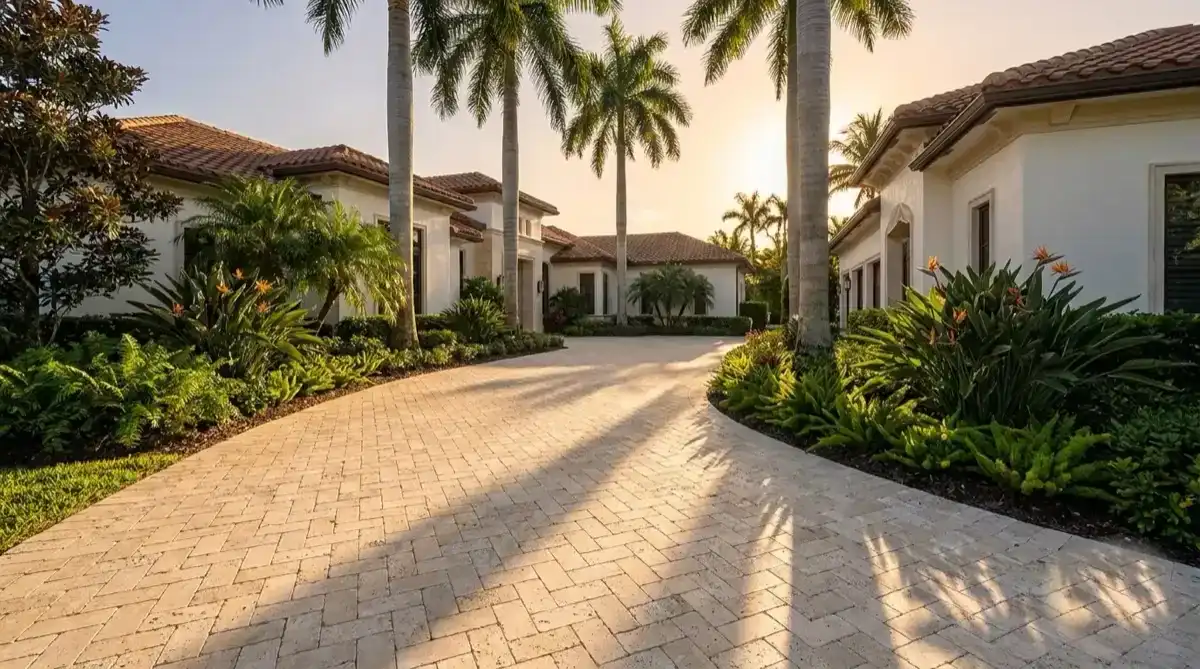
Paver Installation in
Lake Worth Beach, FL
Six historic districts with COA approval, Wycliffe Golf & CC HOA, Journey's End driveways, Parrot Cove flood drainage, Lake Osborne waterfront, and LWDD canal permits. Every project navigated correctly from day one.
Four Distinct Lake Worth Markets — Historic Districts, HOA Communities, Flood Zones, and Waterfront Each Require a Different Approach
Lake Worth Beach (the city officially rebranded from "City of Lake Worth" in 2019) contains six designated historic districts — College Park, Old Lucerne, Northeast Lucerne, Southeast Lucerne, Old Town, and South Palm Park — covering large portions of the city's residential core. Any exterior work in these districts, including driveway and patio paver installation, requires a Certificate of Appropriateness (COA) from the Historic Resources Preservation Board before exterior work begins and before a building permit can be issued. The standard city exemption for projects under $1,000 does not apply in historic districts. Not one competitor page operating in this market mentions the COA requirement. A homeowner in College Park who hires a contractor unfamiliar with this process will face stop-work orders, fines, and mandatory removal at their own expense.
Beyond the historic districts, Lake Worth Beach has three more compliance layers that competitors ignore entirely. Parrot Cove — 600 homes between the Intracoastal golf course and 10th and 13th Avenues North — has a documented 96% severe flood risk from Lake Worth Lagoon king tides, with permeable paver systems the technically correct solution and the city's LDR giving a 50% impervious surface credit for permeable installations. The Lake Worth Drainage District (LWDD), operating ~500 miles of canals, requires its own separate right-of-way permit for any work near canal corridors. And the City of Atlantis, immediately to the south, has its own ARC process and Building Department — entirely separate from Lake Worth Beach's permit system.
The broader Lake Worth service area also includes major HOA communities west and south of the city. Wycliffe Golf & Country Club — fourteen subdivisions, 1,000+ properties in ZIP 33449 — operates its own Architectural Review Committee with material approval lists specific to each subdivision. Journey's End in ZIP 33467, built by Westbrooke Homes between 1999 and 2002, is now 23–27 years into original concrete driveways and pool decks, and the replacement cycle is in full swing. Lake Osborne Estates — 450+ waterfront homes on Lake Osborne with no HOA — requires marine polymeric sand and salt-air-rated materials regardless of distance from the Lagoon. We identify which jurisdiction and which approval track applies to your parcel address before a single permit is filed.
The Lake Worth Beach Climate Challenge
Lake Worth Beach sits directly on the Lake Worth Lagoon — the Intracoastal Waterway — a brackish body connecting to the Atlantic Ocean at the Boynton Inlet. Salt air is citywide, king tides flood documented neighborhoods, and the city's shallow sandy soil over limestone base requires precise base engineering.
| Climate Factor | Lake Worth Beach Reality | Impact on Pavers |
|---|---|---|
| UV Index | 11–12 (Extreme, April–September) | Color fade, surface oxidation, sealer breakdown — UV-resistant penetrating sealer required |
| Annual Rainfall | ~62 inches · Heavy June–September | Joint sand washout, base saturation; LWDD canal levels affect adjacent property drainage |
| King Tides / Lagoon Flooding | Parrot Cove 10th & 13th Ave N documented overflow; 96% flood risk · $500K city mitigation underway | Ponding on standard concrete; permeable systems drain through base — critical for flood-prone addresses |
| Salt Air (Lagoon) | Citywide Intracoastal salt microparticles; brackish water breeze daily | Efflorescence in 2–4 weeks; do NOT seal before 4 weeks; seal every 18–24 months near Lagoon |
| Soil & Base | Sandy soil over Anastasia Formation limestone; 6–8" compacted base required | Excellent drainage when dry; base depth critical for load capacity on Florida's soft subgrade |
| Humidity | 70–75% avg · Peaks Sept–Oct | Mold, mildew, efflorescence accelerated by salt deposits on unsealed historic district brick |
The efflorescence rule every Lake Worth Beach homeowner should know: Efflorescence appears within 2–4 weeks of installation in Lake Worth Beach's combination of salt air and subtropical humidity. This is normal. The critical mistake: sealing too early. Applying sealer before the 4-week mark traps efflorescence permanently beneath the surface. We schedule final sealing 4–6 weeks after installation — not before. Any contractor who seals immediately is creating a problem you'll need to strip and redo.
Permeable pavers and the 50% LDR credit: Lake Worth Beach's Land Development Regulations classify standard pavers as impervious surface. Permeable pavers count at half rate: 2 sq ft of permeable = 1 sq ft of impervious coverage. For Parrot Cove and flood-vulnerable neighborhoods, this creates a direct financial and zoning reason to upgrade. Required off-street parking can legally use permeable pavers in lieu of impermeable paving. No competitor explains this credit.
Journey's End replacement cycle: The Westbrooke Homes community in ZIP 33467, built 1999–2002, is now 23–27 years into original concrete driveways, pool decks, and walkways. Surface cracking, wide joint failure, efflorescence staining, and color loss are endemic across the subdivision. Interlocking pavers on a new compacted aggregate base are the 25–30 year solution — not a patch. If you're in Journey's End and seeing these symptoms, your concrete is at end of serviceable life.
Paver Installation Services in Lake Worth Beach
Driveway Replacement & Upgrade
Serving all residential properties in ZIPs 33460, 33461, 33462, 33463, and 33467. City of Lake Worth Beach permits at portal.lakeworthbeachfl.gov; Palm Beach County Building Division for unincorporated addresses. Journey's End (33467) original concrete driveways built 1999–2002 are entering full replacement cycle. Notice of Commencement filed for all jobs over $5,000. COA process runs concurrently for historic district addresses. 1-foot setback from side and rear property lines applied to all paved surfaces.
Pool Deck Pavers
Lake Worth Lagoon salt air affects pool deck surfaces citywide, not just on waterfront properties. Travertine is the premium choice — natural composition stays cool underfoot in direct Florida sun and resists salt penetration better than concrete. For Wycliffe and Journey's End, we match material and color to community ARC standards to pass architectural review. Sealer applied at the 4–6 week mark after installation — sealing immediately traps efflorescence and is the most common pool deck callback we see from other contractors.
Historic District & COA Installations
College Park, Old Lucerne, Northeast Lucerne, Southeast Lucerne, Old Town, and South Palm Park all require a Certificate of Appropriateness before exterior work begins. We prepare the complete COA submission: material specifications, color samples matching the district's period character, dimensional layout drawings, reference photos, and the exterior alterations checklist required by the Historic Resources Preservation Board. COA and permit applications submitted concurrently. Review cycle typically 30–45 days.
Permeable Paver Systems
Parrot Cove's documented 96% flood risk from Lake Worth Lagoon king tides makes permeable paver systems the technically correct solution — not just an upgrade. Open-grade aggregate base, permeable joint material, and properly engineered drainage slopes let stormwater infiltrate the ground rather than pond on the surface. The city's LDR 50% impervious surface credit means permeable pavers help with lot coverage calculations too. For Parrot Cove addresses near 10th or 13th Avenue North, we assess drainage requirements at the site visit before designing the installation.
Waterfront, Intracoastal & Lake Osborne
Bryant Park, South Palm Park, Oak Haven, and all Lagoon / Intracoastal-adjacent properties require sand-stabilizer polymeric joint compound rated for tidal salt environments. Lake Osborne Estates — 450+ homes on Lake Osborne with no HOA — and Island Estates canal properties require the same marine-grade specification. Porcelain is the recommended surface material for direct Lagoon and Lake Osborne frontage; drainage slopes directed away from seawall foundations on all waterfront installations.
Patio & Outdoor Living
Lake Worth Beach's walkable arts district and Wycliffe's resort lifestyle both drive strong demand for outdoor entertaining spaces. We design paver patios, summer kitchen platforms, fire pit pads, and pergola floors — warm brick tones for historic district properties with COA-approved materials, travertine for pool deck and patio combinations, contemporary porcelain for Intracoastal waterfront homes. For Wycliffe and other HOA communities, all designs are submitted for ARC approval before installation begins.
Paver Installation Cost in Lake Worth Beach, FL
Installed price per square foot, based on 2025–2026 Lake Worth Beach and Lake Worth area projects. Permit fees, COA preparation, and LWDD permits are itemized separately in your written estimate.
| Material | Cost / Sq Ft (Installed) | Best For |
|---|---|---|
| Concrete Pavers | $14 – $20 | Standard residential driveways, patios — most non-historic district properties |
| Permeable Concrete Pavers | $16 – $23 | Parrot Cove, flood-zone addresses — 50% LDR impervious credit, drainage engineering |
| Brick / Clay Pavers | $17 – $24 | Historic districts (College Park, Old Lucerne) — period-appropriate, COA-approvable |
| Travertine | $19 – $27 | Pool decks, Intracoastal waterfront, Lake Osborne — cool underfoot, salt resistance |
| Porcelain Pavers | $21 – $30 | Direct Lagoon-frontage, waterfront — non-porous, optimal for saltwater exposure |
| Marble | $28 – $40+ | Wycliffe luxury entry courts, high-end outdoor spaces |
Historic district projects add 5–10% to total cost for COA preparation and concurrent permit filing. LWDD canal right-of-way permit fees (where applicable) are itemized separately. Notice of Commencement filing for jobs over $5,000 is included — it's required by law and protects your lien rights. Wycliffe and other HOA ARC package preparation is included in project management.
Lake Worth Beach Neighborhoods & Communities
From 1912-era Old Lucerne bungalows requiring COA approval to Wycliffe's 14 HOA subdivisions to Parrot Cove's flood-drainage priority — each neighborhood demands a different approach before a permit is even filed.
College Park Historic District
33460 · 1925–1928 + 1945–1949 · COA required · Mediterranean & Mission Revival
Old Lucerne Historic District
33460 · 1912+ (city's original name) · COA required · Craftsman bungalows
Northeast Lucerne Historic District
33460 · 1915–1952 · COA required · Near Intracoastal
Southeast Lucerne Historic District
33460 · 1915–1952 · COA required · Residential core
Old Town Historic District
33460 · 1912–1949 · COA required · Commercial core + mixed residential
South Palm Park Historic District
33460 · Platted 1925 · COA required · Palm-lined Intracoastal frontage
Parrot Cove
33460 · ~600 homes · 1920s–1960s · No HOA · 96% flood risk · Permeable priority
Bryant Park
33460 · Intracoastal waterfront · Boat launch access · Higher-income residential
Whispering Palms / Pineapple Beach
33460 · No HOA · Ranch homes · Salt-air coastal community
Lake Osborne Estates
33461 · 450+ waterfront homes · No HOA · Marine-grade spec required
Island Estates
33461 · Canal access to Lake Osborne · No HOA · Salt-air installation
Toscana Isles
33461 · Gated · HOA · Paver driveways standard · Community ARC review
Oak Haven
33461 · Gated · Waterfront lots · HOA · Paver driveways noted in listings
Waterside Estates
33461 · 156 townhomes · HOA · Palm Beach County unincorporated
Atlantis (City of)
33462 · Separate city · Own ARC + Building Dept · ARC required before permit
Wycliffe Golf & Country Club
33449 · 14 subdivisions · 1,000+ properties · HOA ARC review
Journey's End
33467 · Built 1999–2002 · 23–27 yr replacement cycle · HOA · PBC unincorporated
Sherbrooke Estates
33467 · 96 units · Mediterranean-style · HOA · Palm Beach County
Also serving all residential properties throughout ZIPs 33460, 33461, 33462, 33463, and 33467. City of Lake Worth Beach permits for incorporated addresses; City of Atlantis permits for Atlantis parcels; Palm Beach County Building Division for unincorporated parcels. We identify your correct jurisdiction by parcel address — not mailing ZIP.
Seven Permit and Approval Layers — Most Contractors Know Two of Them
Lake Worth Beach and the surrounding service area has more overlapping approval authority than any other mid-size South Florida market. Knowing which layer applies to your address before you sign a contract prevents stop-work orders, fines, and forced removal. We map every applicable layer at the free site visit.
- Certificate of Appropriateness (COA) — Mandatory for ALL exterior work in Lake Worth Beach's six historic districts: College Park, Old Lucerne, Northeast Lucerne, Southeast Lucerne, Old Town, and South Palm Park. Issued by the Historic Resources Preservation Board (HRPB) at 7 North Dixie Highway. The city's standard $1,000 exemption threshold does NOT apply in historic districts — any alteration requires a COA. COA and building permit applications must be submitted concurrently; COA must be obtained before exterior work begins. Contact: planning@lakeworthbeachfl.gov | (561) 586-1687.
- HOA Architectural Review Committee (ARC) — Required for Wycliffe Golf & Country Club (all 14 subdivisions), Journey's End, Sherbrooke Estates, Waterside Estates, Toscana Isles, Oak Haven, and all other HOA communities in the service area. ARC approval must precede permit filing. We prepare full ARC packages: specs, material samples, license, insurance. ARC review cycles vary by community — Wycliffe's 14 subdivisions each have their own material approval lists and timelines.
- City of Lake Worth Beach Building Permit — For all properties within the incorporated city. Filed online at portal.lakeworthbeachfl.gov — 'Driveway' is a named permit category. Minimum two inspections: base/foundation before paver laying, final after completion. 1-foot side and rear setback applies to all paved surfaces. Inspection scheduling: lkwo-egov.aspgov.com. Building Division: (561) 586-1647, Mon–Fri 8 AM–4 PM.
- Notice of Commencement (NOC) — Required by Florida law for any project exceeding $5,000 in value. The NOC protects your lien rights and creates a legal record of the project. Contractors who skip the NOC expose homeowners to mechanic's lien risk from subcontractors and suppliers. We file the NOC as part of every project over this threshold — it is not optional.
- Lake Worth Drainage District (LWDD) Permit — For any work near LWDD canal right-of-ways. LWDD operates ~500 miles of canals across southeastern Palm Beach County, completely independent of the city's permit system. Before excavation near any canal: call Sunshine State One Call (811). LWDD permit portal: aca-prod.accela.com/LWDD. We identify LWDD proximity at the site visit and flag required canal permits before any work begins.
- Palm Beach County Building Division — For unincorporated PBC addresses in ZIPs 33461, 33462, 33463, and 33467 (Journey's End, Sherbrooke Estates, Wycliffe, and surrounding areas). This is a separate jurisdiction from the City of Lake Worth Beach. Do not assume city permit rules apply. We identify your permit authority by parcel address — not mailing ZIP.
- City of Atlantis — For Atlantis parcels (ZIP 33462, southern boundary). Atlantis is a fully independent municipality with its own ARC and Building Department. ARC approval required for ALL exterior work before a building permit is issued. Work hours: Monday–Saturday 7:30 AM–6 PM only. If your address is in Atlantis, a Lake Worth Beach permit will be rejected.
Seasonal Homeowners · Lake Worth Lagoon
Book April–October · Be Ready for November Season
Lake Worth Beach's Intracoastal, arts district, and Wycliffe Golf & CC draw seasonal residents from November through April. The optimal project window is April through October: the Historic Resources Preservation Board processes COA applications faster outside peak season, city permit queues are shorter, and your pavers have the full 4–6 week efflorescence window before sealing — plus time to cure before salt air exposure intensifies in late fall. For out-of-state owners, we manage the full project: COA or ARC submission, permit filing, installation, inspection, and final sealing — with photo updates at each stage. You return in November to finished pavers.
Our Lake Worth Beach Installation Process
On-Site Assessment: Jurisdiction, Flood Zone, HOA & Approval Track
We visit your property, measure the project area, assess proximity to the Lake Worth Lagoon (determines jointing compound, sealer spec, and permeable paver recommendation), identify your permit authority (City of Lake Worth Beach, City of Atlantis, or Palm Beach County), confirm whether your address is within one of the six historic districts requiring a COA or an HOA community requiring ARC approval, and flag any LWDD canal right-of-way proximity. Written estimate within 24 hours.
HOA ARC or COA Submission — Day One
For Wycliffe Golf & Country Club (all 14 subdivisions), Journey's End, Sherbrooke Estates, and other HOA communities — we prepare and submit the full ARC package immediately after estimate approval: material specs, samples, contractor documentation, insurance. For historic district properties (College Park, Old Lucerne, NE/SE Lucerne, Old Town, South Palm Park) — we prepare and submit the Certificate of Appropriateness package concurrently with the building permit application. Both tracks must be completed before installation begins. We start on Day 1.
Building Permit Filing & LWDD Check
City of Lake Worth Beach permit filed via portal.lakeworthbeachfl.gov; Palm Beach County Building Division for unincorporated addresses (Journey's End, Sherbrooke Estates, Wycliffe). Notice of Commencement filed for all jobs over $5,000. For Atlantis properties, separate permit filed with the Atlantis Building Department after ARC approval. LWDD right-of-way permit filed at aca-prod.accela.com/LWDD if canal proximity was flagged at site visit. Sunshine State One Call (811) placed before excavation begins.
Base Preparation & Installation
Existing concrete or asphalt removed and hauled. Subgrade leveled and graded for drainage — Parrot Cove and flood-zone properties receive drainage engineering for permeable systems; Lake Osborne and Intracoastal waterfront properties receive marine-grade jointing compound. 6–8" compacted aggregate base installed on Florida's sandy subgrade. Pavers set in approved pattern, cut to perimeter, compacted. Base inspection scheduled and passed before paver laying begins.
Final Inspection, 4–6 Week Cure, Then Sealing
Final building inspection scheduled and passed. Sealer application deliberately scheduled 4–6 weeks after installation — not immediately. This allows efflorescence (the natural white salt migration common in Lake Worth Beach's Lagoon microclimate within 2–4 weeks of installation) to dissipate from the surface before sealing. Sealing too early permanently traps efflorescence beneath the surface. UV-resistant, salt-rated penetrating sealer applied at the correct cure point. Walkthrough with drainage performance and joint integrity verification included.
Base Preparation and Pattern Scale on Lake Worth Beach's Narrow Historic Lots
The downtown historic districts are built out in 1920s-era bungalows and cottages on lots that were platted for one narrow car, a strip of grass, and a front porch. That geometry drives two things most contractors treat as afterthoughts here: how the base gets built when a machine barely fits down the side of the house, and how the pattern is scaled so a period streetscape doesn't end up with a driveway that looks like a shopping-center entry. Both are decided long before the first paver is set.
Excavation Around Old Houses and Old Roots
We excavate the full project area to the depth the finished system needs — base thickness plus sand bed plus paver height, roughly 7–9 inches of total dig for a patio or walkway and deeper for a driveway. On a 1920s lot that dig runs past mature root systems, original walk slabs, and a foundation that predates modern setbacks, so the last foot next to the house is opened by hand rather than by machine. Whatever the previous surface was comes out and gets hauled; nothing gets paved over. Getting the excavation uniformly graded at this stage is what makes every layer above it accurate.
Subgrade, Geotextile & the Beach-Side Split
Lake Worth Beach's subgrade is sandy soil over the Anastasia limestone formation. On the barrier-island side and the blocks nearest the Lagoon, that sand is looser and wetter, and we lay woven geotextile separation fabric across the excavated subgrade so the crushed base can't work its way down into it over successive wet seasons. Inland of the Dixie corridor the ground is firmer and a standard base build performs well without the fabric. We confirm at excavation, looking at the actual soil, instead of applying one spec across a city with two very different sides.
Base Material, Compacted in Lifts
Crushed limerock base material is placed to 6–8 inches under patios and walkways and 8–10 inches under driveways, in two-to-three-inch lifts, with the plate compactor run across each lift before the next goes in. On narrow historic lots this is often a walk-behind compactor working within a nine-foot width, which means more passes and more overlap to reach the same density a wide-open driveway gets easily. A base dumped at full depth and compacted once leaves soft pockets that surface as dips two or three seasons later — the single most common cause of the settled, wavy driveways we get called out to look at.
Screeding the Bedding Sand
A one-inch layer of bedding sand — coarse concrete sand, not fine play sand — is screeded dead level between rails across the compacted base. The pavers seat into this sand bed, so once we level the sand nobody walks it; a footprint in a screeded bed becomes a low paver in the finished surface. Corrections around downspout outlets, old service lines, and porch steps are made by hand with a trowel. On sloped historic lots we hold the screed to a consistent fall so the finished surface sheds water toward the street rather than the crawlspace.
Pattern Scale for a 1920s Streetscape
This is where historic-district work diverges from a new-build subdivision. A large-format contemporary paver on a narrow bungalow driveway is out of scale with the house and with the block — it reads as a modern slab dropped in front of a 1926 cottage, and it generates a cut on nearly every course. Clay tones and warm earth colors in a simple running or herringbone bond sit correctly against the period architecture, cut cleanly at a nine-to-ten-foot width, and give the HRPB a submission consistent with the district's character. We mock the pattern to the actual driveway width before ordering material.
Cut Pavers, Borders & the Perimeter
Narrow lots are cut-heavy work. Every perimeter, every border course, every curve around a planting bed or a meter box is measured and wet-cut individually, and on a tight downtown driveway the cut pieces can be a quarter of the surface. Cuts are made full-depth and set so the sawn face is turned away from view wherever the layout allows. A soldier-course border laid around the field, then cut into, hides the variance an old out-of-square lot always contains — which is why we run one on nearly every historic-district installation.
Edge Restraint, Joint Sand & Final Compaction
A rigid edge restraint is installed around the entire perimeter — spiked plastic edging along planting beds and sod, concrete restraint where the paver area meets open ground. Without a hard edge the outside courses migrate, joints open, and the interlock that gives the surface its load capacity is lost. Polymeric joint sand is then swept into every joint and the plate compactor is run across the finished surface, seating each unit into the bedding layer and driving sand up into the joints. Excess sand comes off with a blower, the joints are misted to set, and the locked joints resist weed growth and king-tide washout. Sealing waits the full 4–6 weeks.
Material choice is a streetscape decision here, not only a durability one: Lake Worth Beach is an arts town with an intact early-twentieth-century core, and the same clay-toned brick and simple bond that sails through a Certificate of Appropriateness review is also the choice that makes a cottage look like itself. On the beach side, salt exposure narrows the material list and shortens the sealing interval; a few blocks inland, neither constraint applies and the field is wide open. We bring samples to the site visit and lay them against the house before anything is specified — the color reads completely differently in Florida sun than it does in a showroom.
Where a DIY Patio Works in Lake Worth Beach — and Where It Stops Being Worth It
A capable homeowner can build a patio in the back garden of a Lucerne bungalow without us, and we would rather say so than sell work nobody needs — a small diy patio on a level rear lot is a real weekend project. The step-by-step is no secret: mark out the project area, excavate, build a proper base, screed a bed of sand, lay the pavers, and lock the joints. What separates a surface that holds for twenty years from one that ripples after two rainy seasons is not skill with a rubber mallet — it is whether every one of those layers was actually built to depth.
Material comes first, because the types of pavers a local supplier will sell you behave very differently under hand tools. Small-format clay brick and ordinary concrete paving stones are far easier to install for a first-timer: they fit the pavers into a narrow, out-of-square 1920s yard with fewer cuts, and a single unit sitting a hair proud disappears into the texture. Large-format contemporary units look simpler and are not — one out-of-level piece telegraphs across the entire paver surface, and on a downtown lot they also read wrong against the house.
Then the paver base, which is the whole job. Under a walkway or patio you want a minimum of 6 inches of compacted crushed gravel over the excavated subgrade, placed in 3″ lifts, and you run the plate compactor across each lift until the stone stops moving underfoot. Rent the machine; hand-tamping does not build a stable base. Over that goes a screeded one inch layer of sand, held between rails and struck flat. Set the pavers straight down into that layer of sand without ever walking the screeded bed, start laying from the straightest edge you have, and check the lines every few courses rather than at the end.
Once the pavers are laid the field still has to be tied together. Edge restraint around the perimeter is there to secure the paver courses along planting beds and sod — skip it and the outer rows creep outward, the joints open, and the interlock that carries load is gone. Polymeric sand goes into the paver joints, the compactor runs the finished surface once more, and the loose sand is blown clear before the joints are misted to set. Cut work is wet-cut, both for a clean edge and to keep silica dust out of the air on a tight lot where the neighbour's windows are fifteen feet away.
Where we tell Lake Worth Beach homeowners to stop: anything carrying a car. A driveway or parking apron needs a deeper base, a permit, and inspections, and it is the single most common failed weekend project we get called out to rebuild. Grade changes that need wall blocks or a retaining wall are structural work, not landscaping. Anything near a storm drain, an irrigation pipe, or the old service lines threaded under downtown parcels wants an 811 locate and a professional excavation. And in the six historic districts the calculus changes entirely — a wood-framed 1926 cottage with a Certificate of Appropriateness on file is not the place to learn, because a non-conforming surface has to come out again with the board's sign-off before it can be replaced.
Choosing the Right Material for Lake Worth Beach's Conditions
Historic Districts · Period-Appropriate · COA-Approvable
Brick / Clay Pavers
The first-choice material for College Park, Old Lucerne, and South Palm Park historic district driveways and walkways. Brick pavers are kiln-fired, maintain warm earthy tones under Florida UV without heavy sealer dependency, and match the period character of Lake Worth Beach's 1912–1949 housing stock that the HRPB is charged with protecting. For COA applications in historic districts, brick typically passes HRPB review — it aligns with design guidelines emphasizing traditional materials. Higher porosity than porcelain requires the 4-week efflorescence rule and proper salt-air sealing schedule.
Standard Residential · Driveways · Wycliffe & HOA Communities
Concrete Pavers
The cost-effective standard for non-historic district residential driveways and patios — and the dominant material in Wycliffe Golf & Country Club and Journey's End HOA communities. Most ARC approval lists include standard concrete paver products in the approved material library. High-density concrete pavers limit salt absorption — the best overall coastal performer at this price point. UV-resistant sealer every 2–3 years; marine polymeric sand for Lagoon-adjacent installations. Notice of Commencement required for full driveway projects exceeding $5,000.
Pool Decks · Intracoastal Patios · Lake Osborne Waterfront
Travertine
Natural travertine stays cool underfoot in direct Florida sun — the reason it dominates the premium pool deck and patio market in Lake Worth Beach's waterfront neighborhoods. Warm natural tones suit the Intracoastal character of Bryant Park and South Palm Park, and Lake Osborne waterfront properties. Salt penetration resistance is better than concrete but requires sealing every 18–24 months for Lagoon-adjacent properties — at the 4–6 week mark after installation, not before.
Direct Lagoon-Frontage · Maximum Salt Resistance
Porcelain Pavers
The correct choice for direct Lake Worth Lagoon and Lake Osborne frontage properties in Bryant Park, Oak Haven, Toscana Isles, and Lake Osborne Estates. Porcelain is fully non-porous — salt cannot penetrate the surface to crystallize and cause damage. Efflorescence is not possible on porcelain, eliminating the 4-week sealing wait entirely. Large-format porcelain (24"×24" and 24"×48") suits the contemporary aesthetic of Lake Worth Beach's waterfront renovation market. Higher upfront cost, significantly lower 10-year maintenance cost on direct Lagoon and lake exposure.
Lake Worth Beach Paver Installation FAQ
Frequently Asked Questions
How much does paver installation cost in Lake Worth Beach, FL?
What is a Certificate of Appropriateness (COA) and do I need one in Lake Worth Beach?
What makes historic district paver installation different in Lake Worth Beach?
Do I need both HOA approval AND Historic Preservation Board approval?
What permit authority covers my Lake Worth property — City of Lake Worth Beach or Palm Beach County?
How does Parrot Cove's flooding affect paver installation in Lake Worth Beach?
What is the Lake Worth Beach permit process for driveway and patio pavers?
What is the Lake Worth Drainage District (LWDD) and does it affect my paver project?
Does Atlantis have different paver permit requirements than Lake Worth Beach?
How does Lake Worth Lagoon salt air affect paver maintenance and sealing?
Can you lay pavers directly on dirt in Lake Worth Beach?
How do you prepare the ground for pavers in Lake Worth Beach?
How much would a 20x20 paver patio cost in Lake Worth Beach, FL?
Ready to Start Your Lake Worth Beach Paver Project?
We handle the Certificate of Appropriateness for historic districts, HOA ARC packages for Wycliffe and Journey's End, LWDD canal permit check, city and county permit filing, and the correct sealing schedule for Lake Worth Lagoon salt air. Written estimate within 24 hours of your free on-site assessment — no obligation.
More Paver Services in Lake Worth Beach