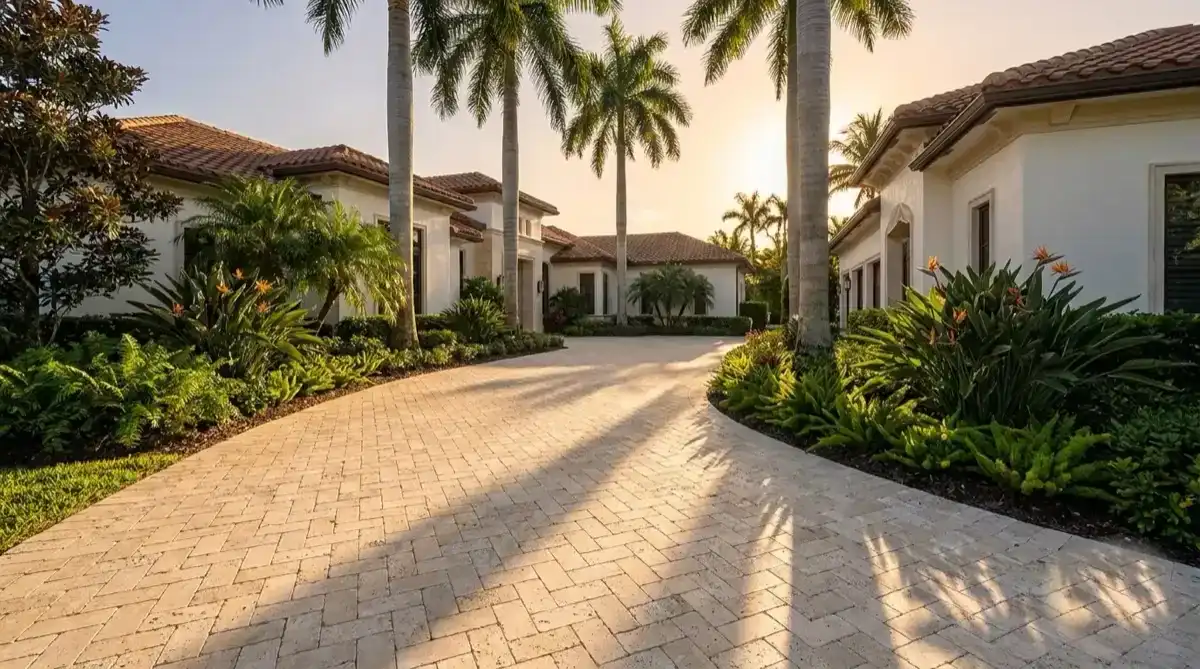
Paver Installation in
Lantana, FL
Intracoastal salt-air expertise, Lake Osborne muck soil drainage, and Hypoluxo Island jurisdiction navigation — the details Lantana homeowners need and most contractors skip.
Three Distinct Lantana Markets — Each Requires a Different Approach
Lantana is a small Intracoastal town with three completely different installation environments compressed into fewer than 3 square miles. Waterfront communities like The Moorings, Island Towers, and Hypoluxo Island sit within constant salt-air range of the Intracoastal Waterway — every installation there requires marine-grade polymeric joint compound and a strict 2-year sealing schedule that most contractors never mention. One block inland, the picture changes entirely.
East-central Lantana properties around Lake Osborne sit atop muck soils — decomposed organic material with no structural bearing capacity — with a water table that rises to within 2–3 feet of the surface during wet season. No amount of skilled paver laying fixes a base built on unaddressed muck. Every Lake Osborne–area project at Craft Pavers starts with a drainage assessment and muck evaluation before any quote is finalized. And for Hypoluxo Island — where median home values exceed $2.1 million — the permit complexity adds another layer: the island is split between Lantana and Manalapan jurisdictions, and filing with the wrong building department means starting over.
Craft Pavers knows the permit contact, HOA review timeline, soil condition, and correct sealing schedule for every Lantana address type. That local knowledge is why our installations last — and why our customers don't get surprised by stalled permits or failing joints after year three.
The Lantana Paver Challenge
Three environmental forces in Lantana destroy standard paver work within 3–5 years. We engineer for each specifically — and disclose the differences before the contract is signed.
| Factor | Lantana Reality | Impact on Pavers |
|---|---|---|
| Intracoastal Salt Air | Nearly every property within 1 mile — all areas exposed | Joint sand erosion, efflorescence, surface spalling; 2-yr sealing required |
| UV Index | 11–12 (Extreme, April–September) | Color fade, sealer breakdown, polymeric sand degradation |
| Annual Rainfall | 57 inches · Rainy season June–Sept | Water table rises near Lake Osborne; surface ponding on muck soil |
| Lake Osborne Water Table | 2–3 ft below surface in wet season (east-central Lantana) | Muck soil heave, paver settlement, joint gaps — requires deep drainage |
| FEMA Flood Zones | A-7 and V-8 along Intracoastal corridor and shoreline | 1–2% grading mandatory; permeable materials recommended for compliance |
| HOA / Condo Approval | The Moorings, Island Towers, Waterway Club, La Coquille, Ocean Walk — all require ARC review | 7–30 day pre-permit delay if package is incomplete or submitted out of order |
Marine-grade polymeric joint compound — Every Intracoastal-adjacent installation we complete specifies marine-grade joint compound rated for continuous salt-air exposure. The $0.30–$0.50/sq ft premium over standard polymeric sand extends joint stability from 2–3 seasons to 5–7 seasons. It is the single highest-impact upgrade available on any Lantana waterfront installation.
Sealing schedule by location — We provide a written sealing schedule with every Lantana installation: 2-year cycle for Intracoastal-adjacent properties, 2.5–3 year for Lake Osborne–adjacent, 3-year for inland Lantana. Pool decks using salt-chlorine systems always seal on a 2-year cycle. The 4-week post-installation wait for efflorescence dissipation applies to all projects.
Paver Installation Services in Lantana
From Hypoluxo Island luxury estates to Seminole Manor driveways — each service engineered for Lantana's coastal and inland conditions.
Driveway Paver Installation
Concrete, travertine, and oolitic limestone driveways with proper 1–2% drainage slope and geo-textile base preparation. Seminole Manor and Lantana Heights wide-clearance driveways for boat trailers standard. Deep base (8–12 in.) for any muck-soil areas near Lake Osborne.
Pool Deck Pavers
Travertine and cool-touch porcelain pool surrounds. Salt-chlorine-resistant sealers applied every 2 years. Non-slip matte finish standard. Drainage graded away from equipment pads to prevent ponding.
Intracoastal Waterfront Patios
The Moorings, Waterway Club, Mango Villas, and Intracoastal-front homes. Marine-grade polymeric jointing standard. 2-year sealing cycle. Full HOA application package prepared and submitted for governed communities.
Hypoluxo Island Luxury Installations
Island-grade travertine and natural limestone for Lantana and Manalapan jurisdiction properties. Jurisdiction confirmed by parcel data at site visit. Condo and co-op board approval packages prepared. Median home value $2.1M — ultra-high-end specifications standard.
Permeable Pavers (Flood Zone & Lake Osborne)
Oolitic limestone permeable pavers for FEMA flood zone A-7/V-8 addresses and Lake Osborne–adjacent properties. Meets Lantana stormwater requirements. Reduces impervious surface coverage. Drainage system integrated into base design.
Outdoor Patio & Entertainment Areas
Custom paver patio designs for outdoor kitchens, pergola surrounds, and entertaining spaces. Seamless indoor-outdoor flow for Lantana's year-round lifestyle. Gas line, electrical, and drainage access coordinated with other trades.
Paver Installation Cost in Lantana
Installed price includes material, base prep, labor, polymeric sand or marine-grade joint compound, edge restraint, and cleanup. Muck soil remediation, HOA package prep, and NOC recording itemized separately.
| Material | Installed Price / sq ft | Best For | Sealing Cycle |
|---|---|---|---|
| Concrete Pavers | $14 – $20 | Inland driveways, Lantana Heights, Seminole Manor | 3 years |
| Permeable Oolitic Limestone | $15 – $22 | Flood zone, Lake Osborne area, stormwater compliance | 2.5–3 years |
| Travertine | $18 – $26 | Intracoastal waterfront patios, pool decks, Hypoluxo Island | 2 years (ICW) |
| Porcelain | $21 – $30 | Premium pool decks, outdoor kitchens, high-end entertaining | 2–3 years |
| Natural Limestone (Premium) | $22 – $34+ | Hypoluxo Island luxury estates, La Coquille, Manalapan properties | 2 years |
Waterfront and Hypoluxo Island properties typically 10–18% above base pricing. Muck soil remediation near Lake Osborne adds $1,500–$4,000 depending on depth and footprint. Free on-site estimate required for complete scoping.
Neighborhoods We Serve in Lantana
From Hypoluxo Island's ultra-luxury barrier island estates to Seminole Manor's no-HOA driveways — with local knowledge of every jurisdiction split, HOA ARC process, and soil condition.
ZIP Codes Served
Permits, HOA & Compliance — We Handle It All
Lantana has more approval layers than most towns
Lantana's Building Department is at 504 Greynolds Circle · (561) 540-5000 · buildingpermit@lantana.org. Payment accepted by cash, check, or money order only — no credit cards. Permit review: 7–14 business days. NOC threshold: $2,500+. For Hypoluxo Island, jurisdiction must be confirmed before any permit is filed — northern 2/3 is Lantana, southern 1/3 is Manalapan.
Lantana's Waterfront Communities Fill Up October–April — Book Before They Return
The Moorings, Hypoluxo Island, and Intracoastal-front communities see seasonal residents return October through April. HOA boards are actively meeting through summer, permit processing is faster May–September, and crews are available. The optimal window: book May–October, install during the off-season, and have your finished outdoor living space ready before the first winter guests arrive.
How We Install Pavers in Lantana
Salt-air exposure, muck soil, flood zone grading, and the Hypoluxo Island jurisdiction split make engineering and permitting steps that inland installs never encounter. Here's what every Craft Pavers Lantana project includes.
Site Assessment, Soil & Jurisdiction Check
On-site evaluation: soil type (muck vs. sandy fill), water table depth, flood zone designation (A-7/V-8), HOA status, and Hypoluxo Island jurisdiction confirmation by parcel data. Lake Osborne–area properties receive a drainage assessment before base design is finalized.
HOA ARC Submission (If Applicable)
For The Moorings, Island Towers, Waterway Club, La Coquille, and Village at Ocean Walk: ARC package prepared and submitted with scope, scaled drawing, specs, contractor license, and COI. City permit filed only after ARC approval is in hand — never simultaneously.
Permitting & NOC Recording
Lantana Building Department permit application: 2 paper copies + 1 digital copy. NOC notarized and recorded with Palm Beach County Clerk for projects at $2,500+ threshold — filed before first inspection, not after work begins. Sunshine State One Call (811) placed.
Muck Removal & Drainage Engineering
Lake Osborne–area: muck removed 12–24 in. and replaced with compacted fill before base stone goes down. French drain or dry well installed where subsurface water is detected. Grading verified at 1–2% away from all structures and toward designed drainage outlets.
Base Preparation & Compaction
Geo-textile weed and separation fabric on prepared subgrade. Compacted base stone in 2-inch lifts. Edge restraint installed with 10-inch spikes at 12-inch intervals. Base inspected at required depth before bedding layer and paver placement.
Paver Installation, Jointing & Sealing Schedule
Marine-grade polymeric joint compound on all Intracoastal-adjacent projects; standard high-quality polymeric sand on inland properties. Final compaction and surface inspection. Sealer applied 4–6 weeks post-installation. Written sealing schedule provided by property salt-exposure rating.
Base Preparation in Lantana: Small Lots, Tight Access, and the Work Nobody Sees
Lantana is barely three miles wide between the Intracoastal and the ocean, and it was platted long before anyone owned a skid steer. Compact lots, older Florida homes sitting close to their property lines, and side yards you can touch both fences in — that geometry changes how a paver project is physically run here, well before anyone talks about material. The pavers are the last fifth of the job. Everything that decides whether the surface is still flat and interlocked in year fifteen happens underneath, and on a Lantana lot it happens the hard way.
Access Survey & Equipment Staging
The first thing we measure on a Lantana job usually isn't the patio — it's the gate. On Hypoluxo Island and in the waterfront pockets off East Ocean Avenue, three-to-four-foot side yards, mature sea grape hedges, and seawall setbacks mean a machine often can't reach the back of the property at all. That decides how base material arrives: by mini loader, or by wheelbarrow one load at a time across protected sod. It also decides which plate compactor fits through the gate and where the excavation spoil sits while the job runs. We walk that route before quoting, because two hundred feet of hand-carting is real labor and it belongs on the estimate, not in a surprise.
Excavation to Engineered Depth
We excavate the whole project area — sod, roots, old slab, and any unsuitable soil — to the depth the finished system needs: base thickness plus sand bed plus paver height. A patio or walkway works out to roughly seven to nine inches of total dig; a Lantana Heights or Seminole Manor driveway sized for a boat trailer goes deeper, because axle loads are carried by base depth and nothing else. On compact lots the dig frequently runs to a fence line or a neighbor's parcel, so we cut the perimeter clean rather than undermining an edge we'd have to rebuild.
Geotextile Where the Water Table Is High
East of Dixie Highway, toward the Intracoastal and the older waterfront streets, the subgrade is loose coastal sand that moves once the wet-season water table saturates it. On those parcels we roll woven geotextile fabric across the excavated subgrade before any base material goes down, so the crushed rock can't slowly punch into and mix with the sand below — because when the base migrates, the paver surface follows it. Inland Lantana, west of Dixie on stable sandy fill, generally doesn't need the fabric. We confirm at excavation, when the actual soil is visible, not from a map.
Base Material, Compacted in Lifts
Crushed limerock base material goes in next: a minimum of 6 inches under a patio or walkway, 8 to 10 inches under a driveway, deeper on saturated coastal sites. We place it in two-to-three-inch lifts and run the plate compactor over every lift before the next one is added. Dumping the full depth and compacting once looks identical on the day and leaves soft pockets that telegraph into dips a few seasons later. More passes per lift is slower work, and it is the only route to a genuinely stable base.
Screeding the Sand Bed
Over the compacted base we screed a one-inch layer of bedding sand — coarse concrete sand, never fine play sand — pulled dead level between screed rails. This sand bed is what the pavers actually seat into, so once we level the sand, nobody walks on it; a bootprint in the screeded bed becomes a low paver in the finished surface. Around pool equipment pads, hose bibs, and drain penetrations, the small corrections are made by hand with a trowel rather than dragged through with the screed.
Pattern Scale & Cut Pavers on a Compact Lot
We start laying from a fixed square edge and work off the laid surface, never off the sand bed. Scale matters more here than on a big inland lot: on a twelve-by-fourteen courtyard behind an older Lantana cottage, an oversized contemporary format reads wrong and forces a cut paver on nearly every edge. A smaller unit in a tighter bond fits the house and cuts the waste. Perimeter pieces, borders, and curves around planters are measured and wet-cut individually — a clean cut line at the perimeter is the difference between a finished patio and an obviously improvised one.
Edge Restraint — The Step Most Failures Trace Back To
A rigid edge restraint goes around the entire perimeter: spiked plastic edging where the paver area meets planting beds and sod, a concrete restraint where it meets open ground or a seawall apron. Without that hard edge the outer courses creep outward under load, joints open, and the interlock that gives the whole system its strength is gone within a couple of wet seasons. On the salt side of town we specify corrosion-resistant spikes — a galvanized spike two blocks from the Intracoastal has a shorter service life than the pavers it is holding in place.
Joint Sand & Final Compaction
Joint sand is swept across the surface and worked down into every paver joint — marine-grade polymeric compound on Intracoastal-adjacent and Hypoluxo Island work, standard high-quality polymeric sand on inland Lantana. We then run the plate compactor across the finished paver surface, with a protective pad on travertine and porcelain, so the final compaction seats each unit into the bedding layer and drives sand fully up into the joints. Excess sand is cleared with a blower before the joints are misted and set. Locked joints are what block weed growth and the joint washout that plagues loose swept-sand installations.
Why access belongs in the conversation early: two Lantana patios of identical size and identical material can be genuinely different jobs — one with a driveway a loader can back down, one where every wheelbarrow of base material crosses a lawn and turns a corner between a fence and an air handler. Neither is a problem; only one of them is a problem when it shows up as a change order halfway through. We measure the access route at the site visit, tell you which job yours is, and price it that way from the start.
Fire Pit Surrounds, Low Walls and the Details That Have to Go In First
A Lantana back yard is rarely a clean rectangle. The paved area has to share a few hundred square feet with a grill run, a planting bed, an air handler pad, and whatever grade the original builder walked away from — so we design the hardscape as one surface with things built into it, rather than a slab with objects parked on top. Three of those decisions have to be made before the base goes in, because retro-fitting any of them means lifting pavers and rebuilding a strip of base.
Fire pit surrounds and seating clearance
A fire pit is a paving detail, not an accessory dropped on afterwards. The units around it are cut to a radius, the base beneath carries the same depth as the rest of the patio, and on a courtyard this size the seating clearance around it is what decides where the patio boundary lands. We usually ring the surround with a soldier course in a contrasting paving stone so the circle reads as intentional, and we keep it off the main walking line so the space still works the eleven months a year nobody lights it.
Low walls where the lot changes grade
Older lots east of Dixie Highway often sit a foot or more above the swale, and that fall has to be resolved by something other than hope. A low retaining wall of segmental wall blocks holds the grade, doubles as seat height at around 18 inches, and gives the paved area a finished boundary instead of a raw slope shedding fill into the lawn every wet season. Walls get their own compacted footing and go in before the patio base, so the two systems are never fighting each other for the same ground.
Sleeves, lighting and the landscape edge
Anything that has to cross under the finished surface goes in before base material does: irrigation pipe, a plastic conduit sleeve for landscape lighting, a gas line out to the grill. We mark those runs at design stage, sleeve them under the base, and then re-lay sod tight against the edging so the landscaping closes the seam between hardscape and lawn instead of leaving a two-inch trench of dead grass around the whole job.
Where the patio meets a driveway or parking apron
In Seminole Manor and Lantana Heights, a walkway or side patio frequently ties into a driveway or parking apron sized for a boat trailer. The two surfaces need different base depths — vehicle loads are carried entirely by base thickness — but they should share one continuous, level transition rather than meeting at a seam that opens. We run a soldier course set over a concrete restraint through that junction so the vehicle side cannot push into the pedestrian side. On a flood-zone address, a parking apron is also the easiest place to use permeable paving — rainfall infiltrates instead of running to the swale and the street storm drain, and the added area stays off the impervious-surface calculation.
One small-lot courtesy that is really a work rule: on Lantana lots the neighbour's window is often fifteen feet from the cut station, so pavers are wet-cut on a saw rather than dry-cut with a grinder. It is slower, and it keeps silica dust off the screen enclosure next door and out of the pool. The same reasoning applies to the wash-down at the end of each day — a compact lot has no back forty to hide a spoil pile or a rinse puddle on.
Paver Materials for Lantana's Coastal Environment
Material selection depends on Intracoastal proximity, soil conditions, flood zone status, and HOA aesthetic guidelines — not just budget.
Travertine
Intracoastal Waterfront & Hypoluxo IslandThe preferred finish for The Moorings, Island Towers, and Hypoluxo Island luxury estates — and the material that complements Lantana's waterfront aesthetic most naturally. Travertine stays cool underfoot in direct South Florida sun, is highly salt-resistant when properly sealed, and meets the aesthetic guidelines of Lantana's most demanding HOA communities. Intracoastal-adjacent properties: 2-year sealing cycle required. Do not apply sealer until 4–6 weeks post-installation (efflorescence must dissipate first).
Oolitic Limestone (Permeable)
Lake Osborne Zone & Flood Zone ComplianceSouth Florida's native stone — naturally adapted to the coastal climate and inherently porous. Permeable oolitic limestone helps meet Lantana's stormwater management requirements for properties in flood zones A-7 and V-8, and is the recommended material for Lake Osborne–adjacent installations where reducing impervious surface coverage matters. Moderate salt resistance makes it suitable for most of Lantana's waterfront-adjacent (but not directly waterfront) properties on a 2.5–3 year sealing cycle.
Concrete Pavers
Inland Lantana · Best ValueThe most cost-effective durable option for Lantana Heights, Seminole Manor, and other inland residential areas. Color-stable, high load-bearing capacity, and wide availability for future repairs on large driveways. Standard high-quality polymeric sand joint sufficient for inland Lantana's reduced salt exposure. 3-year sealing cycle. Upgrade to marine-grade polymeric compound is recommended even for concrete installations within one mile of the Intracoastal — the $0.30–$0.50/sq ft premium dramatically extends joint life.
Porcelain
Premium Pool Decks & Outdoor KitchensNear-zero porosity — highest salt and stain resistance of any paver material available. Large-format slabs (24×24, 24×48) create seamless contemporary outdoor living spaces popular in Lantana's higher-end communities. Non-slip matte finishes for pool surrounds. 2-year sealing cycle for pool decks; 3-year for covered patios. Requires laser-leveled base — muck-soil areas must be fully remediated before porcelain installation begins.
What Makes Us Different in Lantana
Intracoastal Salt-Air Expertise
We spec marine-grade polymeric joint compound on every Lantana Intracoastal-adjacent installation — a meaningful upgrade competitors skip. Written 2-year sealing schedules provided for every waterfront project.
Hypoluxo Island Jurisdiction Navigation
Northern Lantana vs. southern Manalapan jurisdiction confirmed by parcel data at site visit — never by address or ZIP code. The detail that prevents permit rejection and project restart on the island's most valuable properties.
Lake Osborne Muck Soil Expertise
Muck identification, 12–24-inch removal, and stabilized fill replacement included in scope before quoting any Lake Osborne–area project. We will not install pavers over uncorrected muck — it fails within seasons and reflects poorly on our work.
Complete HOA Application Packages
The Moorings, Island Towers, Waterway Club, La Coquille, and Village at Ocean Walk ARC applications prepared in full: scope, scaled drawing, material specs, contractor license, and COI. We coordinate follow-up until approval is in hand.
Flood Zone & Drainage Engineering
Every Lantana project begins with a FEMA zone check (A-7/V-8) and drainage slope verification. Permeable oolitic limestone and French drain systems recommended where needed — not as an upsell, but as a disclosure.
Free Written Estimate in 24 Hours
On-site assessment with jurisdiction check, soil evaluation, flood zone review, and HOA status confirmed. Itemized written quote delivered within 24 hours of site visit. No quote-from-photos. No hidden line items.
Paver Installation in Lantana — Questions Answered
How much does paver installation cost in Lantana, FL?
Why do Intracoastal-adjacent properties in Lantana need pavers sealed every 2 years?
Do I need a permit for paver installation in Lantana, FL?
What is a Notice of Commencement and when does it apply in Lantana?
What makes paver installation near Lake Osborne different from the rest of Lantana?
How does the Hypoluxo Island jurisdiction split work for paver permits?
How do HOA approvals work at Lantana communities like The Moorings or Island Towers?
What paver material is best for properties near the Intracoastal in Lantana?
How do you prepare the ground for pavers in Lantana?
How much would a 20x20 paver patio cost in Lantana, FL?
Can I build a patio myself in Lantana, or should I hire a contractor?
What size and type of paver suits a small Lantana courtyard?
Other Paver Services Near Lantana, FL
Existing pavers that need attention? We cover every service category.
Ready to Transform Your Lantana Property?
Free on-site estimate. All permits handled. HOA packages prepared. Written quote in 24 hours. Book May–October — be done before season.