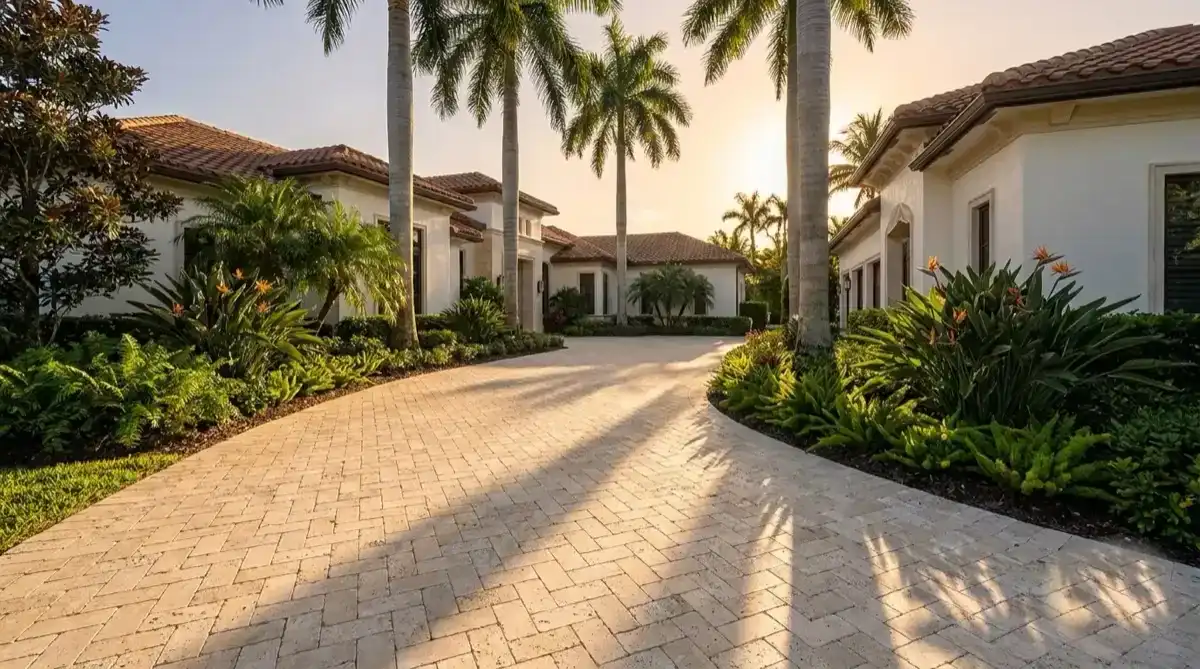
Paver Sealing in
Fort Lauderdale, FL
Marine-grade, UV-resistant paver sealing in Fort Lauderdale — engineered for Broward County's subtropical coastal climate. Serving Fort Lauderdale and Broward County — licensed, insured, and HOA-compliant.
What Fort Lauderdale Weather Does to Paver Sealer
Sealer is a consumable here, not a one-time upgrade. UV, rain volume, and — on the coastal side of Fort Lauderdale — airborne salt work on the film continuously, which is why the resealing question in Fort Lauderdale is really a question about where your property sits.
Marine humidity accelerates biological growth — regular maintenance.
Ready to Get Started?
Free, no-obligation on-site assessment in Fort Lauderdale. Transparent pricing delivered within 24 hours.
Sealing Around Fort Lauderdale: What We've Learned Here
Fort Lauderdale hands us the most demanding paver conditions in Broward, and the most rewarding streets to work on. On the isles — Las Olas Isles, Seven Isles, Harbor Beach — nearly every project sits within a few feet of a seawall on the city's 165 miles of waterways. In Victoria Park and Colee Hammock, we work under a protected live-oak canopy on 1920s-era streets, some still brick-paved, where roots and tannin stains are part of the deal. Rio Vista and Coral Ridge sit somewhere between: old trees, water nearby, buyers who notice details.
Canal-front Lauderdale has two below-ground enemies most contractors never mention. First, king tides: every fall, low-lying isles take water, which is why the city keeps raising seawall standards — a paver deck that can drain and dry beats a slab that traps brine. Second, iguanas: their burrows run under sidewalks, pool decks, and seawall caps all along the canal system, and we've excavated more than one 'mystery' sunken corner that turned out to be a tunnel. Under the oak canopy in Victoria Park, the issues are gentler but constant — root heave and leaf-tannin shadows on light pavers.
Where we work in Fort Lauderdale
When Your Fort Lauderdale Pavers Actually Need Resealing
Sealer doesn't wear out on a calendar — it wears out on exposure, and Fort Lauderdale has two very different exposure zones. Here's the schedule we work to, by where your property actually sits relative to the Intracoastal.
| Where your property sits | Reseal interval | Why it differs |
|---|---|---|
| Salt-exposed — Las Olas Isles, Seven Isles, Harbor Beach and the barrier island | About every 18 months | Airborne salt attacks the sealer film continuously, and brackish splash works into the joints. Coastal surfaces also want a breathable, salt-tolerant product rather than a commodity film. |
| Inland — the western neighborhoods off the canal network | Every 2–3 years | UV Index 11+ and 60+ inches of rain a year are still degrading the film; without the salt load, quality breathable sealer holds the longer interval. |
| Shaded and screened areas | Watch, don't schedule | Shade slows UV damage but keeps the surface damp, so biological growth arrives before sealer failure does. Green in the joints is the cue here, not chalking. |
| Pool decks and splash zones | Inspect annually | Chlorinated or saltwater splash cycles the surface wet-dry every day. Around saltwater pools, natural stone often needs an impregnating refresh well ahead of the field. |
Skip the calendar and use the water test: pour a cup of water on a sun-exposed section. If it beads, the sealer is working and you can wait — we'll tell you that at the assessment rather than sell you a job you don't need yet. If it soaks in and darkens the paver, the protection is gone and every month after that is unprotected time.
Paver Sealing Process in Fort Lauderdale
Surface inspection and sealer compatibility testing in Fort Lauderdale
Biodegradable pre-treatment to kill biological growth
Oscillating surface cleaning (3,000–4,000 PSI)
Specialist stain extraction for rust, tannins, and efflorescence
Polymeric sand joint infusion and compaction
Flooding-coat breathable sealer application
Paver Sealing in Fort Lauderdale — Questions Answered
How often should I reseal my pavers in Fort Lauderdale?
Does paver sealing make surfaces slippery?
Can you reseal pavers that were already badly sealed by someone else?
Can iguanas really damage a paver pool deck in Fort Lauderdale?
Why does a Fort Lauderdale driveway need an engineering right-of-way permit?
Other Services in Fort Lauderdale, FL
Paver Sealing in Fort Lauderdale — Get Your Free Estimate
Expert paver sealing by licensed Florida contractors. Free on-site assessment, transparent pricing, and same-week scheduling.