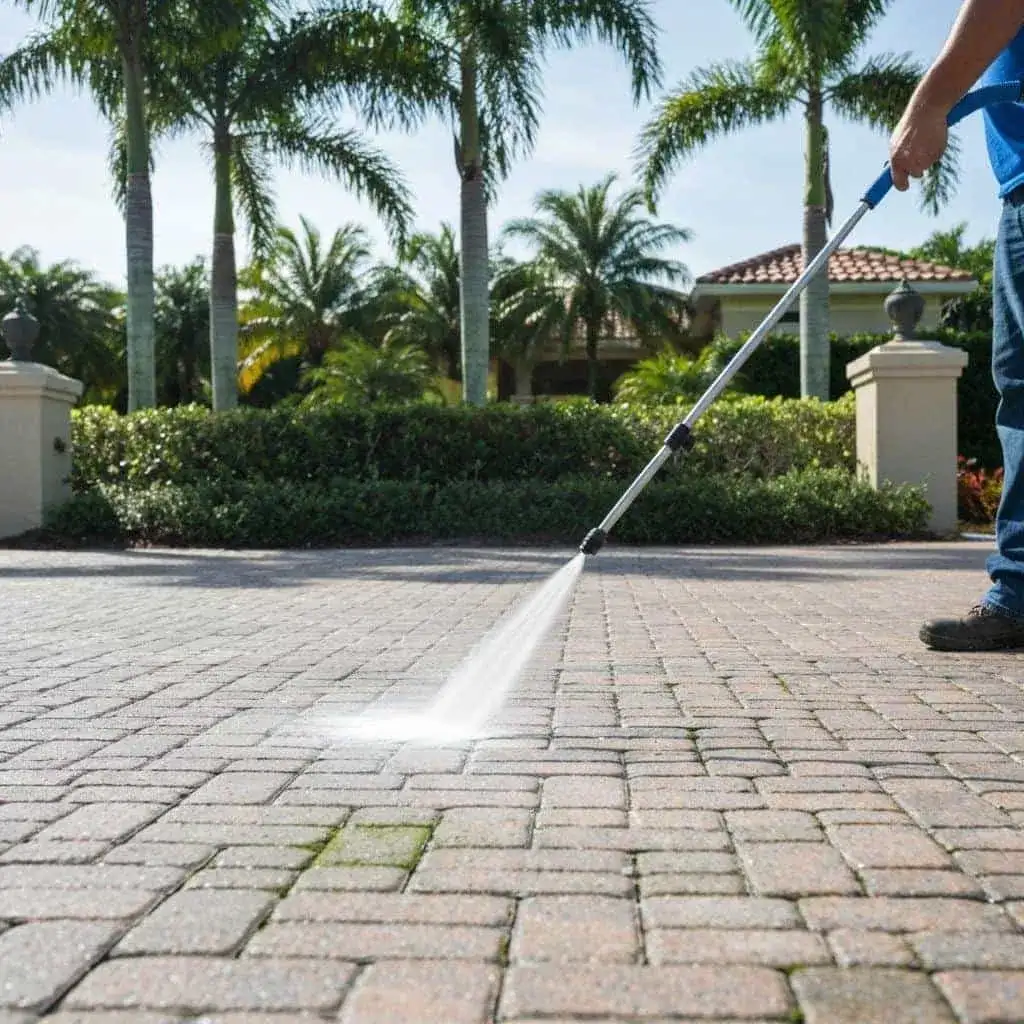
Professional paver cleaning and soft-wash sanitization in South Florida
Paver Cleaning — South Florida

Professional Paver Cleaning Deep Clean, Soft Wash, HOA-Compliant

Deep cleaning for driveway, patio, walkway and pool deck pavers across South Florida — concrete pavers, brick pavers, porcelain pavers, and natural stone. Soft-wash pressure washing paired with biodegradable paver cleaner removes black algae, moss, mildew, oil stains and rust without harsh chemicals that damage the surface. HOA-compliant results with documentation.

HOA Compliance Specialists
Eco-Friendly Biodegradable Solutions
Safe for Pets & Landscaping
Licensed & Insured in Florida
Call Us Now 954-478-4674
5.0
45 Google Reviews

Biological Root Treatment

Kills Gloeocapsa Magma black algae, mildew & lichen at the cellular level — not just surface removal

HOA Inspection Ready

Documented service receipt provided for HOA compliance submissions — avoid fines before they happen

Soft-Wash Technology

800–1,200 PSI calibrated cleaning — no joint erosion, no surface etching, no warranty voids

Iron & Rust Extraction

Specialist oxalic acid extractors for well-water irrigation staining — the #1 issue in Palm Beach County

Quote Free, on-site
Typical Job Same-day – 2 days
License CILB #U-22487
Free Estimate
15+ Years Experience
Licensed & Insured
HOA Compliance Specialists
5-Star Google Rating
HOA Compliance

Florida HOA Compliance Specialists

If you've received an HOA violation notice for "dirty pavers," "biological discoloration," or "mold on driveway" — you're not alone. We handle these calls every week across Palm Beach and Broward Counties.

Fast Turnaround

Most HOA compliance jobs are completed within 1–2 days of scheduling — before your response deadline.

Documented Service Receipt

We provide a detailed, dated service receipt that meets HOA submission requirements for compliance documentation.

HOA Quick-Quote

Send us your HOA notice and we'll provide a same-day quote so you can respond promptly.

Florida HOA Standard

What inspectors look for

  • Visible black algae or green mold on driveway pavers
  • Orange-brown iron staining from irrigation systems
  • Dark organic staining on pool deck or walkways
  • Discolored grout lines or joint sand channels
  • Moss or lichen growth on paver faces
  • General surface darkening from biological buildup
The good news: Every item on this list is fully reversible with the correct professional treatment. Most properties are HOA-compliant within 24 hours of our service.
Florida Biological Threats

What's Growing on Your Pavers Right Now

100% humidity drives regrowth in 6–8 weeks without treatment

Black Algae (Gloeocapsa Magma)

The most persistent biological threat in South Florida. Gloeocapsa Magma is a cyanobacterium that produces a dark, UV-protective sheath — making it resistant to simple pressure washing. It must be killed at the cellular level with the correct biological surfactant.

72hrs is all it takes for mildew to re-establish after rain

Mildew, Lichen & Organic Staining

Florida's combination of heat and moisture creates a perfect greenhouse for mildew colonies and lichen. Left untreated, lichen physically etches into the paver surface — causing permanent pitting that cannot be reversed without grinding.

60% of South Florida homes with well irrigation have iron staining

Iron Rust from Irrigation Systems

Well-water irrigation systems in Palm Beach and Broward Counties carry high iron content. Each watering cycle deposits iron oxide directly onto your pavers — creating the distinctive orange-brown streaking that HOAs flag during inspections.

Our Method

The Craft Pavers Cleaning Protocol

01

Surface Assessment & Strategic Debris Removal

We begin with a full inspection of your paver surface — documenting biological growth patterns, stain types, joint integrity, and any previous sealer residue. Organic debris is removed manually first to prevent it from being ground into the surface during cleaning.

02

Targeted Biological Pre-Treatment

A biodegradable, eco-certified surfactant solution is applied at the correct dwell time for your specific biological threat — 10 minutes for standard mildew, up to 25 minutes for established black algae colonies. This step kills the organism at the root, not just the surface.

03

Low-Pressure Deep Clean & Stain Extraction

Using calibrated low-pressure equipment (800–1,200 PSI vs. rental machine 3,000+ PSI), we flush the loosened biological matter from the surface without disturbing joint sand or etching the paver face. Specialist stain extractors handle rust, oil, and tannin deposits in targeted passes.

04

Strategic Rinsing & Post-Treatment Sanitization

A final neutralizing rinse removes all chemical residue. We apply a post-treatment inhibitor that delays biological re-growth by 12–18 months — significantly outperforming plain pressure washing with no post-treatment.

Paver Cleaning Questions Answered

What is the best way to clean pavers?
The best way to clean pavers is a two-stage cleaning process: (1) apply a biodegradable paver cleaner or cleaning solution, let it dwell 5–10 minutes to break down mold, algae, and grime, then (2) rinse with a pressure washer set to soft-wash pressure (800–1,200 PSI) — not high-pressure. Use a fan tip 15–25° at 12+ inches from the surface. For light maintenance, a stiff-bristle broom and hose rinse can handle everyday dirt. For anything embedded (oil stains, rust, moss), specialized cleaning products are required.
How do you make pavers look new again?
Making pavers look new again is a three-step process, not just a cleaning: (1) Deep clean pavers to remove all biological growth (algae, moss, mildew) and stubborn stains — this alone recovers 60% of the original look. (2) Replace washed-out joint sand with premium polymeric sand to restore structural integrity. (3) Apply a color-enhancing breathable sealer that rehydrates the aggregate face and locks in the color. This full clean-and-seal cycle transforms weathered pavers into looking better than they did on install day for 2–3 years.
What should you not use to clean pavers?
Never use these to clean pavers: (1) Bleach — kills algae but degrades the polymeric sand in joints and damages concrete color over repeated use. (2) Muriatic acid or other harsh chemicals not made for pavers — etches the surface irreversibly. (3) A wire brush — scratches the aggregate face and creates rough spots that hold dirt worse afterward. (4) High-pressure washer over 2,000 PSI at close range — blows out joint sand and undercuts the bedding layer. (5) Dish soap for anything more than a light rinse — leaves residue that attracts more dirt. Stick with a specialized paver cleaner used according to the manufacturer's instructions.
How do you clean pavers without removing sand?
The key to cleaning pavers without removing joint sand is technique, not product. Use a pressure washer at 800–1,200 PSI (soft wash range) with a wide fan tip (15–25°) held at 12+ inches from the surface and swept parallel to the joint lines (never perpendicular into a joint). Better yet, apply a cleaning solution first, let it dwell to lift dirt, then rinse gently with a garden hose — no pressure washer required for light cleaning. If some sand does wash out, top up with polymeric sand before it becomes an entry point for weeds.
What are the steps for cleaning pavers safely and effectively?
Our step-by-step paver cleaning process: (1) Pre-wet surrounding plants and landscaping to protect them from any runoff. (2) Sweep the surface with a stiff-bristle broom to remove loose debris. (3) Apply biodegradable paver cleaner uniformly, let dwell 5–10 minutes. (4) Agitate stubborn stains with a scrub brush (never wire). (5) Rinse with pressure washer at soft-wash pressure or garden hose for light cleaning. (6) Inspect joints — top up polymeric sand if any washed out. (7) Allow full drying (24–48 hours) before applying any sealer. This complete guide sequence protects both the pavers and surrounding outdoor space.
How do you remove specific stains like rust, oil, moss, or efflorescence from pavers?
Different stains need different chemistry: (1) Rust stains from well-water irrigation — oxalic acid-based extractor (chelates the iron). (2) Oil stains — degreaser or absorbent (kitty litter, cornstarch) to lift fresh spills; enzymatic cleaner for older ones. (3) Moss and mildew — biodegradable algaecide with 5-minute dwell time, then soft-wash rinse. (4) Efflorescence (white mineral haze) — dedicated efflorescence remover (mild acidic pH); never use bleach. (5) Tannin stains from leaves — oxygen-based cleaner. For any stubborn stains you can't identify, a professional paver cleaning service is safer than experimenting with random cleaning products.
Can you clean pavers with a pressure washer, and what precautions should be taken?
Yes, but with real precautions: (1) Use soft-wash pressure only — 800–1,200 PSI for pavers, never the 3,000+ PSI of a rental power washer. (2) Use a wide fan tip (15–25°), never a zero-degree jet. (3) Hold the wand 12+ inches from the surface. (4) Sweep parallel to joints, not into them. (5) Pre-treat with cleaner so the pressure doesn't have to do all the work. (6) Plan to top up joint sand after — even careful pressure washing removes a small amount. Rental pressure washers used incorrectly are the #1 cause of paver damage we're called to repair. When in doubt, hire a professional.
What are common mistakes to avoid when cleaning pavers?
The most common paver cleaning mistakes: (1) Using bleach or muriatic acid — damage the pavers long-term. (2) Pressure washing at 3,000+ PSI — blows out joint sand, undercuts base. (3) Skipping the pre-treatment step — pressure alone can't remove embedded biological staining. (4) Using a wire brush that scratches the aggregate face. (5) Not pre-wetting adjacent landscaping — cleaner runoff kills plants. (6) Sealing before the surface is fully dry — traps moisture and causes white blushing. (7) Not topping up polymeric sand after cleaning — leaves joints open for weed germination. (8) Using dish soap — leaves a film that attracts more dirt.
How often should pavers be cleaned and sealed?
For Florida pavers: rinse or light-clean every 3–4 months to prevent buildup; deep clean pavers annually or biennially depending on shade, tree cover, and coastal exposure; reseal every 2–3 years to renew stain protection and lock joint sand. Coastal properties and heavily shaded surfaces need more frequent maintenance; inland full-sun properties with quality sealer can stretch to the longer intervals. Skipping annual maintenance doesn't just look worse — it lets biological growth root into the surface, making eventual restoration significantly harder and more expensive.
When should you consider hiring a professional for paver cleaning?
DIY is fine for routine maintenance — sweep, hose rinse, occasional stiff-bristle broom scrub with mild cleaning solution. Hire a professional paver cleaning service when: (1) you have stubborn stains (rust, oil, deep-set algae) that don't respond to basic cleaning products, (2) black spots or mold have penetrated the paver surface, (3) you're preparing for sealing (professional prep = professional-lasting seal), (4) you don't own a soft-wash pressure washer setup and would need to rent 3,000+ PSI equipment (which damages pavers), or (5) the project is large enough that DIY time-cost exceeds professional cost. Complete guide to when-to-DIY vs when-to-hire is in our paver cleaning resources.

Ready for HOA-Compliant Clean Pavers?

Book a free surface audit. We'll assess your specific biological threats and provide a same-day quote.

Guides & Pricing Resources