“Ciprian can offer a masterclass in paving repair! It was a pleasure to work with him and his services were on point. Timely, responsive, clean, respectful and beautifully completed. If you are looking to work with a paving professional - look no further.”
Paver Repair Near Me — South Florida Base Failure Specialists
Looking for paver repair near you in Boca Raton, Delray Beach, Fort Lauderdale or anywhere across Palm Beach & Broward? We fix sunken pavers, cracked bricks, shifted patios, edge failure, root intrusion, and drainage issues — brick paver repair and restoration by a licensed local contractor. Same-week scheduling on most jobs. Free on-site inspection.
Sub-Base Erosion
#1 CauseFlorida's tropical rainfall — averaging 54 inches per year — is the primary driver of base failure. When edge restraints or joint sand degrade, water infiltrates the sub-base and washes away compacted limestone, leaving voids beneath the surface.
Inadequate Compaction
Most CommonMany original installations fall short of the required 95% Proctor compaction density, especially in South Florida's sandy, expansive soils. Under vehicle load and seasonal moisture cycles, an under-compacted base consolidates over time.
Why Pavers Fail in Florida
Understanding the cause is the only way to guarantee a repair that lasts. Surface fixes without base remediation are temporary — and expensive to redo.
Sub-Base Erosion
Florida's tropical rainfall — averaging 54 inches per year — is the primary driver of base failure. When edge restraints or joint sand degrade, water infiltrates the sub-base and washes away compacted limestone, leaving voids beneath the surface.
Inadequate Compaction
Many original installations fall short of the required 95% Proctor compaction density, especially in South Florida's sandy, expansive soils. Under vehicle load and seasonal moisture cycles, an under-compacted base consolidates over time.
Root Intrusion
Florida's tropical tree species — ficus, oak, royal poinciana — have aggressive lateral root systems capable of lifting entire paver sections from below. Roots follow moisture channels under the base, progressively destabilizing the grid.
Edge Restraint Failure
Without a structurally sound perimeter restraint, the interlocking grid gradually spreads outward under lateral load — a phenomenon called 'paver drift.' Once the edges migrate, the entire field loses its structural integrity.
Complete Paver Repair Solutions
Sinking Driveway Repair
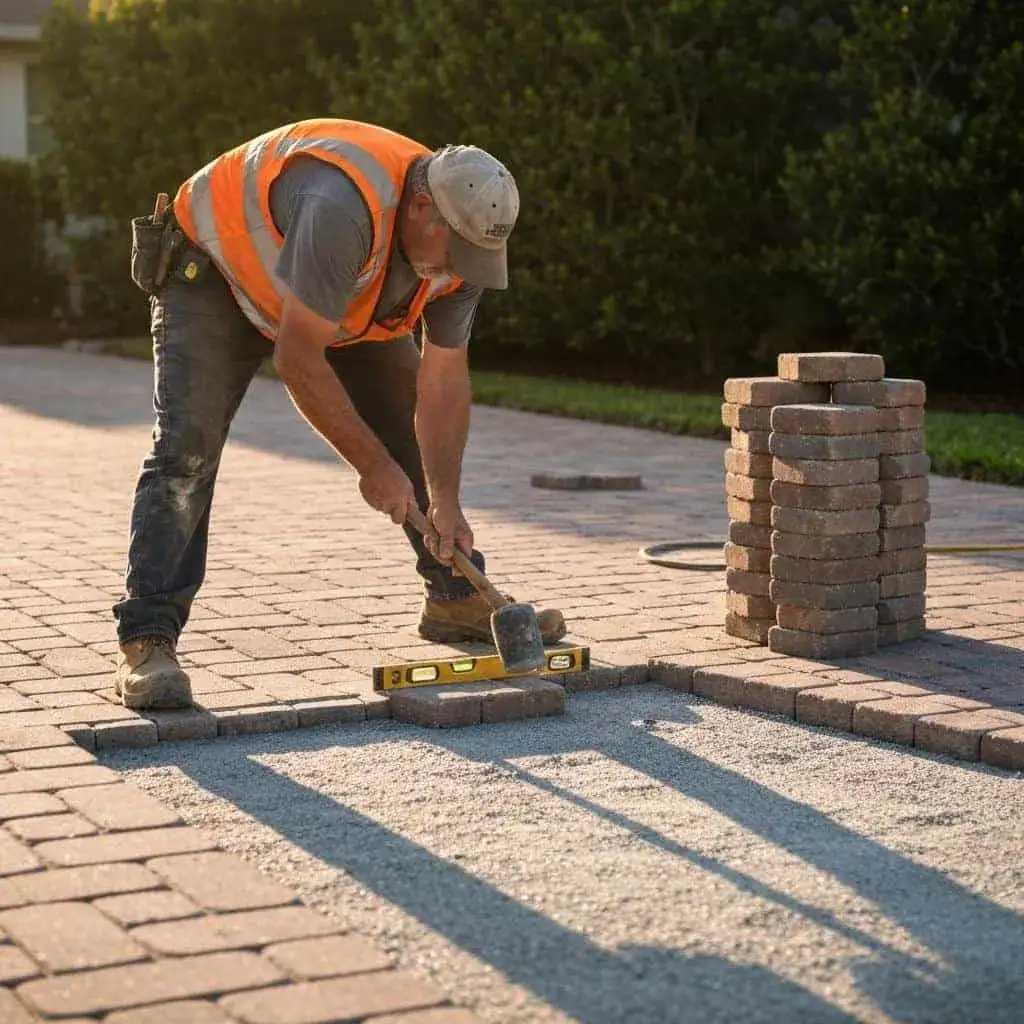
Vehicle weight creates wheel tracks and ruts in driveways with compromised bases. We extract the affected section, add high-density aggregate, re-compact to specification, and re-set the original pavers.
- Full-depth base excavation where required
- Compaction to 95%+ Proctor density
- Original paver re-use preserving pattern continuity
Precision Re-Leveling
Any elevation change of 1/4" or more between adjacent pavers constitutes a trip hazard. We surgically extract and re-set individual pavers using precision laser levels — eliminating liability without disturbing surrounding pavers.
- Laser-level accuracy to 1/16"
- No neighboring paver disturbance
- Pool deck safe — ADA compliant result
Root Intrusion Repair
We carefully remove affected pavers, cut and treat the intrusive root system, install root barrier fabric, rebuild the base, and re-set the original pavers. Root barriers prevent re-intrusion for 15+ years.
- Root barrier fabric installation
- Non-destructive root extraction technique
- Base reconstruction from sub-grade up
Edge Restraint Repair
We excavate the perimeter, install commercial-grade L-profile aluminum or plastic edge restraints secured with 12" landscape spikes, and re-compact the edge zone — permanently locking the grid from lateral drift.
- Commercial-grade aluminum restraint
- 12" spike anchoring per ICPI standards
- Re-stabilizes the entire field, not just edges
Base Remediation
Where sub-base failure is confirmed by probing, we perform full-depth excavation of the affected zone, remove degraded material, install geotextile fabric, and rebuild the base to FDOT standards.
- FDOT-approved limestone aggregate
- Geotextile fabric moisture barrier
- Plate compactor verification to 95%
Polymeric Sand Re-Stabilization
Degraded joint sand allows micro-movement that accelerates all other failure types. We blow out old sand, re-sweep premium polymeric sand, compact, and activate — fully re-stabilizing the interlocking matrix.
- Compressed air joint preparation
- Techniseal HP+ polymeric sand
- 10-year weed and ant protection
Types of Paver Problems We Repair
Whether it's a driveway, patio, walkway, pool deck, or full hardscape — most paver failure modes are fixable without replacing the whole surface.
Sunken Pavers & Low Spots
Wheel ruts on driveways, sinking sections on patio or walkway, low spots that hold water after rain. Almost always a base failure — we lift, re-compact, and re-set the original pavers.
Cracked & Broken Pavers
Individual cracked or chipped bricks from freeze-thaw damage elsewhere, vehicle overload, or dropped objects. Brick paver repair by unit-level replacement — no full-driveway tear-out.
Displaced & Shifted Pavers
Pavers migrating outward (paver drift) from edge restraint failure, or entire sections shifting under lateral load. We fix the root cause: the perimeter restraint.
Loose Bricks
Individual pavers rocking or lifting under foot traffic — a warning sign that the bedding sand has washed out or the joint sand is degraded. We re-bed and re-sand.
Weeds & Washed-Out Joint Sand
Weeds germinating in joints and joint sand disappearing after every rainstorm both stem from the same issue: standard sand instead of polymeric sand. We blow out old sand and re-sweep with premium polymeric sand.
Root Intrusion Damage
Ficus, oak, and royal poinciana roots lift entire paver sections from below. We extract pavers, cut roots, install root barrier fabric, rebuild the base, and re-set the original hardscape.
Edge Restraint Failure
Broken, missing, or improperly installed perimeter restraint — the #1 reason interlocking pavers fail structurally in Florida. Commercial-grade aluminum restraint per ICPI standards.
Drainage Issues
Water pooling on the surface, negative slope toward the house, or storm runoff eroding the sub-base. We regrade drainage during repair — 1–2% slope away from all structures.
Pool Coping & Deck Failure
Loose or lifted coping stones, cracked pool deck pavers, chlorine and salt staining. Specialized mortar-set coping repair paired with sand-set deck field remediation.
How to Tell if Your Pavers Need Repair vs Replacement
Most contractors will quote you a full replacement — because it's bigger revenue. Here's the honest test we use at every free inspection.
| Signal | Repair works | Replace instead |
|---|---|---|
| % of pavers damaged | Under 40% | Over 50% failing across the field |
| Base condition | Solid when probed — voids in isolated zones | Widespread washout across large sections |
| Broken pavers | Replaceable or matchable from our library | Discontinued color and no matches possible |
| Drainage | Fixable with regrading during repair | Fundamental slope-toward-house problem |
| Original install quality | Correct depth, edge restraint present, geotextile installed | Wrong depth, no restraint, no fabric — install was flawed |
| Cost trade-off | $8–$18 / sq ft — 30–50% of replacement cost | $12–$32 / sq ft installed, plus tear-out |
Not sure which category your paver work falls in? Book a free structural assessment — we probe the base, photograph the failure zones, and give you an honest recommendation with the math. If replacement is the right call, we'll say so; see our paver installation service.
Paver Repair Cost in South Florida
Every quote is free, on-site, and itemized — we don't quote paver work from photos. Here are honest starting ranges so you know what to expect before we arrive.
| Repair type | Typical cost | What's included |
|---|---|---|
| Spot repair — a few loose bricks or cracked pavers | $250 – $450 | Extract, replace or re-set, re-sand joints |
| Sunken driveway section — base rebuild | $400 – $1,200 | Excavate, add aggregate, compact 95% Proctor, re-set original pavers |
| Full patio re-leveling + polymeric sand | $6 – $10 / sq ft | Precision laser level, polymeric sand joint replacement, compaction |
| Edge restraint replacement | $8 – $14 / linear ft | Aluminum L-profile, 12" spike anchoring, re-compaction |
| Base remediation for larger failure zone | $10 – $18 / sq ft | Full-depth excavation, geotextile, FDOT limestone base, re-compaction |
| Root barrier + intrusion repair | $450 – $1,800 | Root extraction, barrier fabric, base rebuild, paver re-set |
Coastal properties may add marine-grade polymeric sand (~$0.30–$0.50/sq ft). We recommend sealing 4–6 weeks after repair — see paver sealing cost guide.
Paver Repair Questions Answered
How much does it cost to fix pavers?
Can a broken paver be repaired?
How do you fix pavers that are sinking or uneven?
How do you repair displaced or shifting pavers?
What types of paver problems can be repaired?
How do I know if my pavers need repair or replacement?
How long does a typical paver patio repair take?
What is the process for paver repair?
Should I seal my pavers after they are repaired?
Can paver repairs be done in all weather conditions?
What South Florida Homeowners Say
Is Your Paver Base Still Sound?
Free structural assessment — we probe the base, identify failure zones, and give you an honest repair vs. replace recommendation with no obligation.