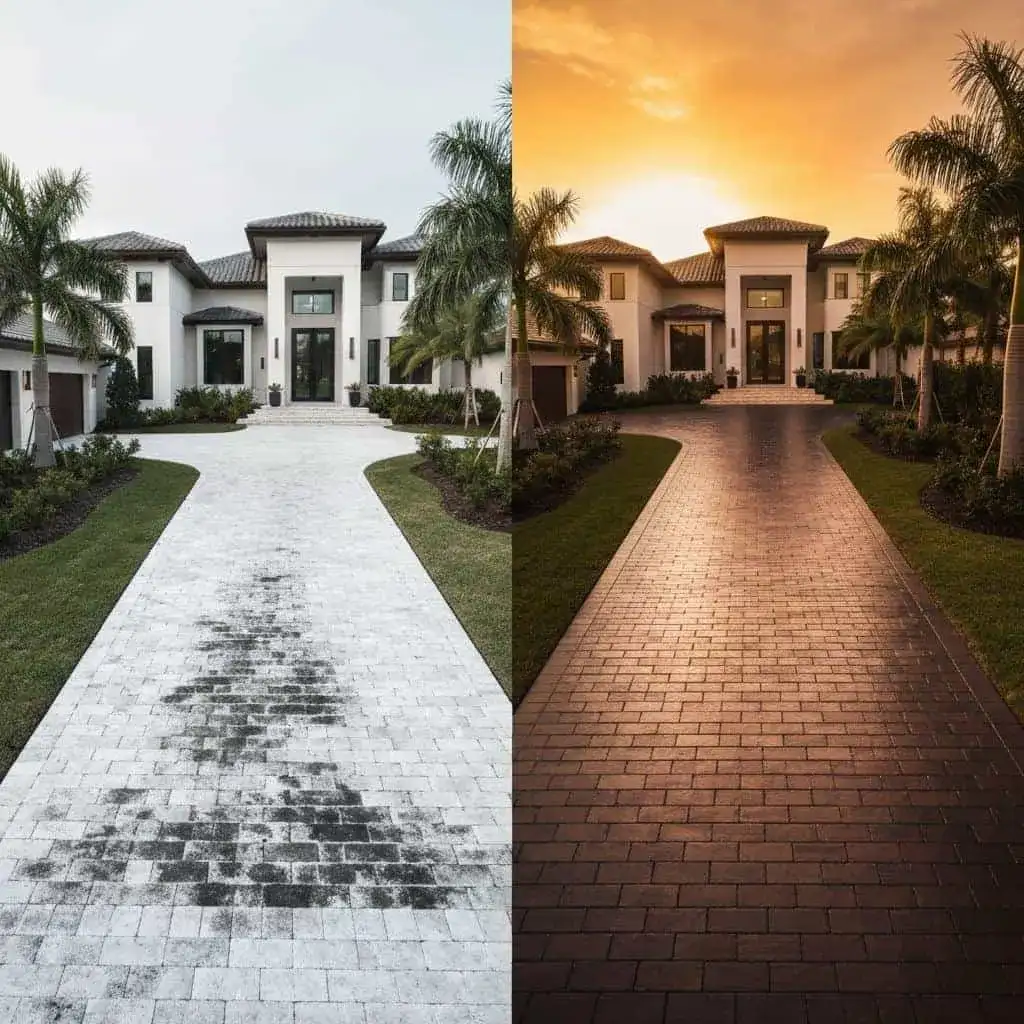
Paver Restoration — Make Faded Pavers Look New
Professional paver restoration across Boca Raton, Delray Beach, Fort Lauderdale and South Florida. We revitalize faded, blushing, weed-choked, or sealer-failed pavers on patio, driveway, walkway and pool deck hardscape — restoring pristine condition at 30–40% of what full replacement would cost. Free on-site assessment. Same-week scheduling on most jobs.
White Haze & Blushing
Failed non-breathable sealers trap moisture under the surface — turning your pavers milky white.
Faded & Washed-Out Color
Florida's UV index strips color from unsealed or poorly sealed pavers faster than anywhere in the US.
Degraded Joint Sand
Old polymeric sand washes out over time, allowing weeds, ants, and water infiltration into the sub-base.
Sealer Buildup & Peeling
Multiple low-quality sealer applications create a flaking, peeling surface that traps humidity and discolors.
$15–$25/sq ft
Full Replacement Cost
$5–$9/sq ft
Professional Restoration
$20,000–$32,000
Savings on 2,000 sq ft
The 5-Stage Restoration Protocol
Every restoration begins with diagnosis — not assumption. We adapt the protocol to what your specific pavers need, nothing more and nothing less.
Surface Diagnosis
We test for previous sealer chemistry, moisture content, and organic penetration depth. This determines the correct chemical protocol and prevents re-application failures.
Moisture meter + sealer compatibility testing on-site
Stripping & De-coating
When required, we apply professional-grade chemical strippers that dissolve failed sealer layers without damaging the paver face or sub-base structure.
Water-based, biodegradable stripping agents only
Mechanical & Chemical Deep Clean
A two-stage process: mechanical agitation removes embedded organic matter, followed by targeted chemical treatment for rust, tannin, and efflorescence staining.
Soft-wash rinse preserves the paver's aggregate face
Stabilization & Precision Sanding
We remove old degraded joint sand completely and install premium polymeric sand using a professional compaction method that locks the grid and prevents future weed intrusion.
Techniseal HP+ polymeric sand — 10-year weed inhibition
High-Performance Sealing
We apply breathable, UV-stable sealer in your selected finish — matte, satin, or wet-look — using a two-coat cross-spray method for even coverage and maximum penetration.
SealMaster, Techniseal, or Surecrete — your choice of finish
Signs Your Pavers Need Restoration
Not sure if it's time to restore your pavers? If you notice three or more of these signs on your patio, driveway, or walkway, restoration will bring more value than continuing to defer.
Faded or Washed-Out Color
Colors look dull compared to when the pavers were new — Florida's UV index 11+ photodegrades pigment faster than any other US climate.
White Haze or Blushing
Milky patches under the surface = failed non-breathable sealer trapping moisture. Only fix: chemical strip + reseal with a breathable product.
Weeds Growing Through Joints
Weed growth means joint sand is either missing, degraded, or was never polymeric. Re-sanding with polymeric sand stops future germination for years.
Joint Sand Washing Out
Sand disappearing after every rainstorm signals standard sand instead of polymeric — Florida's tropical rainfall demands the polymeric grade.
Loose Joint Sand & Loose Bricks
Pavers rocking underfoot or joint sand feeling loose to the touch — early warning of buildup washout before broken pavers appear.
Moss, Algae or Black Buildup
Organic growth (moss, alga, mold) colonizes any unsealed or under-sealed paver surface in Florida's humidity. Deep clean + reseal denies it a foothold.
Rust, Tannin & Oil Stains
Iron sprinkler stains, leaf tannin buildup, or oil marks that don't rinse off. Targeted chemistry removes them; sealing prevents future re-staining.
Sealer Peeling or Flaking
Visibly peeling sealer means the product has failed — never seal over failed sealer. Strip, then reseal properly.
Water No Longer Beads
Pour a cup of water on the pavers. If it soaks in instead of beading, the sealer is spent and the surface is exposed to stain and grime.
Benefits of Paver Restoration
Cost — 30–40% of Replacement
Restoration runs $5–$9 per sq ft; full replacement runs $15–$25/sq ft installed. On a 2,000 sq ft driveway, the delta is $20,000–$32,000.
Speed — 1–3 Days on Site
A full patio restoration finishes in 1–2 days; a large driveway in 2–3 days. Full replacement takes 5–10 days including tear-out and cure time.
Curb Appeal — Often Outperforms New
Color-enhancing sealer amplifies the aggregate's natural depth. Restored pavers often look richer than freshly-installed unsealed pavers.
Protects Property Value
A restored, sealed hardscape signals a maintained home to buyers. Deteriorating pavers cut curb appeal (and appraisal) more than any other single exterior element.
5–8 More Years of Service
A proper restoration adds 5–8 years of service life to pavers that would otherwise need imminent replacement. Timing it right is pure savings.
Lasting Beauty in Florida's Climate
Restored pavers sealed with a breathable, marine-grade UV-stable sealer stay pristine 2–3 years between maintenance cycles — even coastal properties.
Paver Restoration vs Replacement — Which Is Right for You?
In 9 out of 10 South Florida jobs we assess, restoration is the correct call. Here's the honest test we use at every free inspection.
| Signal | Restore | Full Replacement |
|---|---|---|
| Base condition | Solid when probed | Widespread washout / drainage failure |
| % of pavers damaged | Under 40% structural | Over half the field failing |
| Surface problems | Cosmetic (fading, stains, weeds, sealer failure) | Structural cracks running across the field |
| Original installation | Correct depth, edge restraint present | Wrong depth, no restraint, drainage flawed |
| Paver style availability | Match available or replacement bricks matchable | Discontinued, no matches — full re-do needed |
| Cost | $5–$9 / sq ft | $15–$25 / sq ft installed + tear-out |
| Timeline | 1–3 days on site | 5–10 days including cure |
Not sure which category your pavers fall in? Book a free structural assessment — we probe the base, photograph the failure zones, and give you an honest recommendation. If replacement is confirmed necessary, see our paver installation service.
Paver Restoration Cost in South Florida
Every quote is free, on-site, and itemized. Here are honest starting ranges so you know what to expect before we arrive.
| Restoration scope | Typical cost | What's included |
|---|---|---|
| Basic clean-and-seal (well-maintained pavers) | $3.50 – $5 / sq ft | Deep clean, joint touch-up, single-coat sealer |
| Standard restoration (typical scope) | $5 – $7 / sq ft | Clean, remove & replace joint sand, color-enhance sealer |
| Full restoration with sealer stripping | $7 – $9 / sq ft | Chemical strip failed sealer + full protocol above |
| 500 sq ft patio (typical) | $2,500 – $4,500 | Standard restoration, coastal or inland |
| 2,000 sq ft driveway (typical) | $10,000 – $18,000 | vs $30,000–$50,000 full replacement |
| Optional add-ons | + $0.30–$0.75 / sq ft | Marine-grade sand (coastal), non-slip additive (pool deck) |
Detailed cost breakdowns in our paver sealing cost guide and Palm Beach County pricing notes.
Paver Restoration Questions Answered
How can I make my pavers look new again?
Can I put new polymeric sand over old?
How much does paver restoration cost?
What is the paver restoration process?
Should I restore or replace my pavers?
What are the benefits of paver restoration?
What are the signs that my pavers need restoration?
How long will restored pavers last?
How can I maintain my restored pavers?
Why do pavers fade and how can it be prevented?
How much does paver stripping cost?
Before You Replace — Get a Restoration Assessment
In 9 out of 10 cases, restoration delivers showroom results at 30–40% of replacement cost. Find out if your pavers qualify — free, no obligation.