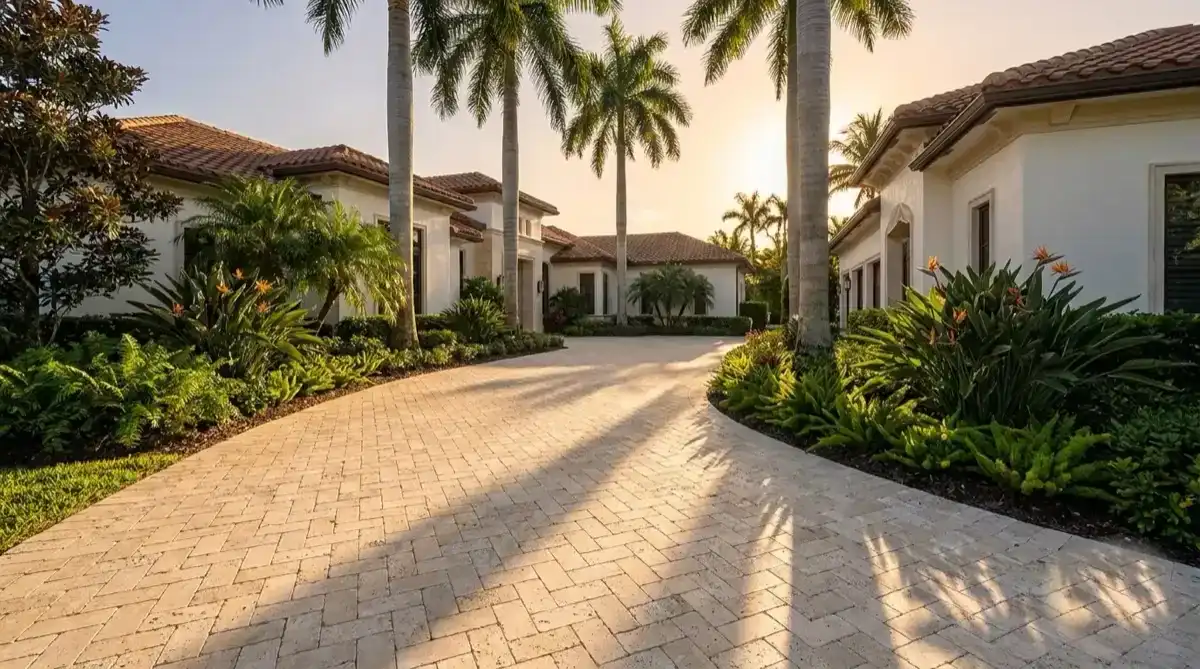
Paver Cleaning in
Delray Beach, FL
Eco-friendly paver cleaning in Delray Beach — soft-wash technology and HOA compliance services for Palm Beach County homeowners. Serving Delray Beach and Palm Beach County — licensed, insured, and HOA-compliant.
Why Delray Beach Pavers Get Dirty Faster Than They Should
Cleaning in Delray Beach is rarely about dirt. It's about biological growth in a humid climate, staining from the specific trees and irrigation water around your property, and the salt or mineral residue that settles on hardscape between rains.
Intense UV, 60in+ rain & strict HOA standards — care guaranteed.
Ready to Get Started?
Free, no-obligation on-site assessment in Delray Beach. Transparent pricing delivered within 24 hours.
Cleaning in Delray Beach: Local Conditions We Plan For
Delray is the market where we most often get called to fix someone else's base work. The prestige addresses — Tropic Isle, Seagate, Palm Trail — sit on some of the trickiest ground in Palm Beach County, and a paver job that would hold up fine in a western suburb settles and ripples here within a couple of years if the base wasn't engineered for it. The Lake Ida ranches are a different story: 1950s homes on oversized lots, voluntary HOA, owners who care more about getting it right than getting it approved.
Tropic Isle's streets are built over muck and loosely consolidated soil — that's not our opinion, it's why the city itself has been raising roads and adding drainage there. For pavers, muck means one thing: the compacted base is everything, and skipping geotextile fabric on these lots is how you get the wavy driveways you see around the neighborhood. Closer to the Intracoastal, the Marina District takes up to ten inches of King Tide water in the fall, so drainage grading isn't a detail — it's the design.
Where we work in Delray Beach
Salt Film, Shade, and Brackish Residue on Delray's Canal Streets
Cleaning pavers in Tropic Isle, Seagate, and Palm Trail means dealing with two things at once: salt and shade. Canal-front lots take airborne salt and splash that dries into a dull, gritty film across a patio or pool deck, and the same lots are usually well shaded, so the surface never fully dries out and algae and mildew get a permanent foothold in the joint lines. In the Marina District the fall King Tides add a third layer — brackish water pushes up onto low-lying hardscape and leaves a mineral residue behind when it recedes. Our first move on those properties is not detergent at all; it is a thorough fresh-water rinse to carry off the loose salt, because applying a cleaning solution on top of a salt crust just wastes product.
After the rinse comes the actual clean: a biodegradable, pH-balanced paver cleaner applied with a pump sprayer, given time to break down the biological film, agitated with a stiff bristle brush where growth has taken hold, then rinsed at soft-wash pressure so the joint sand survives the process. The white bloom that shows up on canal-side pavers is worth naming separately, because it is not dirt. Efflorescence is mineral salt migrating up out of the paver and crystallizing on the face, and scrubbing harder does nothing for it — it needs a dedicated efflorescence remover and, more importantly, an answer to where the moisture is coming from.
This is also where we talk homeowners out of the internet's favorite advice. Vinegar and muriatic acid will etch travertine and shell stone and can bleach the pigment out of concrete pavers; chlorine kills the plantings along the seawall and does not remove staining so much as hide it. Harsh chemicals near a canal are a water-quality problem as well as a surface one. There is no cleaning product that justifies burning a landscape bed to save an afternoon.
Lake Ida Canopy, Atlantic Avenue Foot Traffic, and Making Pavers Look New Again
The Lake Ida ranches are a completely different cleaning job. Those 1950s houses sit on oversized lots under big established canopies, and what accumulates there is organic: constant leaf litter, tannin staining beneath the drip line, moss creeping along the shaded north edge of a driveway, and weeds finding any joint the sand has left. The cheapest maintenance any Lake Ida owner can do is a weekly pass with a push broom — leaf litter that never sits does not stain — and the annual deep cleaning then has one season of film to lift instead of five.
Closer in, the residential streets that back onto the Atlantic Avenue corridor take a level of foot traffic that is closer to commercial than residential, and it shows on the pavers: ground-in grime along the walkway approach, scuffing, and the occasional oil spot at the parking apron. Those are specific stains rather than general dirt, and each wants its own treatment before the general wash — degreaser dwelling on the oil, an oxygenated cleaner on the biological growth, a rust treatment on any orange bloom. Treating them all with one product is the most common reason a DIY clean comes out patchy.
When people ask how to make pavers look new again, the honest sequence is three steps, not one. Deep clean the surface properly, re-sand the joints so the field locks up and the weeds lose their seedbed, then seal — sealing from $1.10/sq ft — so the next year's salt, tannin, and grime sit on top of a barrier instead of soaking into the paver. Cleaning restores the color; the sand and the sealer are what keep it. Skip the last two and you will be booking the same clean again next spring.
What's Actually Growing — or Staining — on Your Delray Beach Pavers
Half the cleaning calls we take in Delray Beach are for something the homeowner has already tried to scrub off. The reason it came back is almost always a mismatch between the stain and the method. Here's how we identify what's on a Delray Beach surface before touching it.
| What you're seeing | What it actually is | What removes it |
|---|---|---|
| Green or black film on the shaded side | Algae and mildew rooted in the paver's pores | A biodegradable pre-treatment with dwell time, then agitation. Pressure alone removes the visible top of the colony and leaves the roots to regrow by the next wet season. |
| Rust-coloured shadows under trees | Tannin — in Delray Beach, leaf litter and tannin from the oversized oak canopies over Lake Ida's 1950s lots | Tannin-specific cleaner, not bleach. Bleach lightens the surface around the stain and makes the shadow more obvious, not less. |
| Orange stripes along one edge | Oxidized iron from irrigation water | An oxalic-acid-based rust treatment, applied and neutralized carefully — then redirect the sprinkler head. No amount of pressure or bleach lifts bonded iron. |
| White powder or cloudiness | Efflorescence, or a failed sealer blushing | Efflorescence rinses with an efflorescence cleaner and fades on its own. A milky failed sealer is a different job entirely — it has to be chemically stripped before anything new goes down. |
| Dark drips near the parking area | Oil or transmission fluid in the pores | Paver-safe degreaser with dwell time. Fresh spills lift in minutes on a sealed surface; a year-old stain needs restoration-grade extraction and sometimes never fully clears. |
We soft wash rather than pressure blast, and we re-sand joints afterward as part of the job. That isn't a philosophical position — it's because every wash takes some joint sand with it, and open joints in Delray Beach mean weeds, washouts, and eventually pavers that rock underfoot.
Paver Cleaning Process in Delray Beach
Surface assessment and biological growth mapping in Delray Beach
Targeted biological pre-treatment application
Low-pressure deep clean and stain extraction
Strategic rinsing and post-treatment sanitization
Service receipt provided for HOA documentation
Paver Cleaning in Delray Beach — Questions Answered
How does paver cleaning help with Delray Beach HOA compliance?
Are your cleaning solutions safe for Florida pets and landscaping?
Can you remove rust stains from well-water irrigation systems?
Why do paver driveways in Tropic Isle settle so fast?
Can pavers help with King Tide water near the Intracoastal in Delray?
What is the white haze on my Delray Beach pavers near the water, and will cleaning remove it?
Can I clean my pavers with vinegar or bleach?
Other Services in Delray Beach, FL
Paver Cleaning in Delray Beach — Get Your Free Estimate
Expert paver cleaning by licensed Florida contractors. Free on-site assessment, transparent pricing, and same-week scheduling.