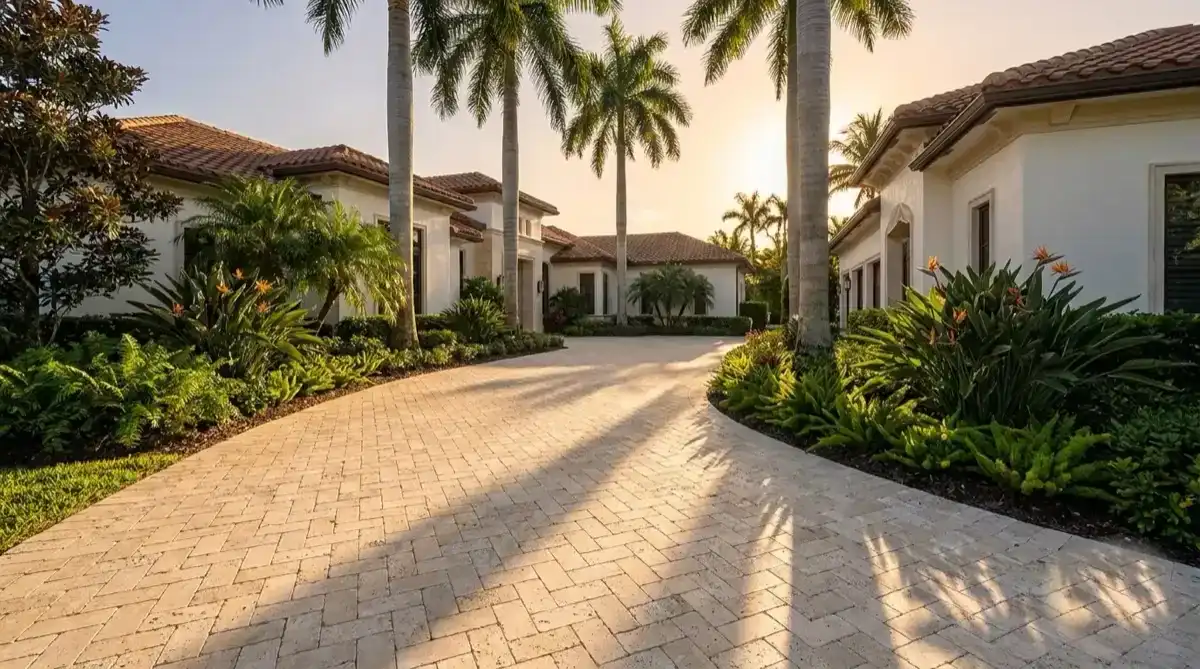
Paver Restoration in
Delray Beach, FL
Complete paver color revival and structural restoration in Delray Beach — save 60–70% vs full replacement in Palm Beach County. Serving Delray Beach and Palm Beach County — licensed, insured, and HOA-compliant.
What Restoration Can and Can't Recover in Delray Beach
Faded colour, failed sealer, stains, and empty joints are all recoverable on a Delray Beach property. A base that has already washed out is not — and knowing which one you have before spending money is the whole point of the assessment.
Intense UV, 60in+ rain & strict HOA standards — care guaranteed.
Ready to Get Started?
Free, no-obligation on-site assessment in Delray Beach. Transparent pricing delivered within 24 hours.
Restoring Pavers in Delray Beach: The Local Picture
Delray is the market where we most often get called to fix someone else's base work. The prestige addresses — Tropic Isle, Seagate, Palm Trail — sit on some of the trickiest ground in Palm Beach County, and a paver job that would hold up fine in a western suburb settles and ripples here within a couple of years if the base wasn't engineered for it. The Lake Ida ranches are a different story: 1950s homes on oversized lots, voluntary HOA, owners who care more about getting it right than getting it approved.
Tropic Isle's streets are built over muck and loosely consolidated soil — that's not our opinion, it's why the city itself has been raising roads and adding drainage there. For pavers, muck means one thing: the compacted base is everything, and skipping geotextile fabric on these lots is how you get the wavy driveways you see around the neighborhood. Closer to the Intracoastal, the Marina District takes up to ten inches of King Tide water in the fall, so drainage grading isn't a detail — it's the design.
Delray runs fully digital permitting through its eServices portal — search 'driveway' in the application assistant and the path is clear. The wrinkle most homeowners miss is the right-of-way: the Engineering Division reviews the ultimate ROW width before you design the apron, and a driveway drawn without that check can come back redlined. We call Engineering before we draw, not after. East of the Intracoastal, add the salt: surfaces there are on our shorter reseal cadence.
Where we work in Delray Beach
Restoration on Delray's Difficult Ground
Delray has a restoration problem other cities don't: some of its best addresses sit on the worst soil. Tropic Isle is built over muck and loosely consolidated ground — the city itself has been raising roads and adding drainage there — and that changes the first question we ask. Before quoting any surface work on those streets we probe the base, because restoring a driveway that is still settling produces a beautiful surface with a wave in it inside two summers. Where the base is sound, restoration is the right call and dramatically cheaper than replacement. Where it isn't, we quote the lift-and-relay and tell you why.
On solid ground — Lake Ida's oversized 1950s lots, the inland club corridor — the recoverable list is the familiar one: sun-faded colour, tannin shadowing under those big oak canopies, joint sand washed low by irrigation and storm runoff, and stains that have had years to set. Deep cleaning, stain extraction, fresh polymeric joints, and a colour-enhancing breathable sealer bring those surfaces back to a condition most owners assume requires replacement.
Closer to the water, in Seagate, Palm Trail, and around the Marina District, add salt and tide. Fall king tides push brackish water across low-lying hardscape, and salt that has been cycling in and out of an unsealed surface for years leaves mineral staining that needs chemistry rather than scrubbing. Restored coastal surfaces also want a shorter protection cycle than inland ones — roughly 18 months against two to three years.
How We Decide Whether Delray Beach Pavers Are Worth Restoring
Restoration only makes sense when the bones are good. In Delray Beach we assess five things before recommending it — and we say "replace" when that's the truth, because a beautiful surface over a failed base fails again on your money.
| What we check | Restore if… | Replace if… |
|---|---|---|
| The base | Solid, no widespread sinking or ponding | Replace when settlement is general rather than localized — no surface treatment fixes a base that has already washed out. |
| Paver condition | Under ~40% damaged; issues are cosmetic | Replace when more than half the field is cracked or spalled, or the pavers themselves have delaminated. |
| The original installation | Correct depth, real edge restraint present | Replace when the install was wrong from day one — shallow base, no restraint, sand over dirt. Restoring that only postpones the rebuild. |
| Surface finish | Faded, stained, or the sealer has failed | These are exactly the problems restoration solves — strip, deep clean, extract stains, re-sand, reseal. |
| Salt exposure — Tropic Isle, Seagate, Palm Trail, the barrier island | Restore, then shorten the reseal cycle | Salt-side surfaces restore beautifully but come back faster: plan on roughly an 18-month protection cycle rather than two to three years, and expect impregnating products rather than a heavy film. |
| Matching stock | Replacements available, or borrow-and-relocate works | Replace when the style is discontinued, no donor area exists, and too many units need swapping to hide the difference. |
In most Delray Beach assessments the base is sound and restoration is the right call at a fraction of replacement cost. When it isn't, we'll tell you before you spend anything — a restoration quote we talk you out of costs us one job and earns the next one.
Paver Restoration Process in Delray Beach
Surface diagnosis in Delray Beach — sealer chemistry, moisture, and stain testing
Failed sealer chemical stripping
Mechanical and chemical deep clean
Polymeric sand joint replacement
Color enhancement and high-performance resealing
Paver Restoration in Delray Beach — Questions Answered
Can faded pavers really look new again?
What does paver restoration cost vs. replacement in Delray Beach?
How do you fix white hazing or blushing on sealed pavers?
Why do paver driveways in Tropic Isle settle so fast?
Can pavers help with King Tide water near the Intracoastal in Delray?
Is restoring pavers worth it on Delray's canal streets?
Can restoration remove king-tide and salt staining in Delray Beach?
Other Services in Delray Beach, FL
Paver Restoration in Delray Beach — Get Your Free Estimate
Expert paver restoration by licensed Florida contractors. Free on-site assessment, transparent pricing, and same-week scheduling.