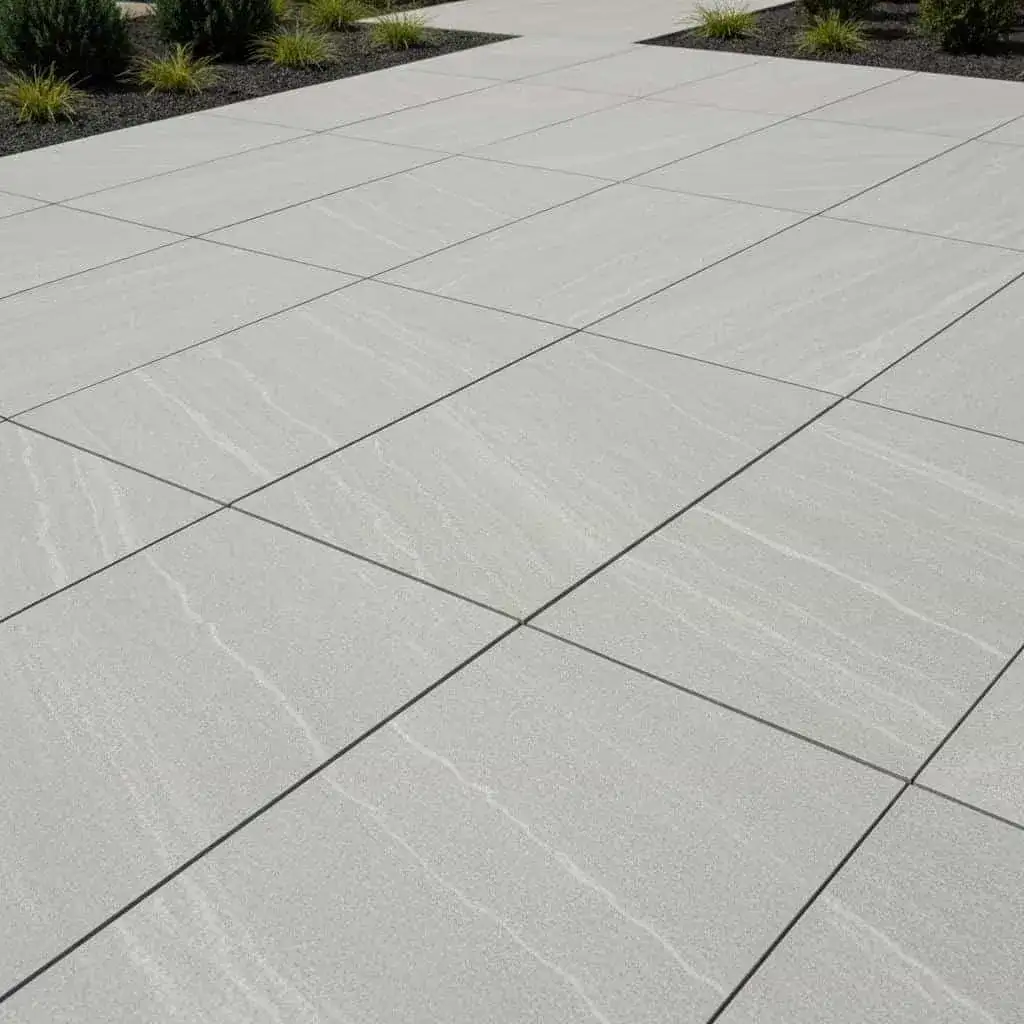
Porcelain Paver Installation South Florida
Kiln-fired at 2,200°F — zero-porosity surface, no sealing required. Mold-resistant, UV-stable, and stain-proof. Large-format slabs up to 48"×48". Stone, wood & concrete looks. From $20/sq ft installed. HOA ARC documentation included.
What Are Porcelain Pavers?
Porcelain pavers are outdoor porcelain tile slabs manufactured by kiln-firing refined clay, feldspar, and mineral pigments at roughly 2,200°F. Unlike traditional concrete pavers — which are cast, cured, and remain porous — porcelain is vitrified into a dense, non-porous body that reads like natural stone, wood, bluestone, or concrete but performs like a hardscape ceramic. For outdoor use in South Florida, we specify 2cm (20mm) porcelain pavers for patios, pool decks, and walkways, and 3cm porcelain for driveways and load-bearing commercial applications where vehicle traffic or heavy point-loads are expected.
Porcelain paving is a relatively young hardscape category in Florida — for two decades outdoor porcelain tiles were reserved for European plaza and terrace projects, then Belgard porcelain pavers and other US-market lines brought the material into residential outdoor living. Today outdoor porcelain pavers are the fastest-growing paver category in Palm Beach and Broward County new construction and remodels. Manufacturers like Daltile, Marazzi, Florim, and Belgard maintain South Florida showroom coverage, and we specify from any collection the homeowner prefers — matching a porcelain tile they've already selected for interior floors, or coordinating a new outdoor scheme from scratch.
Non-Porous Body
Zero water absorption. Nothing organic penetrates the surface — mold, algae, tannins, pool chemicals all wipe clean. Frost-resistant and freeze-thaw stable.
UV-Stable Color
Kiln-fired pigmentation is fired through the body. Direct sunlight and Florida's UV index 11–12 will not fade or shift the color across the material's lifetime.
Load-Bearing Strength
20mm porcelain pavers exceed 8,000 PSI — resistant to cracking under normal residential and light commercial load. 30mm rated for driveways and vehicle traffic.
Porcelain vs Concrete Pavers — The Real Comparison
The two most-compared paver categories in Palm Beach and Broward. Concrete pavers are the traditional concrete workhorse; porcelain is the low-maintenance, high-aesthetic upgrade. Here's what actually separates them in South Florida use.
| Attribute | Porcelain Pavers | Concrete Pavers |
|---|---|---|
| Installed Cost | $20 – $32 / sq ft | $12 – $18 / sq ft |
| Sealing Cycle | None — ever | Every 2–3 years (~$1.10/sq ft) |
| Stain Resistance | Non-porous — wipes clean | Porous — stains penetrate |
| UV Color Stability | Kiln-fired, no fading | Fades under Florida UV over 5–10 yrs |
| Weather / Freeze-Thaw | Frost-resistant, high temperatures OK | Surface spalls over time |
| Heat Underfoot | Warm to hot in direct sunlight | Warm to hot in direct sun |
| Individual Repair | Slab-level, more disruptive | Swap a single paver in minutes |
| Aesthetic Range | Stone, wood, concrete, bluestone looks | Standard shapes and tones |
| Service Life | 40–50+ years | 25–35 years |
| Best For | Contemporary hardscape, minimal maintenance | Cost-driven projects, high-traffic areas |
Full material-by-material breakdown in our cost-to-install pavers guide. Also see travertine vs porcelain for pool deck decisions.
Downsides & Disadvantages of Porcelain Pavers
Porcelain isn't the right material for every project. The trade-offs are real and we'd rather you know before you sign:
- Higher upfront cost. Porcelain runs $20–$32/sq ft installed vs. $12–$18 for concrete pavers. The long-term value is real (no sealing, 40–50+ year life), but you pay more on day one.
- Installation is less forgiving. Large-format porcelain amplifies every base imperfection — an uneven base that concrete pavers would hide will telegraph through porcelain. Wet-diamond precision cutting is required, not standard masonry saws.
- Breakage risk during handling. Porcelain slabs can chip or crack under point-load impact during transport and cutting — expect a 3–5% waste factor built into the quote.
- Repairing a single cracked slab is more disruptive than swapping one concrete paver. Slabs are wider and joint spacing is tighter, so surrounding pieces often need to be lifted.
- Direct sunlight heats dark porcelain. In high temperatures, dark porcelain at solar noon can be uncomfortable barefoot — travertine stays 20–25°F cooler if that's a priority.
- Not a DIY-friendly material. Precision cutting, slab handling, and base flatness put porcelain squarely in the professional-install category.
None of these are dealbreakers for the right project — they're the honest trade-off for a non-porous, UV-stable, easy-to-clean surface with minimal maintenance and 40–50+ year weather resistance. See travertine pavers if barefoot comfort is your priority, or standard patio pavers if budget is.
Porcelain Finishes & Formats for South Florida
Finish determines slip resistance — the only variable that changes based on application. Format determines visual scale and installation requirements. Neither changes the zero-porosity, no-seal surface properties.
| Finish | Best Application | Wet DCOF | Note |
|---|---|---|---|
| Matte / Natural | Pool decks, patios, any outdoor area | 0.60+ wet | Most versatile outdoor finish — natural stone or concrete aesthetic, rain-safe |
| Structured / Anti-Slip | Pool decks, wet areas, commercial outdoor | 0.65+ wet | Highest slip resistance — specified for pool surrounds and water feature areas |
| Polished | Covered patios, screened enclosures, indoor-adjacent only | 0.40–0.55 wet | Not appropriate for rain-exposed outdoor areas — visual luxury for protected spaces |
| Wood-Look Plank | Covered outdoor areas, interior-to-exterior transitions | 0.60+ wet | 6"×24" to 8"×48" plank formats; matte finish; no fading or warping unlike real wood |
12"×24"
Running bond, contemporary rectangular pattern
Most workable format — versatile and widely available
24"×24"
Stack bond or offset, most popular large format
Balance of visual scale and installation precision
24"×48"
Slab format, linear contemporary
Seamless look — requires very flat base prep
48"×48"
Maximum slab format, luxury contemporary
Premium install — two-person handling, precision cutting
Format and finish are confirmed with samples at the on-site visit. Porcelain is a manufactured product — color is highly consistent between pieces, unlike natural stone.
Where We Install Porcelain in South Florida
Porcelain performs well in all outdoor South Florida applications — pool decks, patios, driveways, and indoor-outdoor transitions. The surface properties are the same in all of them: zero-porosity, zero sealing, zero long-term maintenance.
Zero Maintenance · From $20/sq ft Porcelain Pool Deck
Mold-Proof. Stain-Proof. Chlorine-Proof.
For pool decks shaded by palms, live oaks, or pergolas — where tannin staining, algae, and organic debris are ongoing challenges — porcelain's zero-porosity surface eliminates the problem at the material level. Nothing organic can penetrate the surface. No sealing required. Pool chemicals and splash clean off without trace.
- Zero-porosity surface: tannins, algae, mold, pool chemicals cannot penetrate — ever
- Textured finish rated DCOF 0.60+ wet — meets Florida pool deck slip resistance requirements
- Kiln-fired pigmentation UV-stable under Florida's UV index 11–12 — no fading, no color shift
- Drainage graded away from pool equipment and home foundation at every installation
- Large-format slabs (24"×24" to 48"×48") for contemporary, seamless pool surrounds
Contemporary · From $20/sq ft Porcelain Patio
No Sealing. No Staining. South Florida's Lowest-Maintenance Patio.
Porcelain patios are the dominant choice for contemporary and transitional South Florida homes where low maintenance and clean aesthetics are the priority. Stone-look, wood-look, and concrete-look porcelain in large-format slabs create a seamless, high-end surface with zero long-term maintenance requirements.
- Stone-look, wood-look, and concrete-look surface options in matte and textured finishes
- Large-format 24"×48" and 48"×48" slabs for the most seamless contemporary aesthetic
- Tannin staining from overhanging trees: wipes clean — cannot penetrate the surface
- HOA acceptance: most Palm Beach and Broward HOAs accept porcelain in contemporary and neutral palettes
- No sealing required — no ongoing maintenance cost or schedule to manage
Modern Luxury · From $22/sq ft Porcelain Driveway
The Contemporary Estate Entry Material.
Porcelain driveways are the modern alternative to travertine in South Florida's luxury residential market. Large-format concrete-look or stone-look porcelain in dark or light tones creates a graphic, design-forward entry statement. Requires a reinforced base and premium thick-format porcelain (20mm+) rated for vehicle traffic.
- Vehicle-rated 20mm+ thick porcelain for daily vehicle traffic load distribution
- Reinforced base: 10–12 inches compacted aggregate for vehicle load — same depth as travertine driveway
- Large-format formats (24"×24", 24"×48") create a clean graphic entry aesthetic
- Concrete-look and stone-look surfaces are the most popular South Florida driveway specifications
- No sealing required — UV-stable color, oil and chemical splash clean off without penetrating
Seamless Living · From $20/sq ft Indoor-Outdoor Porcelain
One Surface from Living Room to Pool Deck.
Porcelain's manufacturing consistency makes it the only material that can genuinely match interior and outdoor surfaces — same format, same color, different finish (polished interior → textured outdoor). The indoor-outdoor transition dissolves when the flooring is continuous across threshold. Increasingly specified in South Florida's open-plan, glass-wall contemporary homes.
- Interior polished → exterior textured: same tile collection, different finish for outdoor safety
- Visual plane extends through glass walls and sliding doors — eliminates the break at threshold
- Same manufacturer ensures perfect color match between interior and outdoor specification
- Covered outdoor areas can use the same polished finish as interior — only exposed areas switch to textured
- Available in wood-look, stone-look, concrete-look, and solid color collections for any interior style
The Porcelain Paver Installation Process
Large-format porcelain amplifies every base imperfection. Our installation process prioritizes base precision and precision cutting — the two variables that determine whether large-format porcelain looks seamless or shows every error.
Site Assessment & Format Planning
We assess drainage slopes, sun and shade exposure, coastal zone, and HOA requirements. Porcelain format selection (12"×24" vs. 24"×24" vs. 48"×48") is determined at this stage — larger formats require more precise base work and cutting. Pattern and joint width are also specified at the site visit.
Reinforced Base for Large-Format Slabs
Large-format porcelain requires a flatter, more precisely prepared base than smaller pavers. 6–10 inch compacted limestone aggregate for patios; 10–12 inch for driveways. Geotextile separation fabric on sub-grade. Minimum 1–2% drainage slope. Edge restraints set before any porcelain is laid. No shortcuts — large porcelain cracks on an uneven base.
Precision Cutting & Installation
Porcelain is cut with a wet diamond blade saw calibrated to the specific slab thickness — not a standard masonry saw. Large-format slabs require two-person handling during placement. Pattern laid with consistent joint spacing (typically 1/8" for large format). Polymeric joint compound swept into joints and activated. Visual alignment confirmed at every row.
No Sealing Required — Written Care Guide
Unlike natural stone, porcelain requires no sealing. We provide a written care guide covering cleaning schedule (pH-neutral cleaner, soft bristle brush), handling of occasional surface marks, and when to call for joint sand inspection. The guide replaces the sealing schedule we'd provide for travertine or concrete — because you won't need one.
Porcelain Paver Cost in South Florida
Installed price includes sub-grade excavation, compacted limestone base, bedding sand, porcelain installation, polymeric joint compound, edge restraints, and cleanup. No sealing is required after installation.
| Application | Installed / sq ft | Typical Format | Sealing |
|---|---|---|---|
| Pool Deck | $20 – $28 | 24"×24" or 24"×48" matte / structured | None required |
| Patio | $20 – $30 | 24"×24" to 48"×48" — all finishes by area | None required |
| Walkways & Steps | $20 – $26 | 12"×24" or 24"×24" matte | None required |
| Driveway (20mm+) | $22 – $32 | 24"×24" or 24"×48" vehicle-rated | None required |
Coastal properties add marine-grade joint compound (~$0.30–$0.50/sq ft). Driveway installation requires 20mm+ vehicle-rated porcelain and a reinforced base (10–12 inch depth). Permit fees and HOA application prep included in full estimates.
Porcelain Pavers — Questions Answered
The most common questions we get about outdoor porcelain paver installation in South Florida.
What are porcelain pavers?
What are the downsides or disadvantages of porcelain pavers?
Which is better, porcelain or concrete pavers?
Do porcelain pavers need a concrete base?
How long do porcelain pavers last in Florida?
Are porcelain pavers durable?
Are porcelain pavers slippery when wet?
Do porcelain pavers get hot in direct sunlight?
Do porcelain pavers need to be sealed in Florida?
Can porcelain pavers be used for driveways or rooftop applications?
How much does porcelain paver installation cost in South Florida?
What sizes do porcelain pavers come in?
Can porcelain pavers match my interior flooring?
Is porcelain or travertine better for a South Florida pool deck?
More Paver Installation Services
Paver Installation →
Complete guide to all paver installation types, materials, and processes in South Florida.
Pool Deck Pavers →
Travertine & porcelain pool deck pavers — slip-resistant, cool-touch, and chlorine-safe for South Florida pools.
Travertine Pavers →
Natural travertine pavers — stays 20–25°F cooler than concrete, cool-touch pool decks and patios.
Ready to Install Porcelain Pavers?
Free on-site estimate with porcelain samples and format recommendations. All permits and HOA ARC packages handled. No sealing required after installation — ever. No quote-from-photos.