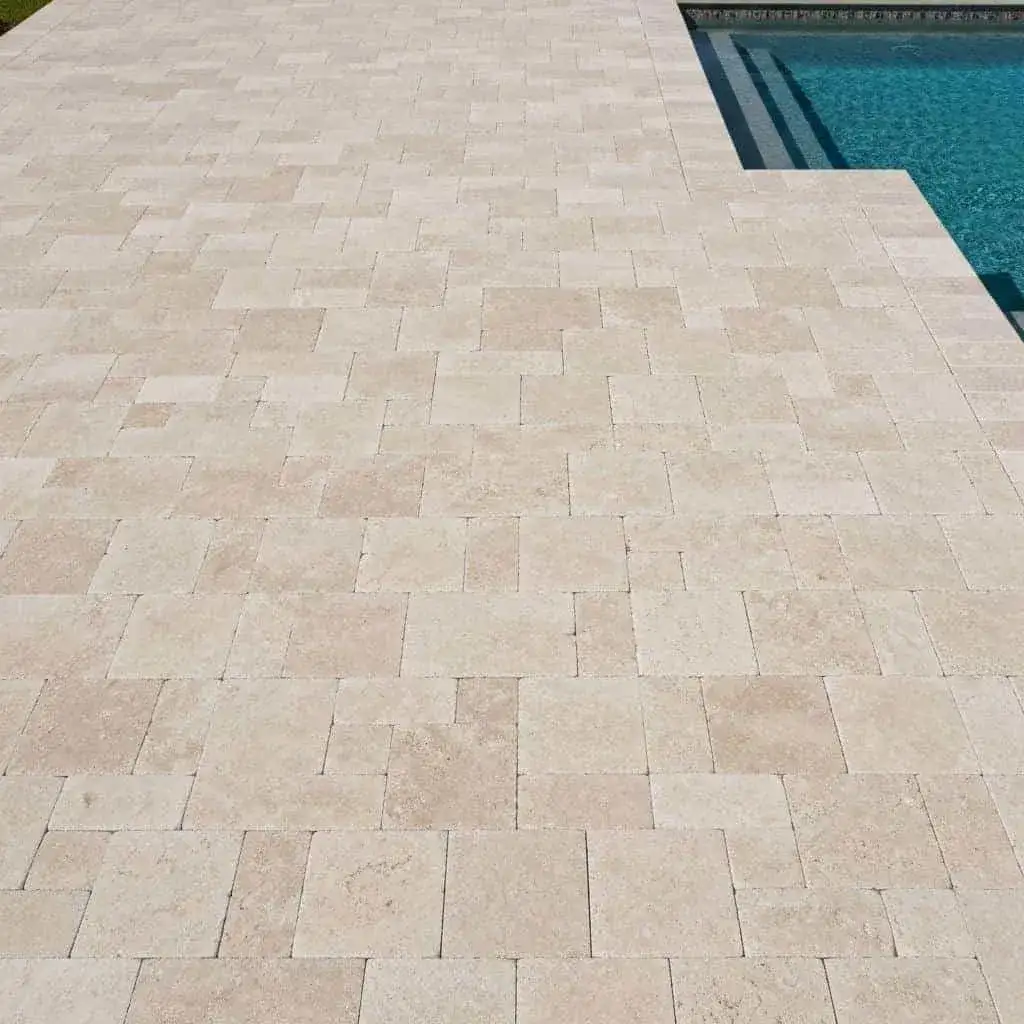
Travertine Paver Installation South Florida
Natural travertine for pool decks, patios, driveways, and walkways — stays 20–25°F cooler than concrete, brushed and tumbled finishes rated DCOF 0.60+. Ivory, Walnut, Silver & Noce. From $17/sq ft installed. HOA ARC documentation included.
Travertine Finishes — Which Is Right for South Florida?
Finish selection determines slip resistance, maintenance requirements, and visual character. For outdoor Florida applications, finish is a technical specification — not just an aesthetic one.
| Finish | Best Application | Wet DCOF | Note |
|---|---|---|---|
| Brushed | Pool decks, patios, driveways — any rain-exposed surface | 0.60+ wet | Most specified for South Florida — uniform texture, hides water marks, easy to maintain |
| Tumbled | Patios, walkways, Mediterranean / tropical aesthetic | 0.65+ wet | Aged, organic look — rounded edges and surface variation; most slip-resistant finish |
| Honed | Covered patios, screened enclosures, interior-adjacent areas only | 0.40–0.55 wet | Smooth and elegant — requires non-slip sealer if exposed to Florida rain or pool splash |
| Chiseled Edge | Steps, risers, borders — not field installation | 0.60+ (face) | Used as accent/edge detail; structural grip at step transitions; pairs with brushed field |
Ivory
Warm beige · widest HOA acceptance · coolest surface temperature
Walnut
Rich brown with veining · Mediterranean & Spanish colonial architecture
Silver
Cool grey with blue tones · contemporary & coastal modern
Noce
Dark walnut-brown · high contrast · estate aesthetic
Color and finish are confirmed with physical samples at the on-site visit. Travertine is a natural stone — color variation between pieces is inherent and part of the material's character.
Where We Install Travertine in South Florida
Each application has different base requirements, drainage priorities, and finish specifications. Travertine performs well in all of them — when the installation is engineered correctly for the specific load and site conditions.
From $17/sq ft Travertine Pool Deck
Cool-Touch. Non-Slip. Chlorine-Safe.
Travertine is the South Florida pool deck standard — not just an aesthetic choice, but an engineering one. The natural porous microstructure dissipates heat instead of storing it, keeping the surface 20–25°F cooler than poured concrete in direct midday sun. Around a pool, that difference determines whether your deck is actually usable at noon in July.
- Surface stays 20–25°F cooler than concrete under direct South Florida midday sun
- Brushed and tumbled finishes: DCOF 0.60+ — slip-resistant on wet pool deck surfaces
- Chemically compatible with chlorine and salt-chlorine pool systems when sealed
- Drainage graded away from pool equipment and home foundation at every installation
- Versailles pattern matches the aesthetic standard in most Palm Beach HOA-governed communities
Classic Choice · From $17/sq ft Travertine Patio
Year-Round Outdoor Living in Natural Stone.
Travertine patios in South Florida benefit from the same thermal properties as pool decks — barefoot comfort in the midday sun. Versailles patterns in tumbled travertine are accepted by the overwhelming majority of Palm Beach and Broward HOAs and create the classic Mediterranean aesthetic that suits the region's dominant architectural styles.
- Versailles, running bond, and random ashlar patterns — HOA ARC compatible in most Palm Beach communities
- Tumbled finish: organic, aged aesthetic that suits Mediterranean and tropical-style homes
- Natural color variation between pieces creates a living surface that hides minor weathering
- Outdoor kitchen integration: travertine lays cleanly to appliance footprints with proper joint planning
- Sealing cycle: 18 months (coastal/shaded) to 3 years (inland/full sun)
Elegant Entry · From $19/sq ft Travertine Driveway
The Statement Driveway Material.
Travertine driveways are the premium entry option in South Florida's luxury residential market. The material requires a reinforced base — 10–12 inches of compacted aggregate for daily vehicle traffic — and proper drainage grading to prevent water penetration into the natural stone. When installed correctly, travertine driveways are structurally sound and visually extraordinary.
- Reinforced base: 10–12 inches compacted aggregate for daily vehicle load distribution
- Concrete-filled void specification available for driveways with heavy vehicle traffic or RVs
- Ivory and Walnut travertine are the most common driveway color choices in Palm Beach County
- HOA ARC: travertine driveway applications include exact color, finish, and pattern documentation
- Sealing cycle: 18–24 months for coastal addresses; 3 years for inland properties
Curb Appeal · From $17/sq ft Travertine Walkways & Steps
Entry Sequence in Natural Stone.
Travertine walkways and entry steps create a material-consistent sequence from street to front door. Chiseled-edge travertine steps with brushed-field travertine pavers are a standard specification in South Florida's estate-level residential market. Running bond pattern for walkways is approved in most HOA communities.
- Chiseled-edge steps: structural stability and authentic natural stone aesthetic at transitions
- ADA-compliant grades: cross-slope ≤2%, running slope ≤5% for accessible walkway routes
- Sea turtle compliant lighting integration for coastal properties (amber LEDs at code)
- Consistent material flow from driveway to walkway to entry steps and porch
- HOA applications include all dimensions, finish specifications, and contractor credentials
The Travertine Installation Process
Travertine is a natural stone that rewards proper engineering and punishes shortcuts. Every Craft Pavers travertine installation starts with the base — not the stone.
On-Site Assessment & Material Selection
We visit the property, assess drainage slopes, sun exposure, coastal zone, soil conditions, and HOA requirements. Travertine color, finish, and pattern are confirmed at the site — Ivory and Walnut in brushed or tumbled finish for most South Florida pool decks and patios; Silver for contemporary homes. We bring physical samples.
Base Engineering for Natural Stone
Travertine requires a well-engineered base — settling under natural stone is both a structural problem and a visual one. 6–10 inch compacted limestone aggregate base (deeper for driveways). Geotextile separation fabric on sub-grade. 1–2% drainage slope away from all structures. Edge restraints set before any travertine is laid.
Travertine Installation & Pattern Laying
Travertine is laid in the confirmed pattern with consistent joint spacing calibrated to the finish and material. Versailles cuts are made with a masonry saw — not a cold chisel — for clean pattern edges. Polymeric joint compound swept into joints and activated. Final plate compaction. Visual inspection of all pieces for color consistency and structural integrity.
Sealing Schedule & Written Care Guide
A written sealing schedule is calibrated to your property's specific coastal exposure and sun/shade ratio. Coastal travertine (within 2 miles of the Intracoastal): first seal at 30 days, then every 18 months. Inland: first seal at 30 days, then every 2.5–3 years. You receive a written schedule — not a verbal recommendation that's forgotten six months later.
Travertine Paver Cost in South Florida
Installed price includes sub-grade excavation, compacted limestone base, bedding sand, travertine installation, polymeric joint compound, edge restraints, and cleanup.
| Application | Installed / sq ft | Typical Finish | Sealing Cycle |
|---|---|---|---|
| Pool Deck | $17 – $24 | Brushed or tumbled — DCOF 0.60+ required | 18 mo (coastal) · 3 yr (inland) |
| Patio | $17 – $26 | Brushed, tumbled, or honed (covered areas) | 18 mo (coastal) · 2.5–3 yr (inland) |
| Walkways & Steps | $17 – $24 | Brushed field + chiseled-edge steps | 18 mo (coastal) · 2.5–3 yr (inland) |
| Driveway | $19 – $28 | Brushed — reinforced base required | 18–24 mo (coastal) · 3 yr (inland) |
Coastal properties add marine-grade joint compound (~$0.30–$0.50/sq ft). Driveway reinforced base (10–12 inch) adds cost vs. patio base (6–8 inch). Permit fees and HOA application prep included in full estimates.
Travertine Paver Grades — What You're Actually Buying
Two quotes for "travertine pavers" can differ by thousands of dollars and describe completely different stone. Grade is where that difference hides.
Premium / Select
- Uniform 3 cm thickness, calibrated cuts — pieces sit flush without lippage
- Consistent color within the lot; minimal factory filler
- Dense structure — lowest absorption, best sealing response
- The only grade we specify for pool decks and visible field areas
Standard
- Noticeable color variation and more surface filler
- Acceptable for borders, side yards, and utility areas
- $1–$3/sq ft cheaper than premium at material level
- We use it only where you approve the trade-off — never silently
Commercial
- Heavy filler that pops out within 1–3 Florida summers
- Irregular thickness — lippage and rocking pieces
- Wide color swings that read as patchwork once laid
- The material behind most 'too good to be true' travertine quotes
Also on the spec sheet: filled vs unfilled (filled = smoother, easier maintenance — our pool deck standard; unfilled/tumbled = organic aged look), cross-cut vs vein-cut (cross-cut shows cloud-like patterning and is the South Florida norm; vein-cut shows linear banding for contemporary designs), and thickness (3 cm sand-set for pedestrian areas · 5 cm or mortar-set for driveways · 5 cm bullnose for pool coping). Every Craft Pavers quote states grade, fill, cut, and thickness in writing — so you can compare quotes on the same stone.
Travertine vs Concrete, Porcelain & Marble Pavers
| Travertine | Concrete Pavers | Porcelain | Marble | |
|---|---|---|---|---|
| Installed cost / sq ft | $17–$28 | $12–$16 | $20–$32 | $22–$35 |
| Surface temp in FL sun | Coolest — 20–25°F under concrete | Hottest of the four | Hot in dark colors | Cool, close to travertine |
| Wet slip resistance | DCOF 0.60+ brushed/tumbled | Good textured | R11 rated lines only | Needs non-slip finish |
| Fade & UV | Natural color — no fade | Pigment fades over years | No fade | No fade |
| Maintenance | Seal every 18 mo–3 yr | Seal every 2–3 yr | Nearly maintenance-free | pH-neutral sealing, most delicate |
| Best for | Pool decks, patios | Driveways, budget projects | Modern patios, outdoor kitchens | Luxury pool surrounds |
The short version: travertine wins pool decks on barefoot comfort and slip safety, concrete wins driveways on value, porcelain wins modern low-maintenance designs. Full breakdowns: travertine vs porcelain · travertine cost guide · full installation cost guide.
Travertine Pavers — Questions Answered
How much does travertine paver installation cost in South Florida?
Is travertine good for Florida pool decks?
Does travertine need to be sealed in Florida?
What are the best travertine colors for South Florida?
Is travertine slippery when wet?
How long does travertine last in Florida?
What travertine finish is best for South Florida outdoor use?
Can travertine pavers be used around Florida pools?
What is the difference between filled and unfilled travertine pavers?
What grade of travertine should I buy?
What thickness do travertine pavers need to be?
Are travertine pavers worth the extra cost over concrete pavers?
More Paver Installation Services
Paver Installation →
Complete guide to all paver installation types, materials, and processes in South Florida.
Pool Deck Pavers →
Travertine & porcelain pool deck pavers — slip-resistant, cool-touch, and chlorine-safe for South Florida pools.
Porcelain Pavers →
Zero-porosity porcelain pavers — no sealing required, mold-resistant, and UV-stable for South Florida outdoor living.
Ready to Install Travertine?
Free on-site estimate with physical travertine samples. All permits and HOA ARC packages handled. Written sealing schedule with every installation. No quote-from-photos.